Showing posts with label Northwest Territory. Show all posts

Saturday, October 27, 2018

The Great Big WHH Presentation!

I broke my "at least one blog post per month" rule for the first time in seven years, but it was for a good cause.
My writing and research energy over the past two months was being used for a presentation I mentioned here before. In May 2018, I was recommended by my friend Mark Fischer to Meg Riestenberg to give a talk to a local nature conservation group Meg belongs to in Lawrenceburg IN called the Oxbow. Mark had given previous talks here on Geocaching and the 2017 Solar Eclipse. I'd never done anything like this before but after some trepidation, I accepted as I felt I was up to the challenge.

This was more of a nature interest group but Meg said they enjoy hearing about local history too. A captive audience! The idea I came up with for them was "Tippecanoe and Trivia Too!". This would be a talk about the local ties that William Henry Harrison had to the Ohio Valley. I also decided to bust some of the myths that surround his life. To keep folks engaged, I added in a mini trivia night similar to the ones that are popular in many bars nowadays. I decided that the winning team would get the theme appropriate gift of a six-pack of Cincinnati made Hard Cider from March First Brewing.
one of the team bookmarks
I volunteered Mark to help out with the logistics of the trivia. He came up with a clever and time efficient way to divide up teams. The added bonus was a way to plug my blog and have a takeaway souvenir that could be used as a bookmark.

On the evening of the presentation on October 9th, we arrived a bit early and found no one there yet. What are two geocachers going to do to kill time? Hmmm. Once we grabbed a couple of caches, one with a spectacular view of the Ohio River I must say, we headed back to the Lawrenceburg conference room and I got all set up. After some Oxbow updates by Jon Seymour and Meg Riestenberg and an introduction by Mark, I gave my presentation.


A 1960s reproduction of a 19th booze bottle with
the WHH Pez and the trivia team/bookmarks by Mark.
Presenter selfie with a couple of candid shots from the evening.

There were about 40 people in attendance (a full house!) for my one-hour presentation which was only 45 minutes short of Harrison's speech. On trivia nights they usually play a song while the teams ponder their answer. I had one technical glitch in that I had no audio for the first two trivia question songs. That was a pretty major component of the entertainment factor so that was a bit distressing. Three songs were renditions of 1840 era campaign songs by a man named Oscar Brand. Another was a W.H. Harrison inspired song by a band called The Executive Branch, and the fifth was a version of "Tippecanoe and Tyler Too" by They Might Be Giants. I finally got the sound figured out and I was pretty pleased with how it all went after that. The audience seemed receptive and engaged. They even laughed at my jokes. One where I said I was going to now read the two-hour speech but was told I didn't have time. My "parley animal" joke went over pretty well too. They even had a few of their own. For example, when it got misconstrued that the trivia answers would be based on something I said, similar to a quiz, I corrected this by saying they would be mainly multiple choice or true/false questions on something I hadn't covered yet. Someone then shouted, "so we really don't have to pay attention then??". That got a good chuckle from everyone including myself.

NWA inspired graphic 
I have to add that this might be the only public WHH discussion where NWA gets mentioned! Although I am pretty positive only one person got that reference.

I had thought of recording my presentation but decided against it so I have no video to show you here. My PowerPoint isn't really suitable for sharing either as it is mostly image based and I relied on my notes vs having so much text on the screen. I can share a few highlights though!

Several of the big myths I busted are written about on this very blog. The circumstances and cause of his death, the confusion surrounding the first photo of a President, and the popularizing of the word booze. I added a bit about the alleged death curse on US Presidents starting with Harrison sometimes attributed to Tecumseh and other times to his brother The Prophet. For local history, I highlighted the two homes in North Bend and talked about his time as a public servant in Ohio and Indiana and of course his military history in the vicinity during the late 18th and early 19th centuries.

It turns out that my trivia questions were harder than I anticipated. This was my fault due to some red herrings I added since I thought the questions might be too easy. Here is a sample of the questions...Do you know the answers? No Googling!


To wrap things up I ended with the very amusing spoof of the Hamilton musical by Off The Top.


Afterward, several folks stuck around to chit chat with me. I learned of a few other local Harrison tidbits from a couple of attendees that I'll likely explore further. This was a pretty great experience for someone like me with almost no experience at public speaking. I have to highly recommend the book that helped me out a great deal in preparing for this called, Speak Easy by Maggie Eyre.

Huzzah!...as Harrison might say.

Friday, May 25, 2018

Oxbows, Books, and Geocaches

This update has all the things that named my blog  "Gehio", Geocaching+History+Ohio

Thanks to the person who got me into geocaching, Mark Fischer, I was invited to speak at the Oxbow Tuesday Lecture on October 9th to discuss a local history subject of my choosing. The Oxbow is a wildlife conservation group in SE Indiana. Mark recently did a lecture on Geocaching which I attended. My name got mentioned as a local early area history expert for possible upcoming topics.  I haven’t firmed up my material yet but it will be in some way shape or form about William Henry Harrison regarding some myths and legends about his life and ties to the area. I'm going to have to brush up on some public speaking skills!

My reading has slowed down as the weather warmed up. I typically read on my lunch breaks and to be honest there have been lots of new geocaches near my office, so I’ve been indulging in that instead. I’m currently about 3/4 into an interesting book from the 1980s on Tekamthi called God Gave Us This Country. I ran across it by accident at the library.  Who the hell is Tekamthi??? The author insists on using what is believed to be Tecumseh’s Shawnee name before it became anglicized. The Shawnee language is actually a bit lispy and European speakers would remove this from the pronunciation as being somewhat effeminate. Ironic since the Shawnee were pretty fierce. One thing that is a bit jarring is the author insists on using the term “reds” and “red men” throughout the book. These are terms all considered dated and a bit derogatory to modern ears. Otherwise, despite the terrible cover and title, it’s a great read and well-sourced book that was previously unknown to me. In fact, I went ahead and bought a copy of my own just for the source notes. I've already made note of some Harrison info I wasn't aware of that will come in handy for the aforementioned lecture.

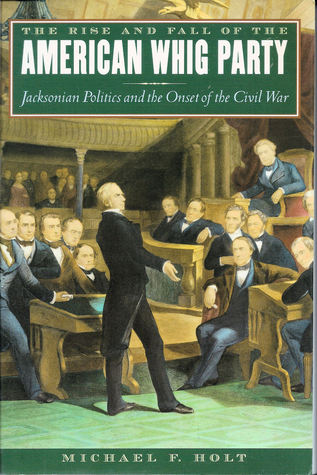
On my to-do list is another book I recently became aware of called The Rise and Fall of the American Whig Party: Jacksonian Politics and the Onset of the Civil War. I guess it could be titled “Everything You’ve Always Wanted to Know About the Whigs But Were Afraid To Ask”. It’s 1300 pages! Oh, and the print is tiny. At the rate I read it may take me as long as the Whig party existed to finish it. So far, everyone I know that has this book never read the whole thing. Regardless, this doorstop will at least serve well as reference material. Oh and a tip to used book buyers.

I also picked up an interesting old title called The Intimate Letters of John Cleves Symmes and His Family. I've seen reference to this early 20th-century book many times where Cleves is mentioned. Don't get too excited. These aren't like the Harding letters. "Intimate" in this case just means "personal". No extensive bio of this important man to the history of the Ohio Valley exists due to most of his letters and journals being burned in a fire. Some say it was arson. There were many lawsuits against the man due to his questionable land business dealings.  The letters that do exist were compiled here from some of his recipient's collections that survived. It sort of humanizes a person that tends to be just a static character in the story of others without any idea of his personal thoughts. One weird thing I learned. Cleves kept referring to a daughter he called "Nancy". He only had one daughter named "Anna" (who married William Henry Harrison) so that was confusing. It turns out "Nancy" was originally a nickname for "Anna". I never knew that.
I got this and the Whigs Tecumseh from AbeBooks for just a few dollars each with free shipping. Ironically I've learned this has been owned by Amazon since 2008 but Amazon's used prices were very high for each of these. I'll be shopping there more often for good used book deals!


Speaking of geocaching, the reason so many new caches are getting published around town and my reading has slowed is that a major Geocaching event called GeoWoodstock 2018 will be held May 26th, 2018 at Coney Island in Cincinnati. This event is expected to bring over 5000 geocachers from all over the world. In fact, a geocacher from France contacted me about carpooling from their Airbnb since I have a cache near the event. I had to politely decline as I don’t really know my full schedule for that day, but I will be attending! How could I not be with "my people" that day?

In personal geocaching news, I'm currently sitting at find 6,408 and have had some interesting cache runs lately. Lot’s of new FTF’s (First To Finds), including a Wherigo (a first FTF of this type if you will). That makes FTF 101 for me. Mark Fisher and I hit not one or two, but three “tunnel” caches in so many weeks. These are caches where you go into a large drainage tunnel, usually with a flashlight. The photo to the left is (eventually) 400' into a tunnel and about that many feet below I-74. I used to be pretty adverse to doing these. In one of them, I was ankle deep in water. Those were some fun adventures!

See you in June!

Wednesday, January 10, 2018

Greene Day

working copy in Greenville
The 20th-century painter Howard Chandler Christy was born on January 10th 1872 in Morgan County Ohio east of Columbus. I'm not going to go into a biography of him, you can look to Wikipedia for that, but you are familiar with his work and don't know it. Christy's most famous painting is a depiction of the Signing of the US Constitution which has been reproduced in countless history books and publications. He has many other notable works but the one I want to focus on here is his 1945 Signing of the Treaty of Greene Ville, or simply, The Signing. Christy, a native Ohioan, was commissioned for the work to commemorate the 150th anniversary of the treaty which technically ended the Northwest Indian Wars and formed most of the future state of Ohio. Again this post is mostly about the painting and not Christy, the preceding events, or the treaty itself.

the final in Columbus
I'd originally seen the painting in person at the Garst Museum in Greenville Ohio (formerly known as Greene Ville) but I was a bit confused as it didn't look exactly like the one I'd seen in print. Then I learned the "real" painting was located in the Ohio Statehouse. I thought maybe the one in the museum was a reproduction. It turns out that there are two versions of the artwork. The painting above the fireplace in the Garst Museum is what is known as the working copy, which is basically a practice version. The painting in the Ohio Statehouse Rotunda stairway is the final version. Both were painted by Christy and there are a few obvious differences. Don't let the difference in colors in my examples fool you. That isn't really an accurate representation. Both are pretty muted when you see them in person.

The working copy measures 6' x 7' whereas the final is a whopping 22' x 17' and the largest painting exhibited in the Ohio Statehouse. I got to lay my eyes on the final when I visited Columbus last month.

The central figures are Little Turtle (Miami) on the left with outstretched arms presenting the wampum, interpreter William Wells in the center, and General Mad Anthony Wayne to the right. On each side are various individuals representing Indian and American figures that signed the treaty. In the background of the Indian side, we see Fort Greene Ville. The council house appears behind the Americans.

One major difference between the two is the 15 star US flag at the top. It seems more faded in the working copy and not as prominent as in the final. It often gets cropped out of reproductions of the working copy. I was hard-pressed to find an uncropped version suitable for this post but it can be seen here. The postcards sold at the Garst Museum show this cropped version as illustrated in the photo at the top. As you can see there is a lot of space between the subjects and the flag so I can see why this is done.

a couple of areas of key differences
There are other reproductions around the town of Greenville. One is a very large uncropped reprint in the lobby of the Wayne HealthCare Hospital. It appears to be nearly as large as the final version. This is something I wouldn't have known about but an old friend of mine was partially responsible for this reproduction and installation and tipped me off. Another is etched on a granite monument at Elm and Main near the location of the proceedings at Fort Greene Ville.

Several individuals have slightly different appearances in the two paintings. The one I noticed right away is with 22-year-old William Henry Harrison, aide de camp to General Wayne. It's probably the best way to tell the difference between the two versions in print. Harrison is standing behind the General and one person over to his left. In the working copy, he looks straight ahead, breaking the 4th wall of the scene. He doesn't resemble Harrison much and has bright ruddy cheeks. In the final, we see him facing to his right and toward Wayne and looking much like the Rembrandt Peale painting of him from 1813. Chaplain David Jones is standing immediately to Harrison's left and whispering to him in the working copy. Perhaps he has some divine knowledge and is saying to Harrison, "when you give your inaugural address in 46 years don't forget to wear your hat and coat". Jones is seated away from the future President in the final and not whispering to him. Perhaps that explains why things turned out the way they did with Harrison.


Lieutenant William Clark (of later Lewis and Clark fame) stands to the right of Harrison and looks more toward his left in the final. Meriwether Lewis is there too by the way. He is behind The Sun (Potawatomi) signing the treaty at the table. It's not that noticeable of a difference but it gives me an excuse to mention that this is where the duo met.

Black Hoof (Shawnee) and Bad Bird (Chippewa), in the foreground to the left and right of standing Little Turtle (Miami), appear to have mohawks in the working copy and instead have horns and feathers adorning their hair in the final.
The treaty itself has had markings added to it in the final.

As I researched this work I came across an interpretation of the painting that felt the scene represented the growth of civilization. For example, as we move from left to right, we have half naked crouching Indians while Little Turtle stands. In the shadowy center, there is William Wells, a white captive raised by the Miami, who went back and forth between the two societies. Wells served as the interpreter here. He was also married to Little Turtle's daughter.  So that's his father in law to his right. Further right in the scene, we see well dressed and seated men with literate scribes representing civilization. I think it's a good theory whether Christy intended it or not.
granite version in Greenville

This painting, like the Signing of the Constitution painting, is a romanticized scene and the events took place over a period of time. In Greeneville's case, these negotiations occurred over the first eight months of 1795 and then signed by representatives on August 3rd. So it is possible that many of the men depicted here were never present together and certainly not like this.

Incidentally, there is a less idealized contemporary oil painting of the 1795 events that was created by an unknown artist but believed to be one of Wayne's officers present at the proceedings. This one is displayed at the Chicago History Museum. This depiction is certainly much more barren than Christy's.

Happy birthday 146th birthday Howard Chandler Christy. Thanks for giving back some of your talents to represent Ohio.


Additional info:
Christy at the unveiling
You can zoom in on these to get a better look:
Working copy info in Garst Museum
Final version info in Ohio Statehouse


Tuesday, June 27, 2017

Review: Arthur St. Clair: The Invisible Patriot

How do you celebrate Gehio's 6th anniversary? With a review of a book on my favorite frontier General. I wish it was a regular blog post vs a review but June was a busy month.

Arthur St. Clair: The Invisible Patriot Arthur St. Clair: The Invisible Patriot by R.W. Dick Phillips
My rating: 1 of 5 stars

I'm very interested in the time period and the subject, so I was excited to find this book. I gave it one star only because I could not give it zero stars. I read through the beginning and was very disappointed. It doesn't appear to be researched well. Phillips goes to great lengths to inform us of St. Clairs lineage and great deeds in order to remind us he shouldn't only be known for his infamous defeat but the author gets loose and repetitious with the facts right off the bat. That didn't instill confidence. Another reviewer mentions the misleading blurb about St. Clair being "President when the U.S. Constitution and the Northwest Ordinance were drafted." and "was America’s first and last foreign-born President". This should read that he was "President of the Continental Congress"... of which there were 14 men, including John Hancock, from 1774 until 1788. The author also asserts that one of St Clair's ancestors built Newport Tower in a pre-Columbian voyage to the New World. That's a fringe theory that's been debunked many times over. A quick internet search shows that carbon dating & other 19th & 20th-century investigation of the mortar dates it to the mid-1600s. It was probably built by Benedict Arnold. No not THAT Arnold but an ancestor, the first Governor of Rhode Island. I thought that was a bit ironic. Stealing the glory of the ancestor of America's most infamous traitor and trying to give it to the ancestor of the General in charge of the worst American military defeat.

So I'm sorry Art, it was my hope...but this is not the modern bio we've been waiting for. Your legacy is still mostly St. Clair's Defeat with the footnote that you re-named Losantiville to Cincinnati. I suppose it's better to be remembered for something than nothing at all.

View all my reviews

Saturday, February 18, 2017

Review: A History of Jonathan Alder: His Captivity and Life with the Indians

A History of Jonathan Alder: His Captivity and Life with the Indians A History of Jonathan Alder: His Captivity and Life with the Indians by Larry Nelson
My rating: 5 of 5 stars

I can't believe I just got around to reading this book that I've seen sourced in other history books many times. I've read a few other captivity narratives but this one is right up my alley in that it mostly happened in Madison County Ohio near Columbus. In fact, when I was in the middle of reading it, I happened to be off work for Christmas break so I took advantage of that timing and combined my hobby of geocaching and made the 90-minute drive to visit some of the places mentioned, including Alder's 210-year-old cabin and final resting place. It's always great when history becomes a hands-on experience.

Alder's 1806 cabin in Madison County
Since Indians in that period had no written language we have to rely on what was told to Europeans and Americans regarding day to day life. Many times that is filtered through misinterpretation, misunderstandings, or prejudice. Alder was captured by Shawnee in Virginia and adopted by Mingo at eight years of age in 1781. He assimilated and was treated well so I think we get a pretty accurate look at his experiences, good and bad. Nelson's version denotes other versions and additions of the story by others in an italic font to what the author believes is the truest account of Alder's life. The actual story of Alder's story is a bit complicated and the author explains this in the introduction.

Alder voluntarily left his adopted Mingo family in 1805 as white settlers arrived after the Treaty of Greenville. He reunited with his birth family in Virginia and returned to Ohio with them and his new wife 1806. He served as a Captain in the War of 1812. After the war, he became a farmer and befriended the famous pioneer Simon Kenton. Alder lived out his days in Madison County Ohio until his death in 1849.

We learn so much about regular life as an Indian in Ohio in the early 19th century from Alder's excellent narrative. Nelson also provides additional footnotes throughout the story that details further what Alder was referring to at times or what he meant when in the vernacular. Definitely, do not skip out on those notes if you get this version of the book.
Alder's grave in Madison County

All in all, this is a very easy read and should be required reading for any student of the history of the early United States and the old Northwest Territory.

View all my reviews

Friday, November 4, 2016

Review: The Victory with No Name: The Native American Defeat of the First American Army

I've decided to post some of my short Goodreads reviews of 4 or 5-star history books I've read over the last several years. I finished this book in November 2014. This seemed like a good one to start with as you will see why...

The Victory with No Name: The Native American Defeat of the First American Army The Victory with No Name: The Native American Defeat of the First American Army by Colin G. Calloway
My rating: 5 of 5 stars

I was excited to see a new book on one of my favorite periods of US history. I've read many accounts of this battle and events which were included in other books, as well as "Wabash 1791: St Clair's defeat" by John Winkler that came out in 2012. Both are fantastic and worthy reads on this overlooked era of American expansionism but I feel that Colin G. Calloway's book captures a better understanding of the political and societal background issues in the US at that time while Winkler's 2012 book delves more into the details of the military campaign itself which in my opinion is correctly identified by Calloway as an "American Invasion".

On a personal note, I thought it was interesting that I decided to read and then finish this book exactly 223 years to the day of St. Clair's Defeat on November 4th, 1791. I also just now realized the first book I read on the Shawnee was Calloway's "The Shawnees and the War for America" four years ago. I guess I will be checking out more of his books!

View all my reviews

Monday, July 13, 2015

The Fool and The Buckeye

Arthur St. Clair doodle
On this day in 1787, the Northwest Ordinance was enacted forming the Northwest Territory

People tend to think of history as some sort of concrete timeline where the occasional revisionist meddles with the facts. While that may be true at times, the fact is, some history just gets lost. Original sources like books, documents, paintings, etc turn up missing or get destroyed. Sometimes the original source is found to be wrong or subsequent authors didn't have access to good sources. Then folks use that as a source. You get the idea.

Back in the 18th century, seals were all the rage. Not the adorable trick-performing fish-eating mammals but rather the circular emblem type with a Latin motto. It made things all official-ly looking. The Old Northwest Territory, which would give birth to six US States had its own official seal designed by my favorite terrible frontier General and Governor Arthur St. Clair himself. I hadn't really thought about the Seal of the Northwest Territory too much until I ran across a funny reference to it in a 1939 book called "Cincinnati: Story of the Queen City" by Clara Longworth de Chambrun.

Arthur St. Clair
The man who runs the Dust Jacket, a collectible bookstore in Mt Lookout in Cincinnati told me a little about the author. Clara was a Longworth, one of Cincinnati's first and richest families, related to Teddy Roosevelt and Marquis de Lafayette. That's pretty good breeding. She had lived just up the road and said the book had some "real gossipy stuff". I was intrigued. After reading it I understood more of what he meant. It wasn't scandalous like TMZ or something, it was full of unsourced and anecdotal historical stories. Don't get me wrong though, she meant well and it's still a very interesting and worthy book with lots of good local material and illustrations. Just don't take everything she says as the last word.

Clara Longworth de Chambrun
Clara Longworth de Chambrun states that the seal design by "Saint Clair" (her odd spelling) represents the planting of a buckeye among the stumps of the fallen forest. She says that the design was criticized by people insisting "the Fool had cut down a good apple tree and replaced it with a worthless buckeye" (her quotes). She goes on to say that many felt no seal was needed since statehood was in sight. This was accompanied by an image of the seal. Notice she also spells "St. Clair" as "Saint Clair". I guess she really was a blue-blood Francophile. I think she just took a shine to the original French spelling of this surname. While there were variations, Arthur definitely spelled it "St. Clair" in his signature and I've never seen spelled any other way. Most historians pronounce it "Sinclair" too.

At any rate, as funny as I thought that "worthless buckeye" comment was, something didn't quite sit right with her apocryphal statement. She makes it sound like the seal was only in use very briefly. While St Clair certainly made his mistakes, he was a scholarly and educated man. The Old Northwest Territory existed from 1787–1803. The seal's first recorded use was in a proclamation made on July 26, 1788, by Arthur St. Clair himself. Statehood certainly was not in sight in 1788. That wouldn't happen until 1803. So it was in use for at least 15 years. In the image, there also seems to be no way to tell what kind of tree that is in the design.

William Hayden English
In the late 19th century a man named William Hayden English (a one time 1880 VP Democratic candidate who lost to the Garfield team) did some research while serving as the President of the Indiana Historical Society. He found that no official record existed on the full description or on the symbolism of the seal. In fact, it was difficult finding a copy of it that had all parts of it distinctly shown. Remember, these were nearly 100-year-old papers and they weren't exactly stored in a sealed climate controlled room. English basically recreated it from six photographs of documents and a lead rubbing of an impression of the seal.

His research was published in the 1896 book, Conquest of the Country Northwest of the River Ohio, 1778-1783 and concluded:

The coiled snake in the foreground and the boats in the middle distance; the rising sun, the forest tree felled by the ax and cut into logs, succeeded, apparently, by an apple tree laden with fruit; the Latin inscription, "Meliorem lapsa locavit," "he has planted a better than the fallen," all combine forcibly to express the idea that a wild and savage condition is to be superseded by a higher and better civilization.

I believe what English came up with reconciles with what someone like Arthur St Clair had in mind. White men civilizing nature and "savage" Indian country. Also, English's book was published over 60 years prior to de Chambrun's. Whatever image Clara was looking at was the one re-created by English's research. As amusing that remark is about the fool and the buckeye is, and as much as I wanted it to be true, I think I have to go with English's more mundane interpretation. But where did Clara Longworth de Chambrun's notion come from? I guess that's the story lost to time.