Showing posts with label Native American. Show all posts

Wednesday, January 10, 2018

Greene Day

working copy in Greenville
The 20th-century painter Howard Chandler Christy was born on January 10th 1872 in Morgan County Ohio east of Columbus. I'm not going to go into a biography of him, you can look to Wikipedia for that, but you are familiar with his work and don't know it. Christy's most famous painting is a depiction of the Signing of the US Constitution which has been reproduced in countless history books and publications. He has many other notable works but the one I want to focus on here is his 1945 Signing of the Treaty of Greene Ville, or simply, The Signing. Christy, a native Ohioan, was commissioned for the work to commemorate the 150th anniversary of the treaty which technically ended the Northwest Indian Wars and formed most of the future state of Ohio. Again this post is mostly about the painting and not Christy, the preceding events, or the treaty itself.

the final in Columbus
I'd originally seen the painting in person at the Garst Museum in Greenville Ohio (formerly known as Greene Ville) but I was a bit confused as it didn't look exactly like the one I'd seen in print. Then I learned the "real" painting was located in the Ohio Statehouse. I thought maybe the one in the museum was a reproduction. It turns out that there are two versions of the artwork. The painting above the fireplace in the Garst Museum is what is known as the working copy, which is basically a practice version. The painting in the Ohio Statehouse Rotunda stairway is the final version. Both were painted by Christy and there are a few obvious differences. Don't let the difference in colors in my examples fool you. That isn't really an accurate representation. Both are pretty muted when you see them in person.

The working copy measures 6' x 7' whereas the final is a whopping 22' x 17' and the largest painting exhibited in the Ohio Statehouse. I got to lay my eyes on the final when I visited Columbus last month.

The central figures are Little Turtle (Miami) on the left with outstretched arms presenting the wampum, interpreter William Wells in the center, and General Mad Anthony Wayne to the right. On each side are various individuals representing Indian and American figures that signed the treaty. In the background of the Indian side, we see Fort Greene Ville. The council house appears behind the Americans.

One major difference between the two is the 15 star US flag at the top. It seems more faded in the working copy and not as prominent as in the final. It often gets cropped out of reproductions of the working copy. I was hard-pressed to find an uncropped version suitable for this post but it can be seen here. The postcards sold at the Garst Museum show this cropped version as illustrated in the photo at the top. As you can see there is a lot of space between the subjects and the flag so I can see why this is done.

a couple of areas of key differences
There are other reproductions around the town of Greenville. One is a very large uncropped reprint in the lobby of the Wayne HealthCare Hospital. It appears to be nearly as large as the final version. This is something I wouldn't have known about but an old friend of mine was partially responsible for this reproduction and installation and tipped me off. Another is etched on a granite monument at Elm and Main near the location of the proceedings at Fort Greene Ville.

Several individuals have slightly different appearances in the two paintings. The one I noticed right away is with 22-year-old William Henry Harrison, aide de camp to General Wayne. It's probably the best way to tell the difference between the two versions in print. Harrison is standing behind the General and one person over to his left. In the working copy, he looks straight ahead, breaking the 4th wall of the scene. He doesn't resemble Harrison much and has bright ruddy cheeks. In the final, we see him facing to his right and toward Wayne and looking much like the Rembrandt Peale painting of him from 1813. Chaplain David Jones is standing immediately to Harrison's left and whispering to him in the working copy. Perhaps he has some divine knowledge and is saying to Harrison, "when you give your inaugural address in 46 years don't forget to wear your hat and coat". Jones is seated away from the future President in the final and not whispering to him. Perhaps that explains why things turned out the way they did with Harrison.


Lieutenant William Clark (of later Lewis and Clark fame) stands to the right of Harrison and looks more toward his left in the final. Meriwether Lewis is there too by the way. He is behind The Sun (Potawatomi) signing the treaty at the table. It's not that noticeable of a difference but it gives me an excuse to mention that this is where the duo met.

Black Hoof (Shawnee) and Bad Bird (Chippewa), in the foreground to the left and right of standing Little Turtle (Miami), appear to have mohawks in the working copy and instead have horns and feathers adorning their hair in the final.
The treaty itself has had markings added to it in the final.

As I researched this work I came across an interpretation of the painting that felt the scene represented the growth of civilization. For example, as we move from left to right, we have half naked crouching Indians while Little Turtle stands. In the shadowy center, there is William Wells, a white captive raised by the Miami, who went back and forth between the two societies. Wells served as the interpreter here. He was also married to Little Turtle's daughter.  So that's his father in law to his right. Further right in the scene, we see well dressed and seated men with literate scribes representing civilization. I think it's a good theory whether Christy intended it or not.
granite version in Greenville

This painting, like the Signing of the Constitution painting, is a romanticized scene and the events took place over a period of time. In Greeneville's case, these negotiations occurred over the first eight months of 1795 and then signed by representatives on August 3rd. So it is possible that many of the men depicted here were never present together and certainly not like this.

Incidentally, there is a less idealized contemporary oil painting of the 1795 events that was created by an unknown artist but believed to be one of Wayne's officers present at the proceedings. This one is displayed at the Chicago History Museum. This depiction is certainly much more barren than Christy's.

Happy birthday 146th birthday Howard Chandler Christy. Thanks for giving back some of your talents to represent Ohio.


Additional info:
- Christy at the unveiling
You can zoom in on these to get a better look:
- Working copy info in Garst Museum
- Final version info in Ohio Statehouse


Saturday, December 30, 2017

Review: The Lance and the Shield: The Life and Times of Sitting Bull

The Lance and the Shield: The Life and Times of Sitting Bull The Lance and the Shield: The Life and Times of Sitting Bull by Robert M. Utley
My rating: 5 of 5 stars

I've had a paperback copy of this book in my possession for a couple of years. I picked it up second hand somewhere but never got around to reading it.
I actually haven't even finished the book but I'm on the last chapter and I felt compelled to write a quick review. This book is an amazing account not just of Sitting Bull and his times but of his way of thinking and the Sioux way of doing things. Popular culture has diluted this man and created a caricature of him that's hard to shake but the author does a good job, warts and all. The book is packed full of detail but it is easy to read and heavily sourced. I do however wish the author included more about his time with Cody's Wild West Show.
Near the end, I learned of his friendship with Indian advocate Catherine Weldon and discovered there is a book about her and a movie based on that book has just been released in September 2012 but I'm having trouble locating the 2002 book Woman Walking Ahead by Eileen Pollack at a reasonable price. It also seems like the movie is currently seeking US distribution.
This is one of those books I'll be sad when it ends! Will we ever get a proper movie biopic of Sitting Bull?

View all my reviews

Update to the review posted to Goodreads: I finished this book in October 2017 and did end up reading the informative Weldon book. The movie should be out in 2018.

Wednesday, November 29, 2017

Famous Ohio Indians glasses

Cornstalk, Little Turtle, Pontiac, Logan
In a recent post, I told you all about some Ohio Presidential glassware. This time it’s Ohio Indian glassware featuring Famous Ohio Indians: Blue Jacket, The Prophet, Tecumseh and Cornstalk (all Shawnee), White Eyes (Delaware), Little Turtle (Miami), Chief Logan (Mingo), and Pontiac (Ottawa). Each painted glass is 16 ounces and measures 6 1/2" tall and 2 3/4" across. It's clear that no attempt was made to resemble the person they are depicting. These are generic looking Indians but at least they appear to be an attempt at an Eastern Woodland look. In other words, there are no big Plains Indian war bonnets. I'll give them points for that.

very rare original box sighting
A funny coincidence. Eight Ohio Presidents, eight Ohio Indians. Both are also kind of loose with the "from". For example, of the Ohio Presidents, WH Harrison was born in VA but lived much of his adult life in Indiana. He ran for POTUS with his home state as Ohio and served in government there. Ohio and VA both claim him. For Grandson Ben, he was born in Ohio but served the state of Indiana and that state was his home state when he ran for President. Ohio and Indiana claim him. Grant was born in Ohio but lived most of his life elsewhere and Illinois was his home state. Ohio and Illinois claim him. You get the idea...

White Eyes, Tecumseh, The Prophet, Blue Jacket
Exact Indian birthplaces from that time period are hard to determine in many cases. Pontiac was likely born in MI although some think it was Defiance Ohio. Little Turtle was likely born in Indiana. Cornstalk and White Eyes, probably PA by birth. Logan was born somewhere East of Ohio, maybe WV. Most historians agree that the Shawnee Indians Blue Jacket, Tecumseh, and The Prophet were all born in Ohio. Regardless of those details, important aspects of all their legacies are tied to Ohio in some manner.

Oh, my. Here am debating the historical accuracy of frosted glass tumblers!

Blue Jacket
I'd originally seen an entire set at a local antique mall for $45 and I was kicking myself for passing it up. I ended up cobbling together my eight-piece set as individual purchases and Christmas gifts over a year or so. I certainly paid more than $45. Lesson learned

The set is from the late 1950s or early 1960s (I've never determined exact years) and was promoted by Bonded Oil. One glass was awarded for every $2.50 in gas purchased. Gas was about 25 cents a gallon then, but before you get too nostalgic on the gas price, keep in mind that with inflation that would be $2.10 a gallon in 2017 money. So roughly the same. I guess this was sort of like Kroger Fuel Points in reverse.

White Eyes
Unlike the Ohio President glasses, I’ve never been able to determine who made this series. A seller on eBay said Hazel-Atlas but that company had a distinct marking that I have not seen here. But as I’ve mentioned before, Ohio was one of the world’s leading glass producers so it’s pretty safe to say that given the context, they were made in Ohio.

I found a mention online that indicated that the art itself was done by Indian artist Acee Blue Eagle. The font in the heading is even the same as another collection he is known to have designed. That was an exciting development! However, I was able to quickly debunk that theory. I saw another article online that first appeared in an antique magazine in 1991. That person makes a good case that Blue Eagle had nothing to do with the Ohio glasses. They ARE very similar to a set of Oklahoma Indian glasses he painted and released in 1959 for a similar promotion by Knox Oil, but having been well known at the time, his artwork would have incorporated his name. The Ohio glasses are likely just a copycat design by another gas station chain capitalizing on mid-century America's Indian nostalgia thanks to movie Westerns and TV shows like The Lone Ranger.

Pitcher and original box - on my wishlist
There is also a 2-quart pitcher that goes with the set. I don’t have one and have never seen one in person. They show up on eBay from time to time. I'm hoping one shows up under my Christmas tree this year.
"c. Bonded" marking
For a while, I speculated that the pitcher was not really part of the set as it doesn’t have “Famous Ohio Indians” on it and also does not have “c. Bonded Oil Co.” anywhere like the glasses do. The artwork is even a bit different. However, I found that the original box with those words is printed on it. So the pitcher is definitely part of this set. Supposedly the pitcher was the bonus after you collected all eight glasses.

Now for a couple of unsolved mysteries.

4 smaller glasses - also on the wishlist
I've seen 4 smaller 4 3/4 oz glasses being sold sometimes with the pitcher and the eight large glasses which are: Little Jumping Rabbit, Princess Little Fawn, Little Princess Red Wing, Little Running Bear. These are all just generic names and cartoonish compared to the full-size glasses. None of them have a tribe listed or a mention of Ohio. I'm not really sure if they really go with this series or not but they do have “c. Bonded Oil Co.” on them and as far as I know, this is the only promotion like this that Bonded issued. They seem to be hard to find.

There may have even been a metal rack for the eight glasses but I've only seen one mention of that anywhere.

the lone Pontiac mystery glass
During my research, I discovered another oddity. Besides the eight glasses, there is a ninth “bonus” glass with the heading “Famous Ohio Indian” (note the singular), and “Pontiac/The Red Napoleon” at the bottom with a depiction of this chief but no tribal affiliation. It doesn’t have “c. Bonded Oil Co.” on it either. I’m not sure what the story is here. It's not the same artwork as the Pontiac in the full set but overall is similar in design. Perhaps it was prototype before the whole series was made? If so, I'm not sure why they would choose Pontiac. Tecumseh would be more "Ohio" than the others. This  Ottawa leader was active in Ohio but his birthplace is open for debate and most historians think he was born in Michigan where his famous rebellion occurred. Maybe it was because of the Pontiac car and these were gas station giveaways?   I have no idea and I was unable to find any more information.  I did, however, find one on eBay and snapped up this outlier for $13!

It’s one of my favorite glass collections. They are beautiful to look at and the set represents American Indians in the Ohio Valley from a time period I fell in love with many years ago.

Thursday, August 31, 2017

Review: Last Stand

Last Stand Last Stand by Michael Punke
My rating: 4 of 5 stars

A story of greed, survival, and redemption in America. Punke tells us how mankind can have a devastating impact on the environment and how one man helped turn it around.

This is more than just a book about how American thirst for land nearly destroyed the buffalo and how one man led a cause to halt it. Once again I am reminded of the way movies and cartoonish history books have shaped our views of the past and make everything seem so clean and noble. Most Americans likely believe that mere rugged individuals set out and tamed the wild west in a quest for adventure. Yee haw..the end. That sentiment is partly true but it is not even close to the whole story. Oftentimes history and its cast of characters can be a paradox.

In the late 19th century the West was tamed, or plundered if you will, in part by the robber barons and railroad men of the Eastern US who held great influence over Congress. The frontier men doing the dirty work were generally Army deserters, fugitives, and men who could make more money poaching and panning for gold vs Army life, mining or ranching. Both groups of people knew that protection laws and Native American treaties barely had a penalty and rarely enforced if they could be enforced at all. The robber barons made sure of that via their lobbyists in Washington during the scandalous Grant Administration. I find it ironic that the US Army was sent to patrol Yellowstone and prevent the further demise of the buffalo when just a few years earlier they were the very ones sent to help wipe out the Plains Indian in part by destroying the buffalo which they relied on for almost every need. That policy forced American Indians into the reservation system.

George Bird Grinnell witnessed this all first hand. He was born into a privileged class and could have been another robber baron but instead became a naturalist, author, and editor of Forest and Stream, the leading natural history magazine in the US during a time of wanton greed and reckless over-hunting. Many of the characters such as Grinnell, Teddy Roosevelt and William Tecumseh Sherman, like Daniel Boone before them, would come to lament the passing of the wild frontier and the near extinction of the buffalo, something which they helped cause.

Like all history, context is important and it is difficult to judge the zeitgeist of the past by today's standards but there were people then who found some of these policies and ideas unjust and worked to change conventional wisdom and in some cases redeemed themselves from a deplorable past. To me people such as this are the true heroes of history yet Grinnell, who later founded the Audubon Society, savior of Yellowstone and the buffalo, among other great successes, was a man the NY Times called in 1938 the "father of American conservationism" remains an obscure historical figure.

View all my reviews

Sunday, July 30, 2017

Muse Over Miami

Around the 2nd century BCE, the concept of the modern nation-state is a long way off. Most folks at this point identified with a particular tribe or clan. During this period the Romans were the first to call the people in the land we now call Germany, Germans, meaning spear man. By the 2nd century CE, they were called Saxons, whose name developed from the type of knife they carried, the seax. They called themselves Diutisg, meaning "of the people" which formed into Deutsche and Deutschland. This is what they still call themselves, while the rest of the world calls them Germans. In the 8th century CE the Franks and others called new seafaring invaders from this region Northmen or Norsemen. The kingdoms in Britain called them Danes which has unclear origins but is where Denmark gets its name. The Slavs to the East called them Rus, which meant "the men who row". This is where Russia gets its name. These raiders and explorers may have called themselves Víkingr. In the Icelandic Sagas, they use the phrase "to go on a vikingr" or to raid. The English variation "Viking" came along later.
By the 11th century, the seafaring Vikings encountered people they called Skraeling, believed to be ancestors of the modern Inuit, or Eskimo, the northernmost inhabitants of the New World. Skraeling meant "barbarian". This is ironic since that's what the English and the Franks thought of their Norse invaders. How's that? 12 centuries of European history in 300 words or less?

Great, but what does this have to to with Ohio history?

Fort not built by the Miami, also not in Florida
We all know that the general term Indian itself is technically incorrect. 15th-century folks thought they reached a shortcut to the East Indies.  Individual Indian tribal names can be as perplexing as European tribal names a half a millennium earlier before those groups formed into the nations of England, France, Germany, Denmark, etc. with a central authority.

We see similar names such as Cree and Creek, Dakota and Lakota, Mahican and Mohegan, for example. Are they the same tribes? Is there any relation? It can get complicated. To add to the confusion, different bands or septs within the same tribes sometimes used different or multiple names as well. I'm not going to research or attempt to explain them all in a mere blog post, but two tribes I've always found interesting are the Algonquian language speaking Delaware and Miami people.

Lord Delaware, definitely not Indian
Many times European explorers didn't bother with the difficult to pronounce or unclear indigenous name. This is true with the Lenni Lenape people who were renamed the Delaware by settlers. As is the case with many autonyms in the world, Lenni Lenape means original people. They also lived near a river named after Lord De La Warr, the first Governor of the Virginia English colony. So they were called the Delaware for many years. The state of Delaware derives its name from the same source. As settlers moved in, the Delaware people were pushed West to the Ohio Valley. Their descendants have since reverted to the name Lenape. There is also a town and a county named Delaware in Ohio.

Other times the modern tribal name is a European corruption of the tribe's autonym and/or a version of what one tribe, called another tribe. The Miami (or Maumee) people of the Ohio Valley, who incidentally are thought to be descendants of their Lenape or Delaware "grandfathers", fall into this category. So at least an attempt was made to use the correct name, even if it wasn't. More on that in a bit.

In the state of Ohio, we have the Maumee River, the Great and Little Miami Rivers. Places called Maumee, Miamitown, Miamiville. Miamisburg, New Miami, Miami County, Miami Township. A park named Miami Whitewater Forest. Miami University in Oxford OH. The British built Fort Miamis near Toledo. In Indiana and Kansas, there are similar cities, counties, and townships.

WTF?
Then there is Miami Florida...a thousand miles south of Ohio. What's the story here? I've read that the Suwanee River in Florida might be connected to the Ohio Shawnee who migrated south at one point. Did the Miami people do the same?

The French were the first Europeans to encounter this Algonquin speaking Maumee in the mid 17th century. Miami comes from Maumee, a French corruption of Myaamia, which meant downstream people. Another source says it meant allies. Either way, it appears to be a name given by another tribe. These are just examples of the names. It's actually a bit more complicated.

When those French explorers encountered the Myaamia, they recorded a confederation of six bands. The French did their best to distinguish each of them by calling them "Maumee of the Ohio (river)", "Maumee of the Lake (Erie)", Maumee of the Woods", etc. This group was also known by other names by other tribes. For example, the Lenni Lenape people probably called them Twightwee which has unclear origins. One theory regarding Twightwee is that it's a reflex of Twatwa which could be the original name of the Miami people. Twatwa itself might come from the sound their sacred bird the sandhill crane makes. Whichever it is, the Miami name stuck and the Miami use the name to this day.

One of the many "Miami's" in Ohio
Through warfare, disease, and consolidation in the fight for self-survival during the French and British years, many Miami bands merged. By the end of the 18th century, there were only three bands. The Miami people were then pushed into the modern state of Indiana by United States expansion. In 1846 due to forced relocation by the US government, the Miami moved to Kansas and then to Oklahoma. By the end of the 19th century, there was basically one band, the federally recognized Miami Tribe of Oklahoma. There have been efforts to legally recognize an Eastern group that returned to Indiana in the 20th century. Both of these modern groups consider themselves to be the same people.

flag of the Miami Nation
note the Twatwa 
So how is Miami Florida related any of this? In Florida's case, "Miami" derives from the native people of that area of southern Florida through the 1740s until they became extinct. The indigenous people there referred to the large lake in that area as Mayaimi, meaning Big Water (this is now Lake Okeechobee from the Hitchiti, another extinct tribe), so similar to the English with the Delaware, the Spanish called them Mayaimi. In other words, the names are just a coincidence and "Miami" was in use in the Ohio Valley well before Florida's Miami.

I was attempting to draw parallels between ancient European history and comparatively recent American history but that's where the similarities mostly end. American Indians seem to have a unique place in this world. Today there are over 500 federally recognized self-governing nations within US borders, however, they are not completely sovereign like the nation states of Europe. Federal tribes are technically citizens of the United States, the US state in which the tribe resides, and the tribe itself. The Old World eventually would have found and explored the New World. Had history taken different courses, perhaps if European discovery occurred earlier, or had the people in the Americas been better armed, or maybe just more resistant to devastating European diseases, it's possible there would be a large multicultural Indian nation-state or even several bordering the modern United States or a different modern nation altogether. Don't laugh, the idea of a US-run Indian state was considered (sort of) at least once...with the Lenape...in Ohio!
Quiz time.
What's the largest ethnic group in Ohio comprising 25% of the population? Hint: It's also the largest in the US overall...Germans!
Oh, and who loves Miami Beach?...Germans!

Friday, November 4, 2016

Review: The Victory with No Name: The Native American Defeat of the First American Army

I've decided to post some of my short Goodreads reviews of 4 or 5-star history books I've read over the last several years. I finished this book in November 2014. This seemed like a good one to start with as you will see why...

The Victory with No Name: The Native American Defeat of the First American Army The Victory with No Name: The Native American Defeat of the First American Army by Colin G. Calloway
My rating: 5 of 5 stars

I was excited to see a new book on one of my favorite periods of US history. I've read many accounts of this battle and events which were included in other books, as well as "Wabash 1791: St Clair's defeat" by John Winkler that came out in 2012. Both are fantastic and worthy reads on this overlooked era of American expansionism but I feel that Colin G. Calloway's book captures a better understanding of the political and societal background issues in the US at that time while Winkler's 2012 book delves more into the details of the military campaign itself which in my opinion is correctly identified by Calloway as an "American Invasion".

On a personal note, I thought it was interesting that I decided to read and then finish this book exactly 223 years to the day of St. Clair's Defeat on November 4th, 1791. I also just now realized the first book I read on the Shawnee was Calloway's "The Shawnees and the War for America" four years ago. I guess I will be checking out more of his books!

View all my reviews

Tuesday, September 1, 2015

Mount Molehill

Mountain-shaped McKinley Tomb in Canton OH
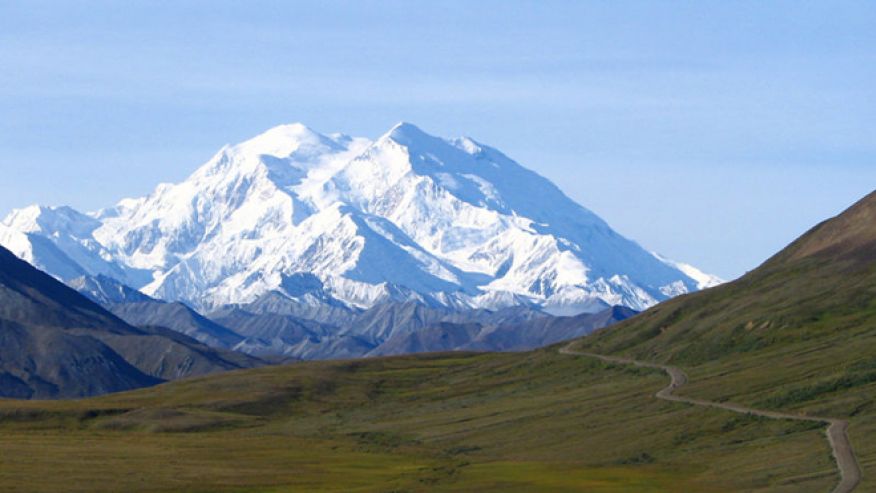
On August 30th, 2015 President Obama changed the name of Mt. McKinley, the 20,237-foot mountain and the tallest in North America to Denali.
What is a lover of Ohio history and a Native American sympathizer like myself to do?
Ohio politicians are fit to be tied. Some are saying it's an example of the President circumventing Congress. Others say it's a slight against Ohio's martyred native son. A meme going around had racist overtones. Former Ohio Congressman Rep. Ralph Regula (R) went so far as to call Obama a dictator. Hyperbole much?

After some soul-searching (in the form of Google), I uncovered some things known as "facts".

Obama himself didn't really change or "decree anything". The headlines you see are mostly clickbait. More on that in a bit.

1896 adoption certificate
The mountain was known as Denali or Deenaalee, a Koyukon Native American word meaning “the high one” or “great one", for centuries. The first documented non-native sighting was by a Russian named Andrei Glazunov in 1834 who used a variant of the name "Tenada" in his 1839 map. Then along came a gold prospector in 1896 named William Dickey (not from OH but just gaga for gold and McKinley) who decided to call Denali, Mt. McKinley since he had just been named the Republican nominee for President. That's pretty good PR. McKinley was elected, served a full term, started the Spanish-American War, annexed Hawaii, got re-elected. But his main legacy is being assassinated in his second term by an anarchist in 1901. For that, he got a whole mountain.

The first mapped depiction of Denali
in an 1839 expedition
In 1917, sixteen years after the President's death, the US officially recognized the name Mt. McKinley when the surrounding national park was created.
Here's the thing. Charles Sheldon, who promoted the idea of creating McKinley National Park, wanted Congress to call the mountain Denali. They ignored that request. Alaska just kept calling the mountain Denali and has had a standing petition for the Federal name to be changed back to Denali since 1975. Ohio politicians kept blocking the 1975 proposal and the name remained Denali in Federal records. McKinley National Park was later renamed Denali National Park in 1980 without much controversy. But Mt. McKinley stayed. I suppose if they had done what Charles Sheldon wanted in the first place, we wouldn't even be discussing this now.

In 2015, Interior Secretary Sally Jewell, citing authority in a 1947 law passed by Congress, changed the mountain name back to Denali. The 1947 law states that the  Interior Secretary can authorize name changes if the U.S. Board on Geographic Names does not act within a reasonable time. Alaska's entire Congressional delegation, Rep. Don Young (R-AK), Sen. Lisa Murkowski (R-AK) and Sen. Dan Sullivan (R-AK) praised the decision saying "Denali, the 'Great One' comes home" and "Today, the nation recognizes what Alaskans have known for generations". It's worth noting that Sen. Sullivan was born in OH just 70 miles from McKinley's birthplace.
McKinley was never here

The Obama administration isn't entirely innocent. The timing of the restored name came on the eve of a planned presidential visit with an emphasis on Alaska's connection to climate change. So there is some political maneuvering there. But it's not all rainbows and unicorns for Obama with the state of Alaska. Protesters are planning to greet the President. Not to protest the name change, but to urge him to reverse his decision to allow Shell Oil to drill in the Arctic.
Keep in mind that McKinley never visited Alaska and has absolutely no historical connection to the state of Alaska. None. Re-naming it Mt. McKinley in 1896 was the political stunt.

“With our own sense of reverence for this place, we are officially renaming the mountain Denali in recognition of the traditions of Alaska Natives and the strong support of the people of Alaska.”  - Interior Secretary Sally Jewell

The new 2015 GMC McKinley. Thanks, Obama.
McKinley, a pretty mediocre POTUS in historical rankings, has lots of things named after him, schools, streets, a gun club(!), memorials, a great tomb.
Get over it Ohio. It's embarrassing. I love you lots but you don't get to name mountains in Alaska.

Bonus trivia: McKinley was the first president to ride in an automobile. The one that took him to the hospital after being shot. There is no car named after McKinley, but there is a GMC Denali. Go figure.

Another Gehio post on McKinley

Friday, August 21, 2015

Little Phil

Sheridan in his Civil War prime
History is full of great people who did wonderful things but flawed in other ways. I sometimes wonder how Washington, Jefferson, Lincoln, FDR, etc would fair in today's hyper-critical sound bite world. The Founding Fathers kicked the slavery issue down the road, Lincoln was called a tyrant by half the country, FDR ordered internment camps for the Japanese-Americans. Imagine if they had Twitter or cable news then. Those were different times we always say. Future generations will no doubt say the same thing about us.

I never know what to think of guys like General Philip Henry Sheridan.  He certainly isn't a Jefferson or FDR but he was a major figure in preserving the Union during the Civil War which also ended the institution of slavery. That in itself is a noble thing. But he isn't really remembered for that so much. With the Union intact, the US looked again to the West. Sheridan and his peers resumed American expansionism with the exploitation and near genocide of the indigenous people of America. He is mostly remembered for an infamous (mis)quote "the only good Indian is a dead Indian."

Sheridan Monument in Somerset OH
March 6th, 1831 is considered to be Philip Henry Sheridan's birthday and I meant to post something on that day. 2015 is also the 150th anniversary of the end of the American Civil War. I had thought Sheridan was born in Ohio which is why I decided to write up something about him. In history, even the simplest things can be quite murky.

It turns out Sheridan, who earned his "Little Phil" nickname from his 5'5" stature, either didn't know where he was born or lied about it because he had early Presidential aspirations. He is on the record as saying Somerset OH at one point, Albany NY another time, and even Massachusetts. In all likelihood, he was born in Ireland or possibly on the ship from Ireland to the US. The dates of his parent's immigration seem to suggest this. The city of Somerset OH claimed him as early as 1888 and erected a statue of him in 1905. The memorial is the only Civil War equestrian statue in Ohio. His Mother is also on Team Somerset but said his birth certificate was burned in a fire. Convenient. We do know he spent his early childhood there. For the record, Albany NY claims him as well. For more on all this check out this link with telegrams and articles from February 1888.

During the Plains Indian Wars in the last half of the 19th century, they had a tough time determining a friendly or a "good" Indian vs a hostile or "bad" Indian. Some "good" Indians assisted Americans soldiers as scouts and provided intelligence on other Indians. It got complicated. Some bands or individuals within the same tribes had differing allegiances. To most Americans on the Plains, there was no distinction. "The only good Indian is a dead Indian."

The original "dead Indian" story has Comanche Chief Tosahwi identifying himself to Sheridan in 1869 at Fort Cobb in present-day Oklahoma as a "good" Indian meaning he was cooperative and not hostile to US goals. Sheridan supposedly replied,  "The only good Indians I ever saw were dead." Sheridan denies he ever said such a thing.

Post Civil War diplomacy in the 1860s and 1870s seemed to be shoot first and...who the hell cares about asking any questions, just shoot! Entire villages, women and children too, could be easily mowed down by the new automatic Hotchkiss guns. Keep in mind, many whites at that time considered Indians as an inferior savage race. Even good old George Washington stated a hundred years prior “Indians and wolves are both beasts of prey, tho’ they differ in shape". Dee Brown's "Bury My Heart at Wounded Knee," tells the 1867 account of Colonel Maynadier and a local "good" Indian named Spotted Tail. He was shocked to see Spotted Tail cry upon hearing the news of his daughter's death. The Colonel was raised to believe Indians didn't really have human emotions like whites.

Little Big Phil Sheridan in 1876
Several witnesses claim Sheridan did make his remark in some form. If true, given the climate of the time, I'm not sure why he would deny it. Some have argued that the "dead Indian" statement was a message of regret and not an insult. Supposedly opponents of the General changed it to the infamous quote to smear Phil politically. I don't know about that. While not as catchy as the dead Indian statement, he is known to have said, "If a village is attacked and women and children killed, the responsibility is not with the soldiers but with the people whose crimes necessitated the attack." In essence, "kill em all, let God sort em out."
So, if he denied the quote why wasn't he taking credit and bragging rights? Or for that matter, if it was a statement of regret, why not just say that? No one seems to know. The General died in August 1888 from heart failure at the age of 57. Ironic, right?  If he ever wrote about it we'll never know. His personal papers were burned in the 1871 Chicago Fire. I assume this was the same fire that destroyed his birth certificate.
I suppose it makes no difference if he said it or not. While the quote is apocryphal it certainly embodied the spirit of his attitude and the general American outlook in the late 19th century. At the end of the day, even though his name and image adorn towns, counties, tanks, mountains, stamps and old bank notes, the "quote" will always be his legacy.
Happy late belated birthday. I guess.

other sources:
Philip Henry Sheridan at PBS.org
Philip Sheridan at History.com
Colonial Williamsburg - The Indian War

Collection of 1888 articles & telegrams claiming and disputing Sheridans birthplace

Tuesday, March 17, 2015

March Ohio History Madness!


March is rich in Ohio history goodness. 
OK, not all of it is good. Some of it is bad and downright shameful. It is interesting nonetheless and makes us who we are. Are we learning yet?

I've written up some things on most of the following items. The link will take you to that post.

Tecumseh was born in 1768 somewhere in SW Ohio. Historians don't agree on the exact day or place (probably Xenia) but the date is likely sometime in March based on conversations with a white man named Stephen Ruddell who grew up as his adopted brother.

The month also marks Ohio Statehood Day when Ohio became the 17th state March 1st, 1803. So happy belated birthday.

Adopted son of Ohio, war hero, Tecumseh adversary and shortest term President William Henry Harrison gave that long speech on March 4th, 1841. It contributed to his early demise one month later. March really sucked for him. You can follow him on Twitter.

A terrible scar...
"Adopt our religion and our ways, be farmers and everything will be fine"...that's basically what the Americans said to the Indians.
It made little difference when they complied.
The Gnadenhutten Massacre took place March 8, 1782. Ninety farming Christianized Delaware Indians were slain by militiamen in Ohio as revenge for raids carried out by other Indians. They were even praying as the men, women and children were executed en masse. This escalated tensions greatly in the area and led to years of bloody conflict and distrust.

Onto something more positive...
Ohio produced 24 astronauts including Neil Armstrong. March 16th, 1962 marks his first trip to space aboard Gemini 8. He would later, of course, be the first man to walk on the Moon.

Back to bummersville...
Many Wyandot, like Leatherlips and Tarhe, sided with Americans in the 18th and 19th centuries but it didn't matter. Their reward? They were the last Indians get booted from Ohio to "Indian Country" upon the signing of the Treaty with the Wyandot on March 17th, 1842. The last sentence of the treaty may as well have been "Thanks for the help with the British and other Indians, we'll take all the land now."

Time for some music!
March 21st, 1951 was the first rock concert, Allan Freed's Moondog Coronation Ball in Cleveland OH. 20,000 people showed up to a venue that held half that. Pandemonium ensued. Headlining was Paul Williams and his Hucklebuckers. Tickets cost $1.50. The fact that it was interracial was a big big deal too.

Ah well back to terrible good old days...
On March 27th, 1884 a mob in Cincinnati, Ohio, attacked members of a jury who had returned a verdict of manslaughter in a clear case of murder, and then over the next few days would riot and destroy the Hamilton County Courthouse. This would become known as the Cincinnati Courthouse Riots. One of the worst riots in American history. 50 people died and many important historical documents and court records were lost in that melee.

Arthur St Clair, governor of the Northwest Territories was born in Scotland on March 27, 1737. He was infamous for his major Indian defeat as well as naming Cincinnati.

March 31st, 1933 marks the completion of Union Terminal which now houses the Cincinnati Museum Center. The citizens just passed a levy to save this fantastic building that needs plenty of work. Thanks for that! I no longer volunteer but my heart is there.

And last but not least, I acknowledge March 21st, 2010 as my Ohio History Epiphany Day. This is when the local history lightbulb went off for me. Read all about it here if you like.

Monday, January 5, 2015

Finney & Sprong - Forgotten Pioneers, Forgotten Cemetery


The first Gehio post of 2015! I'll try to get some more non-cemetery traditional posts together for the new year so this doesn't turn into just a graveyard blog! Eh. Mebbe.

Finneytown OH was founded by Ebenezer Ward Finney and his son-in-law David Sprong in 1798. The area of land had been acquired by their families after the Revolutionary War from John Cleves Symmes.  Personally, I wish they called it Sprongtown! I do like the sound of that! "Finney & Sprong" also sounds like a fine bluegrass duo.

Pvts. Finney and Sprong are buried in what is now a hidden little cemetery that's had several names over the years. The Old Wesleyan or Old Finneytown Cemetery was also known as Winton Ridge Lane Cemetery and God's Half Acre Cemetery. Ironically, per Google Maps, the 1802 cemetery sits just outside the border of Finneytown in what is now College Hill.
The six foot tall by fifty-foot wide mound in the center is a c.800 BCE Adena Indian burial mound. Seen in the last two photo, next to the graveyard, is the top of the immense 1930s era  Winton Road Water Reservoir. I believe it is unused now but I wasn't able to find additional information.  You can clearly see it in the overhead and street view maps in the link above. If anyone knows anything more about the reservoir I'd love to know! I'd hate to see it torn down. Maybe it can be a skate park!

For a great deal of time, no one knew who owned the old cemetery and as a consequence became overgrown and run down. This actually happens quite a bit. It is especially sad here not only because the founders of the community are buried here but also because 59 other early settlers and several veterans of the Revolutionary War and the War of 1812 vets are interred here as well. Then, of course, there are the prehistoric Adena Indians buried in the mound. So much history in this half acre!

Finney and Sprong with their consorts
In 1935, President Roosevelt started the Work Project Administration or WPA to create jobs during the Great Depression. By then many old cemeteries, especially veteran cemeteries, were in sorry shape due to neglect. One WPA project was to record all the graves nationwide of those who served in all the US wars up until then. This cemetery and its occupants were recorded at that time along with the "old Indian Mound". I have a feeling that this place would have been lost forever without the WPAs involvement.

Since it still had no official caretaker or owner, the burial ground was pretty much forgotten about again for 50 more years.
In 1982, the Adena mound was rediscovered and partially excavated, but then was once again forgotten. We never seem to learn, do we?

Over the years, such as in 1995 and 2004 Boy Scouts and other civic groups have cleaned up the cemetery grounds. They have replaced or fixed some of the stones and even rededicated it.

the grounds with the Indian mound
and the reservoir to the right
Unfortunately, in early 2009 the grounds became associated with a heinous crime. The burned body of murdered teenager Esme Kenney was found near here.

The current state of the grounds seems to depend on when you visit as it relies on volunteer help. I had been here on two occasions in the last several years. On one visit it was nearly impossible to see the mound because the weeds were so high. By the second visit, I could clearly see the mound and the gravestones.
I don't believe in curses and am not typically creeped out by graveyards. However, seeing this mostly rundown cemetery with its nearly forgotten pioneers and ancient people, resting in the shadow of the hulking unused reservoir and then knowing about the horrible crime here certainly gave me pause and a major case of the willies.

Special thanks to the Prell Geneology Website for all the research of this property! Update 2022: the Prell website is gone but I found a copy from 2013 in the Wayback Machine…  https://web.archive.org/web/20131028111827/http://members.nuvox.net/~zt.jprell/

Sources:
- FindAGrave
- History of Finneytown 
- 2012 Cincinnati Enquirer article 
- Genealogical information and article on the cemetery re-dedication. (Includes maps,photos and archaeological information by a descendant of Finney and Sprong.)

Wednesday, October 22, 2014

Battle of the Pumpkin Fields

Little Turtle overlooking the Ohio
Today marks the anniversary of the end of a failed US campaign against Indians in the Northwest Territory. The goal was, as usual, to destroy villages and demoralize the Native Americans in the area to make way for white settlement. You may be thinking it was the infamous St Clair's Defeat but there was one before that. On this date, October 22nd, 1790 a final battle in Harmar's Campaign occurred in present-day Fort Wayne Indiana. Referred to as Harmar's Defeat by Americans, the Miami called it the Battle of the Pumpkin Fields. This was due to the steam rising off all the scalped skulls left on the riverbank. It reminded them of squash steaming in the autumn air. Just in time for Halloween.


General Josiah Harmar, commander of the U.S. Army in the Northwest Territory, lost half of his 360 man force. Harmar was court-martialed for incompetence and acquitted. Indian casualty estimates vary from 40 to less than 200 out of 1000 men. There is no doubt this was a large Indian force but it is well known that when a US commander saw one Indian, he saw ten. In other words, the military liked to inflate the numbers of the enemy to look better. By November 3rd, 1790, the remaining Americans, some never firing a shot, fell back to Fort Washington in Cincinnati.  Up until then, this was the worst defeat by the US against the Indians. Lucky for Harmar, St. Clair's overwhelming loss one year later in Ohio eclipsed this military blunder. Fool me once, shame on you; fool me twice, shame on me...The US would eventually rethink their tactics of frontier warfare. Several years later The Battle of Fallen Timbers would more or less drive Indians from the area.

sources:
-Saving Private Boone
-Lane Library - Butler County Place Names 
-Ohio History Central  - Harmar's Defeat
-Journal of the Indian Wars Volume 1, Number 2

Saturday, July 26, 2014

Cincinnati Sioux and Botanical Garden

1896, Sicangu Lakota Sioux
at the Cincinnati Zoo
"Just four years shy of the 20th century, the Cincinnati Zoo kept one hundred Sioux Native Americans in a mock village at the zoo for three months."
That was the sentence I read. It sounded horrifying. I was intrigued by this (new to me) historical curiosity in Cincinnati, but something didn't sit right. Did the victors in this land grab display Sioux Indians alongside wild zoo animals for people to gape at? I believe I saw this in a Twilight Zone episode. A Google search showed that same sentence repeated in many places, but more information was hard to come by. A forgotten atrocity perhaps? A zoo cover-up? Could it be true? Well no not really. It's not as deplorable as I thought but the story I found is still interesting.

1895, Cree family at the Cincinnati Zoo
By the late 1890s, the American Indians were a defeated enemy. They were forbidden to practice their traditions while living on squalid reservations and dependent on meager government handouts. Until the 1924 Citizenship Act most US states Indians were not even considered American citizens. Oddly, a sense of nostalgia had been sweeping the nation for the "old west". Out of this longing was born the Wild West Shows. These were romanticized outdoor demonstrations that toured not only the US but the entire world. They had phony gunfights, mock Indian attacks and all the other sorts of things you would expect to see. They even hired authentic American Indians as "actors" in these plays. The legendary Sioux Chief Sitting Bull toured in Buffalo Bill's Wild West Show in the 1880s. They were not forced to, but let's get real. Given the choice of rotting on a poverty-stricken reservation vs getting paid to see the world, what would you choose? There wasn't a lot of work for unemployed Indians back then. Letters and articles from that period gave a sense that Indians didn't see themselves as victims and were trying to make the best of a bad situation. They seemed to at least enjoy performing and showing off their skills and past traditions even if some of it was exaggerated. It was far better than "rez" life and maybe some good could come of it.

Sicangu Lakota Sioux 
resting up between acts
So back to the Cincinnati Zoo. In 1895 a band of Cree Indians from Montana were abandoned by a Wild West showman in Bellevue KY near Cincinnati. It's not as if Indians in the 1890s could just hop the next expensive train home. Whites still saw Indians as "wild savages". The last Woodland Indian tribe, the Wyandot left Ohio in 1843. Custer's Last Stand happened 20 years earlier and the Wounded Knee Massacre occurred just a few years earlier in 1890. With the Wild West nostalgia fad was going strong, the zoo officials invited the Cree to camp on the zoo grounds for two months and live like historical Indians. A pretty easy gig considering how they were Indians and had all their stuff with them. It was a big hit and boosted zoo attendance. The Cree made $25,000 which funded their trip back home. Later in 1896, the zoo invited a group of the Sicangu Lakota Sioux from the Rosebud Reservation in South Dakota to camp as well as put on reenactments like the Wild West Shows. The Bureau of Indian Affairs approved. 89 Sioux came to Cincinnati by train with their tee-pees, horses and other gear and put on two shows a day for spectators from June 6th to September 20th, 1896. Along with horseback exhibitions and stagecoach attacks, they re-enacted the massacre of Wounded Knee and the battle of Little Big Horn. Children earned $5 per month, female adults $15, male adults $25 and Chiefs earned up to $50 per month. No small sum at a time when the average US adult male earned just a dollar a day. Unfortunately, the Sioux encampment and show didn't financially do as well as they hoped. There was much rainy weather that summer along with competition from other traveling Wild West Shows.

1896, Some of the Sicangu Lakota Sioux
at the Cincinnati Zoo
So it looks like the zoo wanted to help out the Cree and make some money themselves in the process. Then they attempted to repeat it with the Sioux. Everyone was happy. That doesn't sound so bad I guess. It is difficult for us in this modern age not to look at history through our 21st-century values. In those days this was considered a cultural program. These shows did have some detractors on both sides though. Some felt this interfered with "civilizing" the Indian which was the official policy in those days. Others felt this exploited them and exposed Indians to the bad elements of white society and reinforced negative stereotypes. Lakota Sioux Chief Chauncey Yellow Robe opposed the Wild West Shows and found them degrading and fraudulent. A participant, Pawnee Young Chief saw it as a way to make money and help those at home. It turns out that long before Hollywood Westerns gave us Indian stereotypes and bad history, these shows were doing it first. For example, mock attacks on Cincinnati's Fort Washington were re-enacted with the Indians in full regalia with war bonnets and all. The problem is, Indians never attacked Fort Washington. Woodland Indians didn't dress like that either. In fact, except for an occasional traveler, a Plains Indian never saw Cincinnati until the 1890s and they got there on a train.
 Blokaciqa or Little Stallion
AKA Arthur Belt, corresponded
with Meyer and other Cincinnatians
for many years
John Goetz Jr. , President of the Cincinnati Zoological Society justified the deal (in 1890s terms) saying "the presentation of wild people is in line with zoology, and so, when we exhibit Indians...or any wild or strange people now in existence, we are simply keeping within our province as a zoological institution." In short, he and many others felt it had educational value even if it was a bit off base. I still wonder if the Cree or Sioux fantasized about being more realistic and turning on those gawking white audiences just for old times sake? One last stand. Who could blame them? No one knows what went on in their hearts but sources show they struck up many friendships while they were in Cincinnati that lasted after they went back home. One such friendship several Indians made was with Cincinnati photographer and artist Enno Meyer. He corresponded with his new Indian friends for years afterward, exchanging notes and gifts. Letters still exist from Good Voice Eagle to Meyer where he inquires about coming back for more shows. Unfortunately, by 1898 the zoo was having a financial crisis and could not afford to do so.
Draw your own conclusions but I feel that as usual the truth is in the middle somewhere and given the situation, none of this sounds as bad as I thought. These were human exhibitions but the conditions were not as bad as a dreadful and tragic the human zoos I'd read about. The participants had a choice, but just barely.

Sources: 
The Cincinnati Zoo and Botanical Garden: From Past to Present by David Ehrlinger 
Images of America: The Cincinnati Zoo and Botanical Garden by Joy W. Kraft
Cincinnati's Wild West: The 1896 Rosebud Sioux Encampment by Susan Labry Meyn*
*Many thanks to Dr. Mark Fischer from the College of Mt St Joseph for supplying me with a copy of this PDF. 
Enduring Encounters: Cincinnatians and American Indians To 1900 by Susan Labry Meyn
Photos by Enno Meyer (1874-1947)