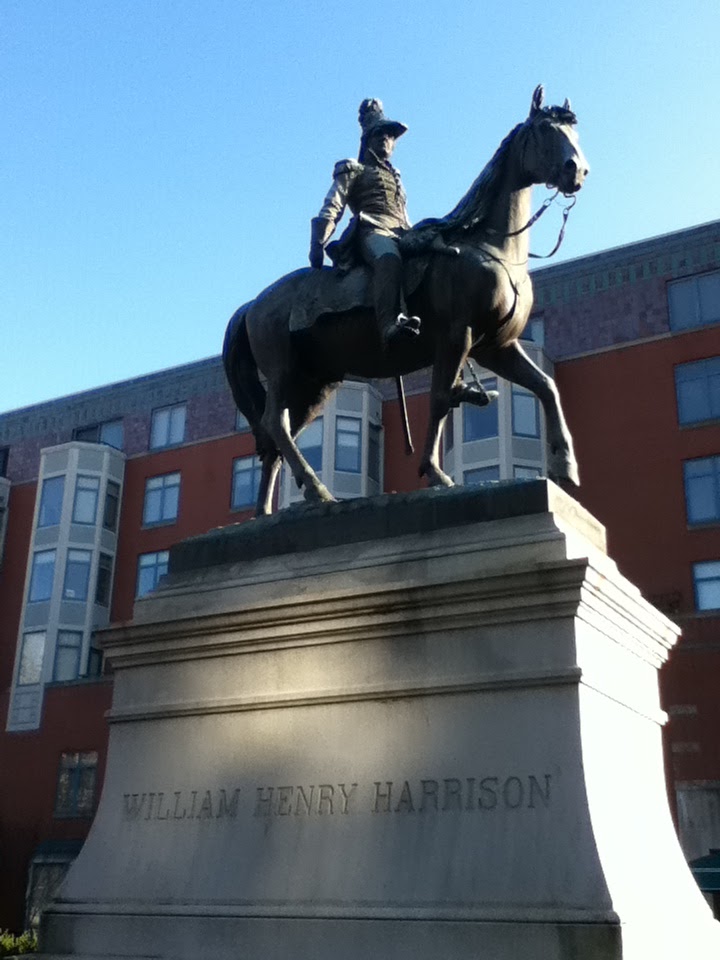
Showing posts sorted by relevance for query harrison. Sort by date Show all posts

Monday, November 7, 2011

Straight Outta Tippecanoe

The November 7th, 1811 loss at the Battle of Tippecanoe near Lafayette IN was a devastating blow to Tecumseh's Pan-Indian Confederation but it wasn't just the military skills of William Henry Harrison that won the battle. Not to disparage Harrison or anything. He showed great leadership rallying his troops when under fire. Most observers say that if it were not for Harrison's boldness and courage, many of his troops would have cut and run. He was an impressive military leader overall and had a great resume but fair is fair. The "win" by the American's can be attributed mostly to the rise of Shawnee religious fundamentalism by Tecumseh's brother, Tenskwatawa or "The Prophet" rather than any brilliant strategy by Harrison. From what I understand, much of Tenskwatawa's "prophecies" were based on natural phenomena that Tecumseh had read about in almanacs that he had access too. I suppose with any prophet there will also be a large degree of luck before and much interpretation after the fact. For a while, this strategy worked but it would ultimately be their undoing.


Prophet's Rock where Tenskwatawa rallied his troops
Up until this point, much of Tecumseh and Tenskwatawa's plan in building the confederation of Indians involved returning to the old ways to please the Moneto, their supreme being. The Prophet taught that Indians were suffering and losing ground to the "Shemanese" (AKA Americans) because they had lost their way and had succumbed to the influence of the whites and their lifestyle. He taught that they should refrain from the use of alcohol, trading for European foods and goods, marrying whites, practicing Christianity, etc. There were exceptions to this. In this case, it was the use and trade of European weapons which they received from their British allies.

While encouraging abstinence from alcohol was a noble cause, as it had an especially devastating effect on Native American culture, the other items came with quite a heavy price. For example, in the autobiographical captivity story of Chippewa adoptee John Tanner, he writes of encountering Shawnee parties who were quite literally starving to death because of this lack of trade goods that the Native Americans had come to rely on.

The Prophet also taught that the Moneto, the Shawnee Supreme Being, would protect them in battle. Literally. As in bullets would not harm them. Up until this time The Prophet had been on a pretty good run of prophecies that seemed to have come true. There was much faith in this man at this time. In fact, Tenskwatawa, had so much faith in himself at this point he felt he could make his own decisions without his brother who had already been instructed him not to engage the enemy at Prophetstown and wait for his return. The Prophet had other ideas and decided to strike first as Harrison's army moved in to quell what Harrison rightfully perceived as an Indian uprising in the making.

at Tippecanoe battlefield
In keeping with the assurance and words of The Prophet at about 4am on November 7th, the Indians uncharacteristically attacked and fought openly and did not seek cover. When they saw that their warriors were easily being cut down by the soldiers this shook their faith and saw it as a bad sign and withdrew their attack. They had no way of knowing that they were actually winning the battle at that point. They likely would have overrun the advancing soldiers in this surprise preemptive attack if their ammunition held out. Harrison meanwhile, rode alongside his troops boosting their morale and encouraging them. In the number casualties at the battle, the Indians were technically winning when they withdrew. Their number of fatalities was 50 to Harrison's 62 and an even lower number of wounded to Harrison's men and after 2 hours of fighting that was the end of the Battle of Tippecanoe.

After this loss, many Indians retreated back to their villages and Tecumseh, upon learning what had happened nearly killed his own brother but instead chose to strip him of all rank and prestige. Not much is known of Tenskwatawa's life after this event. He died 25 years later in 1836 near Kansas City, Kansas in relative obscurity.

Tecumseh died two years after Tippecanoe in the War of 1812 at the Battle of Thames in Canada fighting with the British against General Harrison.

1840 Yard Sign
In 1841 after 30 years, William Henry Harrison who after his military career served as the Governor of Indiana, US Representative for Ohio and a US Senator from Ohio was inaugurated as the 9th US President. His campaign was based heavily on his military career, most notably this battle, using the slogan Tippecanoe and Tyler Too. People seem to think that modern politics invented political spin to get elected but opponents of Harrison characterized him an out of touch drunkard of an old man. Harrison's people touted him as a common man who grew up in a log cabin. He was anything but a common man and gave speeches that would rival Roman emperors. Harrison was certainly wealthy and privileged by the standards of his day. As usual, the truth is in the middle somewhere.

the tomb of #9 in North Bend OH
What Harrison is mostly known for now will help you win at Trivial Pursuit. He caught pneumonia and died 30 days after his lengthy inauguration speech and became the first President to die in office with the shortest Presidency. His death was supposedly the beginning of "Tecumseh's Revenge" that killed 7 US President elected every 20 years from 1840 - 1960. In 1980 Reagan broke the supposed curse, but just barely. As for the origins of the "curse", there is no record of one until someone noticed the pattern and published it in 1934s Ripley's Believe it Or Not.

Tuesday, April 4, 2017

Review: A Child of the Revolution: William Henry Harrison and His World, 1773-1798

A short book review on a biography I read in 2014 of William Henry Harrison on the anniversary of his death in 1841.


A Child of the Revolution: William Henry Harrison and His World, 1773-1798 A Child of the Revolution: William Henry Harrison and His World, 1773-1798 by Hendrik Booraem
My rating: 4 of 5 stars

The book's subtitle makes it clear that this is not a full biography of William Henry Harrison. It just covers the first 25 of his 68 years. Most books about Harrison cover his better-documented life after 1798 such as his second military career and/or his later political life through his Trivial Pursuit worthy death in 1841, so this is a nice addition. The author notes that there is scant primary source material on Harrison's early days. Therefore, much of what is in the book is somewhat speculative at times yet Booraem provides ample evidence to support those assumptions.

What little records there are of Harrison's life before 1798 are obtained from a variety of sources and then compared with Harrison's own accounts written decades later as he was ramping up for a Presidential run. Much like today, folks running for political office like to fluff up the old résumé a bit and cast a better light on some of their more youthful indiscretions. Harrison was no different so we must take his words from the 1830s with some caution as most autobiographical accounts should. For those early gaps, Booraem takes Harrison's words, known events, customs and other evidence of the period and constructs educated theories of some of Harrison's early life and whereabouts. He does a fine job at it.

Any student of William Henry Harrison's life or the early American Republic should consider this required reading to better understand how the son of a well-off slave owning Anglican Virginian planter who signed the Declaration of Independence can be transformed into an abolitionist, a military man, and a politician.

View all my reviews

Thursday, June 18, 2015

The Whirlwind Weekend WHH History Tour

inside the 2nd gate at last!
Perhaps you've noticed that I have a zeal for our trivialized 9th President? My wife has. For my half-century birthday, she surprised me with a Whirlwind Weekend William Henry Harrison History Tour in Ohio and Indiana. How about that? All the stops were presented to me in a sealed envelope along the way, so I didn't know what was next! She even packed my "got William Henry Harrison?" t-shirt for the occasion. Huzzah!

Stop #1 on Saturday, June 13th was a short drive to the Harrison Memorial and Tomb in North Bend OH.
I've been here several times but my wife really went the extra mile on this one. You can usually only go into the 1st gate of the tomb and peer into the main area. The 2nd gate stays locked except on special occasions. I guess this was one those. Tricia got a hold of Terry Simpson who is in charge of the property. She arranged for him to meet us there at 7:30AM and let me in the 2nd gate to stand inches away from WHH himself!  I've spoken to Terry before over at the Harrison-Cleves Museum. It was fantastic of him to meet us there early on a Saturday morning. Oh, and there appeared to be some empty spots in the tomb near William Henry and wife Anna Symmes. I called dibs on one of them. I just found out I'm related to WHH by marriage. My 4x Great Grandfather William Henry Smith was a cousin of the Symmes family.

Stop #2 was the main course, Harrison's home he had built in Vincennes IN, the Indiana Territorial capital in the early 19th century, population 700. He named his home Grouseland, for the many game birds on this 300-acre tract of land in this former French trading post. Harrison arrived in Vincennes in 1801 as Governor and once completed lived at Grouseland from 1804 - 1812. This has been on my "local" history bucket list for a while.
view of Grouseland from the historic walnut grove

William Henry Harrison moved from North Bend OH to Vincennes with his wife Anna Symmes after he was appointed Governor by President Jefferson. Tricia and I had the luxury of a modern highway that took a pleasant 4 hours. By contrast, land routes were rare, rugged and dangerous in 1801 so the Harrison family took the 4 week trip by boat down the Ohio River to Louisville KY and then to southern Indiana where they continued upriver by keelboat on the Wabash. By all accounts, they had good weather or it would have taken much longer. I'm glad we live in 2015!

Our drive along Rt 50 was beautiful and highly recommended vs the somewhat faster but more boring I-74 to I-70 route. We passed through and by Hoosier National Forest Martin State Forest, a couple of wildlife refuges and many small historic towns. I would like to come back to that area and explore it a bit more. Indiana ain't just corn fields. One would think it would all be flat (like the Interstate) but it was hilly and forested in many spots and reminded me of driving through parts of rural Kentucky. Of course, if you enjoy billboards and chain restaurants take the interstate. Your call.
My friend and fellow geocacher Mark also helped Tricia pre-plan some geocaches for me to find on the way so I didn't have to do that on the fly. Huzzah!
Harrison and Tecumseh met here!
Once we got to Grouseland we took the guided tour of the Virginian plantation styled brick home and its 17 rooms, including an attached one and a half story dependency. The friendly staff there was great and rather than just be a good sport, my wife actually enjoyed it herself. Because it was a private collection, no photos were allowed in the home. There were signs everywhere about that. Did I cheat? Maybe once. This site and the official site have some pretty good interior photos and descriptions as well as some history of the home after Harrison moved back to Ohio during the War of 1812.
Some interesting tidbits I took away from the visit - The house was built to withstand attacks by hostile Indians, British or any general melee. The windows were shuttered inside and out as a defensive measure. There was, in fact, a bullet hole in the dining room shutter, an alleged attempt on Harrison's life by a rogue frontier ruffian. The basement windows also had bars with a clear view of the Wabash River so that any incoming river traffic could be observed and defended if necessary. Exterior and interior walls were three bricks thick and the basement had a water well, munitions storage and a French drain toilet in the case of any long siege. As I understood it reading elsewhere, Harrison started the first Indiana Public Library in this basement too.
It's worth noting that Vincennes University, across the street from Grouseland, was Indiana's first college and, you guessed it, founded by WHH in 1801.
gift shop stop
The home was quite spacious for his large family (I think five of his ten children were born here). We learned that the good Governor had an open door policy whereby any citizen that felt unsafe in this hostile frontier could find refuge at the mansion. It was common for one to find regular citizens and travelers sleeping in the upstairs hallways.
We could also see some minor structural damage from the powerful 1811-12 New Madrid Earthquakes. These were the quakes that caused the Mississippi River to run backward in one section and the rumble was felt as far away as Boston. This is one strong house and it's clear that Harrison cared for the people he governed based on his protective policies and promotion of education. Huzzah!
One of the highlights for me was seeing the hat and sword that Harrison wore at Tippecanoe along with a remnant of the flag from his regiment in that battle. It was also great sitting in the walnut grove where the Shawnee Chief Tecumseh and Governor Harrison had their parleys in 1810. One of those meetings almost ended in bloodshed but cooler heads prevailed. If that had turned out differently we may never have heard much of Tecumseh or Harrison, if at all. Lewis and Clark, whom Harrison knew from the 1795 Treaty of Greenville, also stopped here on the way back from their famous expedition.

Soldiers and Sailors Monument in Indy
I was unsuccessful in playing matchmaker to my teenage daughter (unbeknownst to her back in Cincinnati) with the teenage docent who really seemed to enjoy his volunteer work and knew his stuff. He was taken, so I'll have to look for another future son-in-law. Because of my yakity yak with the wonderful like-minded staff and my dawdling in the gift shop (where I picked up some great trinkets for my collection), we blew Tricia's timeline a bit for the next stop. That just meant we had to eat lunch on the run.

Stop #3 was an overnight stay at the Hilton in Downtown Indianapolis a block away from the mighty impressive 19th century Soldiers and Sailors Monument on Monument Circle which includes accolades to local early history including of course WHH. They were doing repairs so it was all covered in scaffolding. We had a nice dinner downtown that evening.

Stop #4 on Sunday was also near the hotel. It was the grandiose Indiana War Memorial which was dedicated by General Pershing in 1927. It had well-done displays on Indiana's contributions to the various war efforts from the Revolutionary War to WHH's War of 1812 service up to the present day and ended with the 110' tall Shrine Room with its massive 24 marble pillar. You can see it in a virtual tour here. It is quite overwhelming to stand in that quiet and massive room.

Pez Prez WHH overlooks Downtown Indy
Alas, all good things must come to an end and we had to head home on Sunday afternoon. What a great way to spend a weekend for a WHH and local history fan like me!

Maybe for the 60th, Tricia will take me to Harrison's birthplace, Berkeley Plantation in Virginia? Fingers crossed!

Other Gehio related WHH posts you may find interesting:

Saturday, October 1, 2016

19th Century Booze News You Can Use

WHH never slept here
In the election of 1840, Democrat incumbent President Martin Van Buren and his re-election team attempted to smear his Whig opponent William Henry Harrison by portraying him as a hard cider drunk and a hayseed. It didn't matter that WHH was once a US Ambassador, US Congressman (both kinds), Governor of the Indiana Territory, Secretary of Northwest Territory, a US Army General and a celebrated war hero. He had an impressive resume, was college educated, and came from a wealthy family just like Van Buren and most politicians of that era.  I'm not entirely sure what Harrison’s drinking habits were as a younger man. Most men back then drank quite a bit. Supposedly he was a teetotaler later in life.

What Would WHH Do?

1840 campaign medal
Harrison's team embraced the attempted slander and adopted a log cabin as his campaign symbol, the symbol of frontier rustic-ness, and portrayed himself as a regular "Jebidiah the Blacksmith" every-man who enjoyed his Bud Light, I mean hard cider. This tactic was no different than politicians now that put on those plaid shirts for the camera and walk around a farm with their family or don a hard hat and shake hands with factory workers to connect with the common man. It's all political spin and 1840 was no different. Ironically this populist strategy is also what got former War of 1812 General and war hero Andrew Jackson elected as the 7th US President when he ran against incumbent John Quincy Adams. It was Henry Clay's Democratic-Republicans opposition to Jackson and his policies that gave birth to the Whig party in 1833.
The truth is, Harrison never once lived in a log cabin. His campaign team, again taking a page from Jackson, accented the old General's War of 1812 war hero status by coming up with the very first presidential campaign slogan and song "Tippecanoe and Tyler Too" emphasizing his win at the Battle of Tippecanoe. The Log Cabin and Hard Cider Campaign was on, complete with cups, plates, flags, and sewing boxes made with his image on them.

Booz...but not from the 1840s

Back to the booze...

Now it is known that there were variants of the word “booze” associated with drunkenness going back to the 14th-century Dutch word “búsen” and even in early America, adjectives such as “boosy” meant "drunk". It has been said that Harrison's Presidential campaign popularized the term again in 1840. It's serendipitous to note that Martin Van Buren was of Dutch ancestry and spoke Dutch as his first language. He later learned English in school.

As the legend goes on to say, WHH commissioned the E.G. Booz Distillery (erroneously listed as E.C. Booz at times) in Philadelphia to make log cabin shaped whiskey bottles with the “Booz” surname featured prominently. Harrison allegedly gave away this free booz(e) at campaign stops to potential voters. I've seen this mentioned in an antique glass bottle book from 1920. It's even in the 1941 biography William Henry Harrison, His Life and Times by James A. Green and repeated in many other publications. I myself believed the boozy tale and even wrote about it here*.

Not so fast...

It would be interesting to find the earliest mention of the booze story. I know for example that the Harrison speech/hat and coat/pneumonia story doesn't appear in print until 1939 in the Freeman Cleaves biography "Old Tippecanoe", long considered the go-to book on WHH which incidentally doesn't mention the "booz" story at all, whereas Green's 1941 book does. Hmmm.

Edmund G. Booz was born in 1824, which would make him only 16 years old in 1840. As it turns out, Edmund didn't start selling log cabin shaped whiskey bottles embossed with his family name until 1858. This was at a time when the brand new Republican Party, founded by former Whigs, was gaining popularity with another up and coming log cabin guy named Abraham Lincoln. Since Harrison, the first Whig President, had the famous Log Cabin campaign with lots of other swag, Mr. Booz likely stamped one of them with the 1840 year as a tribute...or possibly as a deception. Either way, this allusion apparently led folks to believe the bottle was from 1840 election and the tale developed from there. I've also learned that Clevenger Brothers Glass made reproductions of the bottles in the 1930s. Sometimes these are sold mistakenly as 19th-century originals. This leads me to believe that the story originated not in the 1850s but in the 1930s, which is around the time Green wrote his book.
So while it is feasible Harrison gave out free booze or hard cider (in regular type bottles with no "booz") in 1840 to lubricate thirsty voters and E. G. Booz, with his convenient, name re-popularized an old term for alcohol in the 1860s, it’s just not possible that William Henry Harrison or his campaign had anything to do with it in 1840.

Myth.Busted.


*Note: This is a rewrite of a post from December 2011 that originally credited the 1840 Harrison campaign with popularizing the term "booze". As explained above, new information had come to my attention that indicates this wasn't true. 

Monday, April 4, 2016

William Henry Stemwinder

March 4th, 1841
William Henry Harrison gets a bad rap. Conventional wisdom states that our 9th President must have been a blustery egotistical old fool to give a speech that lasted nearly two hours in the cold rain. Maybe he was but while it's true that his inaugural speech was twice as long as any of his eight predecessors, it was common to give lengthy speeches in those days. In our modern sound bite world, the thought of a speech like that generates gasps and ridicule. Most movies aren't even that long. But this was 1841, not 2016.

Oratory skills in the 19th century were highly prized. They especially came in handy for Harrison during his old frontier Governor days. He became a seasoned negotiator with Native American tribes who relied on verbal tradition and valued such speaking skills. WHH was also well read and idolized Plato and Cicero so much so that he emulated and referenced them in his public speeches. In the 1800s a term was coined for a long rousing speech, a stem-winder. This was slang for speeches so long that listeners had to rewind their watches during its course. And it was a compliment! Lincoln is famous for his short two-minute address at Gettysburg but the speech that preceded it by former Secretary of State Edward Everett was two hours. People thought that was too short. American poet Ralph Waldo Emerson once exclaimed "The highest bribes of society are all at the feet of the successful orator. All other fame must hush before his. He is the true potentate."
Practicing oratory skills with Tecumseh in 1810
The bottom line is, while still a tad bit lengthy, it was shorter than Harrison's original. Future Harrison/Tyler US Secretary of State Daniel Webster (a contemporary of Emerson) had edited down the President elect's speech in February 1841 killing "seventeen Roman proconsuls", Webster boasted. Still, none of this had any bearing on his cause of death. Harrison probably died from a deadly combo of typhoid and early 19th-century medical treatment, not just the pneumonia that is often cited. A cold can irritate the lungs creating an environment where the bacteria that cause pneumonia can thrive, but one doesn't catch a cold from dressing poorly in the cold. That's common knowledge now. Also, Harrison complained of no symptoms until March 27th. That was 23 days after the speech. 

I doubt his cause of death will ever be corrected (or fully known) in the history books. It's repeated so much so that it is now the "truth" much like other moments in history that make great stories. Daniel Boone wore a coonskin cap (only on TV). Paul Revere yelled, "the British are coming" (he didn't). Al Gore claimed he invented the internet (he didn't really say that). 
April 4th, 1841
Could Harrison have given a 20-minute speech and survived?  Maybe. But his death certainly wasn't caused by ego-driven fashion choices on a cold and damp March day. In fact, the idea that the weather and the length of the speech is what killed him didn't appear until the 1939 Harrison bio "Old Tippecanoe". Yes, NINETEEN thirty-nine.
It seems to me that at the age of 68 and environmental factors he would have contracted some sort of malady. Bacteria-infested drinking water caused by open sewage was literally everywhere in DC. No matter what he got sick from, Harrison would have likely died anyway given the state of medicine in 1841. 
Harrison's doctors did what they thought was best in their day for their high profile patient. Yet...they did have another option. Instead of leeching, cupping, and enemas along with cocktails of mercury, opiates, and brandy, they could have just done nothing and let whatever was ailing him run its course. Oddly, had he not been the President, this is what a doctor may have prescribed for a mere citizen. Non-treatment was even prescribed for gunshot victims in those days. As long as the shrapnel wasn't endangering an organ or bleeding someone out, leave them be. The crude medical treatments here were, in fact, weakening the 68-year-old President even further. Harrison died a week later on April 4th, 1841 at 12:30 AM. The official cause of death was listed as "bilious pleurisy", known now as pneumonia, which was really a secondary diagnosis from a few days earlier.

Hey, it sure has been good fodder for one and a half centuries. Let's stop now.


Friday, February 9, 2018

Wishing (If I Had a Photograph of WHH)


not the 1841 photo or the 1850 copy you think it is
 For many years I was under the impression that William Henry Harrison was the first President to be photographed while in office. While this is true, all is not as it seems or what we have been led to believe.

I've been looking so long at these pictures of you
That I almost believe that they're real - The Cure

A daguerreotype (an early form of photography introduced in 1839) WAS in fact taken of the new President at the US Capitol on inauguration day March 4, 1841. According to the photographer Justus F. Moore, President Harrison was “delighted with the results.” We'll have to take his word on that since it was never seen again and no known copy exists. The image often implied and misreported to be an 1850 photographic copy of that lost image is likely a daguerreotype made by Albert Southworth of an oil portrait by Albert Gallatin Hoit that Harrison sat for in 1840.
One might wonder, perhaps the painting was done from the photo? Good question!...but according to a Salmon P Chase diary entry, Hoit (sometimes spelled Hoyt) traveled from Boston to North Bend OH in May 1840 to paint this portrait of Harrison, then a candidate for President, for the Boston Whig Association.

I have seen the digital version of the painting and the 1850 photo previously and while it occurred to me they are very similar it hadn't dawned on me that they are basically the same image. Everything seems to match up. The photo seems to be tilted a bit counterclockwise from the original. and the early crude photographic process adds some slight variances. Just like an Instagram filter, it also produces some shadowing and contrast changes which give the daguerreotype a more life-like three-dimensional appearance. It's no wonder this myth came to be. It looks very much like a photo and not a photo of a painting. Other engravings were also based on the painting such as this one.

Every picture tells a story, don't it? - Rod Stewart

the 1840 Hoit painting used for the photo 
I asked my new friend over at Harrison Podcast about the matter thinking I'd just been mistaken all along (can you believe there is a bigger Harrison fan than I?) and he was also unaware of any of this and is respectfully not completely convinced of my findings. He takes a much more measured and scholarly approach to such things and would like to examine this more before reaching a final conclusion, although I think I have him leaning my way. I respect his work and look forward to any new evidence and will report back as needed. However, for now, I feel that the visual evidence, as well as the dated journal entry by Chase, confirm my findings.
So alas, while Harrison does indeed get the honor to be the first President to be photographed in while in office, no one has seen it since 1841 and what we often see credited as an 1850 copy of that photo is an 1850 photo of an 1840 painting.

Sorry to break the news on William Henry Harrison' s 245th birthday, born on this day 1773. President's Day is on the 3rd Monday of February. Did you know only four US Presidents were born in February? Washington, Harrison, Lincoln, and Reagan.

In case you are wondering, the oldest surviving original photo of a sitting US President is that of James Polk from 1849. The oldest surviving photograph of a US President, recently discovered, is that of elderly John Quincy Adams taken in 1843, well after his time in office.

If I had a photograph of you
It's something to remind me
I wouldn't spend my life just wishing - Flock of Seagulls

A note about the images used. The daguerreotype was taken directly from the Metropolitan Museum of Art website and while slightly cropped by me to match the size of the painting is otherwise an untouched image. Retouched versions of this photo with the scratches and marks removed routinely appear online. 
The Hoit portrait image was taken from a general internet image search also resized and cropped by me for comparison purposes.  The original painting and image can be seen at the Smithsonian National Portrait Gallery


Saturday, February 9, 2013

Tippecanoe and Trivia too!


WHH and the horse he rode in on in Cincinnati
Up until a few years ago, thanks to Trivial Pursuit and rushing from the Mayflower to the American Revolution and then on to the Civil War in history classes, (as if nothing really happened in between) I always thought William Henry Harrison was just some nobody who stumbled into the presidency, died 30 days later and that was pretty much it. End of story. I didn't even know he has a fantastic tomb just to the west of the city I call home, Cincinnati.

William Henry Harrison, Ohio's adopted son born February 9th, 1773 in the Virginia territory, the man I love to hate, the man I hate to love, one of Ohio's unsung founding fathers. He would have been 240 years old had he lived. The 9th President's life was cut short by a common ailment at the tender age of 68. The standard treatment of opium and leeches could not save him and he died of pneumonia 30 days later on April 4th, 1841.  In fact, the "cure" is probably what hastened his death and while he may have had pneumonia, typhoid is likely the real culprit.

1st photo of a sitting President
WHH's achievements tend to get overshadowed by the trivia surrounding his legacy but it is impressive trivia nonetheless:

  • first President to have a campaign slogan (Tippecanoe and Tyler Too!)
  • oldest elected President until Reagan (68 years, RR was 69)
  • the first sitting President to have his photograph taken
  • longest inauguration speech of any President (1 hr 45 min, 8,445 words)
  • first President to die in office
  • shortest term President (30 days, 12 hours, and 30 minutes)
  • last President born as a British subject before American Independence
  • only President to have a grandson follow him to the White House (Benjamin Harrison)
  • his Dad signed the Declaration of Independence (Benjamin Harrison V)
  • two states claim Harrison as their own. He was born in the Virginia colony before the American Revolution but he spent most of his life in the Ohio Valley as a military and political leader and had a home there.
  • supposedly he caused "Tecumseh's Curse" that caused the presidents elected or re-elected in years divisible by twenty to die in office...until Reagan broke the curse. The list of presidents who died includes 3 Ohio born presidents....hmmm. It should be noted that no mention of any curse appeared until 1931.
that's WHH at the Treaty of Greenville
But he was not a mere footnote in history as Trivial Pursuit and history class would lead you to believe. Prior to the Presidency, he had an impressive resume:
  • Present at the signing of the Treaty of Greenville in 1795 as an aide to Gen. Mad Anthony Wayne
  • Secretary of the Northwest Territory (modern OH, IN, IL, MI, WI, MN from 1798-1799)
  • Governor of the Indiana Territory (modern IN, IL, WI and parts of OH, MI and MN from 1801-1812)
  • Expanded US territory by 60 million acres*
  • Won the Battle of Tippecanoe against the Indian confederacy led by Tecumseh in 1811**
  • helped defeat the combined British and Indian forces in the War of 1812
  • Member of the U.S. House of Representatives from Ohio (1816-1819)
  • US Senator from Ohio (1825-1828)
  • Ambassador to Columbia (1828-1829) 
Harrison's tomb in North Bend OH
I realize that this list is not as fun as the trivia list but he seemed as suited, if not more than any other for the Presidency. He wasn't just some schmuck that fell off the turnip truck.
He did do some bad stuff too and some of the good stuff is dependent on how you look at it. For example, as Governor he played around with the wording of the law to keep slavery alive in the Indiana Territory as indentured servitude when slavery was supposed to be illegal there. *The thirteen land treaties with Native Americans were at best on shaky legal grounds. He knew full well that these treaties made him look very good so he obtained many of them on flimsy terms sometimes for personal gain. **The 1811 Tippecanoe battle that helped him get elected? This was considered a draw at best after it happened. In fact, it was originally considered a defeat for the US because of the number of casualties.

Much has been written about his engagements with Tecumseh. Tecumseh nearly killed him once at a meeting when Tecumseh uncharacteristically lost his temper out of frustration. That event certainly would have altered history. WHH  finally helped end the life of Tecumseh at the Battle of Thames during the War of 1812. I sometimes wonder if as Tecumseh laid there dying he regretted not killing Harrison when he had the chance.

Marysville OH (he never lived in a log cabin)
In life and in death he was portrayed as a simple man who was born in a log cabin. This, however, is not true. Harrison was born on a Virginia plantation to a wealthy prominent family and was well known for making long drawn out speeches that referenced and quoted Roman Emperors and military leaders. He really saw himself and wanted others to see him, in this light. Even the home he had built in the Indiana wilderness, Grouseland was a mansion for that time period. He was an American aristocrat who married Anna Symmes, the daughter of land speculator Judge John Cleves Symmes who at first was opposed to Harrison, whom he considered only a mere military man with no future. The myth of his humble beginnings was created to get him elected President. Ironically it was originally used as a slur by his political enemies, Harrison's team ran with it and transformed their man into a "real" man of the people. Sound familiar? Presidential candidates have been doing it ever since. Happy Birthday Mr. President.


Monday, February 18, 2013

The Bad News Buckeyes


Happy President's Day from Gehio!

Ohio figures prominently in Presidential history. During Presidential elections, the focus is on Ohio since our voters have correctly picked the winning Presidential candidate in the last 12 election cycles. I suppose that Ohio represents the average middle of the road American.

Ohio could also be known as the Home of the (Worst and Most Trivial) Presidents. 19% of the 43 Presidents called Ohio home. That's eight if you count adopted Buckeye William Henry "King of Trivia" Harrison who was born in the Virginia Territory but spent most of his adult life and lived in Ohio when he was elected. 
The state of Virginia has the distinction of having the most Presidents born in their state as they include Harrison in their tally as well for a grand total of eight. I think we can at least call Ohio Harrison's stepmother. 

There was a high mortality rate among the eight Ohio Presidents. 50% of them died in office. In fact, only eight Presidents in total from all states have died in office. Of the Ohioans, two were shot (McKinley and Garfield) and the other two of natural causes (WH Harrison and Harding) although there are rumors that Harding's death was suspicious.

Harding and Grant are considered by many to be the most corrupt administrations of any US President although to be fair neither seemed to be directly involved in the scandals that occurred during their terms. They just surrounded themselves with despicable people I guess.

The four that managed to survive their terms, Grant, Hayes, B. Harrison, and Taft all finish in the bottom half when rankings are averaged by historians but Harding is considered the #1 worst overall. Finishing out the list, WH Harrison (5th), Grant (7th), B. Harrison (11th), Garfield (14th), Hayes (19th), Taft (21st) and McKinley (23rd). 

Go Ohio!

Wednesday, January 10, 2018

Greene Day

working copy in Greenville
The 20th-century painter Howard Chandler Christy was born on January 10th 1872 in Morgan County Ohio east of Columbus. I'm not going to go into a biography of him, you can look to Wikipedia for that, but you are familiar with his work and don't know it. Christy's most famous painting is a depiction of the Signing of the US Constitution which has been reproduced in countless history books and publications. He has many other notable works but the one I want to focus on here is his 1945 Signing of the Treaty of Greene Ville, or simply, The Signing. Christy, a native Ohioan, was commissioned for the work to commemorate the 150th anniversary of the treaty which technically ended the Northwest Indian Wars and formed most of the future state of Ohio. Again this post is mostly about the painting and not Christy, the preceding events, or the treaty itself.

the final in Columbus
I'd originally seen the painting in person at the Garst Museum in Greenville Ohio (formerly known as Greene Ville) but I was a bit confused as it didn't look exactly like the one I'd seen in print. Then I learned the "real" painting was located in the Ohio Statehouse. I thought maybe the one in the museum was a reproduction. It turns out that there are two versions of the artwork. The painting above the fireplace in the Garst Museum is what is known as the working copy, which is basically a practice version. The painting in the Ohio Statehouse Rotunda stairway is the final version. Both were painted by Christy and there are a few obvious differences. Don't let the difference in colors in my examples fool you. That isn't really an accurate representation. Both are pretty muted when you see them in person.

The working copy measures 6' x 7' whereas the final is a whopping 22' x 17' and the largest painting exhibited in the Ohio Statehouse. I got to lay my eyes on the final when I visited Columbus last month.

The central figures are Little Turtle (Miami) on the left with outstretched arms presenting the wampum, interpreter William Wells in the center, and General Mad Anthony Wayne to the right. On each side are various individuals representing Indian and American figures that signed the treaty. In the background of the Indian side, we see Fort Greene Ville. The council house appears behind the Americans.

One major difference between the two is the 15 star US flag at the top. It seems more faded in the working copy and not as prominent as in the final. It often gets cropped out of reproductions of the working copy. I was hard-pressed to find an uncropped version suitable for this post but it can be seen here. The postcards sold at the Garst Museum show this cropped version as illustrated in the photo at the top. As you can see there is a lot of space between the subjects and the flag so I can see why this is done.

a couple of areas of key differences
There are other reproductions around the town of Greenville. One is a very large uncropped reprint in the lobby of the Wayne HealthCare Hospital. It appears to be nearly as large as the final version. This is something I wouldn't have known about but an old friend of mine was partially responsible for this reproduction and installation and tipped me off. Another is etched on a granite monument at Elm and Main near the location of the proceedings at Fort Greene Ville.

Several individuals have slightly different appearances in the two paintings. The one I noticed right away is with 22-year-old William Henry Harrison, aide de camp to General Wayne. It's probably the best way to tell the difference between the two versions in print. Harrison is standing behind the General and one person over to his left. In the working copy, he looks straight ahead, breaking the 4th wall of the scene. He doesn't resemble Harrison much and has bright ruddy cheeks. In the final, we see him facing to his right and toward Wayne and looking much like the Rembrandt Peale painting of him from 1813. Chaplain David Jones is standing immediately to Harrison's left and whispering to him in the working copy. Perhaps he has some divine knowledge and is saying to Harrison, "when you give your inaugural address in 46 years don't forget to wear your hat and coat". Jones is seated away from the future President in the final and not whispering to him. Perhaps that explains why things turned out the way they did with Harrison.


Lieutenant William Clark (of later Lewis and Clark fame) stands to the right of Harrison and looks more toward his left in the final. Meriwether Lewis is there too by the way. He is behind The Sun (Potawatomi) signing the treaty at the table. It's not that noticeable of a difference but it gives me an excuse to mention that this is where the duo met.

Black Hoof (Shawnee) and Bad Bird (Chippewa), in the foreground to the left and right of standing Little Turtle (Miami), appear to have mohawks in the working copy and instead have horns and feathers adorning their hair in the final.
The treaty itself has had markings added to it in the final.

As I researched this work I came across an interpretation of the painting that felt the scene represented the growth of civilization. For example, as we move from left to right, we have half naked crouching Indians while Little Turtle stands. In the shadowy center, there is William Wells, a white captive raised by the Miami, who went back and forth between the two societies. Wells served as the interpreter here. He was also married to Little Turtle's daughter.  So that's his father in law to his right. Further right in the scene, we see well dressed and seated men with literate scribes representing civilization. I think it's a good theory whether Christy intended it or not.
granite version in Greenville

This painting, like the Signing of the Constitution painting, is a romanticized scene and the events took place over a period of time. In Greeneville's case, these negotiations occurred over the first eight months of 1795 and then signed by representatives on August 3rd. So it is possible that many of the men depicted here were never present together and certainly not like this.

Incidentally, there is a less idealized contemporary oil painting of the 1795 events that was created by an unknown artist but believed to be one of Wayne's officers present at the proceedings. This one is displayed at the Chicago History Museum. This depiction is certainly much more barren than Christy's.

Happy birthday 146th birthday Howard Chandler Christy. Thanks for giving back some of your talents to represent Ohio.


Additional info:
Christy at the unveiling
You can zoom in on these to get a better look:
Working copy info in Garst Museum
Final version info in Ohio Statehouse


Saturday, September 3, 2016

Ohio History Harvest

September is rich and abundant in Ohio Presidential trivia goodness. Here is a crop of nine savory nuggets from our ninth month. Let's start with the early adventures of our 9th President.

General Harrison statue
in Cincinnati
1812 - The Siege of Fort Wayne began in the Indiana Territory on September 5th led by Potawatomi and Miami Indians. Future 9th President General William Henry Harrison's Kentucky militia from Newport Barracks (across the Ohio River from Cincinnati) joined Ohio militia on September 8th and arrived at the fort September 12th. Known in advance of the approaching superior force the Indians led by Chief Winimac abandoned their attack.
Although born in Virginia and Governor of the Indiana Territory, Harrison would adopt Ohio as his home state, serving in various Ohio political offices and residing in North Bend OH when he became President. I've probably written more blog posts about Harrison than any sane person ever would. Here is a short one to match his brief Presidency.

1812 - Hey what do you know, another WHH entry!...On September 17th William Henry Harrison is made Major General of the US Regular Army by President Madison. Harrison would later defend Ohio from Indian and British advances by building Fort Meigs near Toledo in the War of 1812.

Hendricks is the only VP on US money
1819 - One of three Ohio born US Vice Presidents, Thomas A. Hendricks, 1st VP under Grover Cleveland was born on September 7th in Muskingum County OH. Having spent most of his life as a Hoosier and served as its 16th Governor, he ran with Indiana as his home state in the 1884 election. Hendricks is the only VP whose portrait appears on US paper currency, the $10 silver certificate of 1886. Hendricks died unexpectedly in his sleep just 8 months after being sworn in as Vice President in 1885.

grade school book
about Woodhull
1838 - Suffragette Victoria Woodhull is born September 23rd in Homer OH. Who? In 1872 she was the first woman to run for President and she couldn't even vote for herself. It wasn't just because she was a woman, but she was also in jail on election day. Oh, and black abolitionist Frederick Douglass was named as her running mate by her Equal Rights Party. One problem. Douglass was, in fact, supporting Grant. There’s also no record of how many votes the Woodhull/Douglass ticket received because they apparently weren't even counted. As you can deduce, this Presidential run was more of a protest.

I have to admit I didn't know much about Hendricks or Woodhull before researching for this post. I definitely would like to read more about Woodhull. Notorious Victoria by Mary Gabriel is on my Goodreads to do list.

I have several blog posts about the next four items which are linked in the text.

1855 - Illinois lawyer Abraham Lincoln Rudely was rudely greeted in Cincinnati on September 20th. One of the impolite greeters was Steubenville OH born Edwin Stanton who would later become Secretary of War seven years later under President Lincoln during the Civil War. Politics makes strange bedfellows they say. Upon Lincoln’s death in 1865, it was Stanton who tearfully said the famous words “Now he belongs to the ages.” 

Taft birthplace in Cincinnati
1857 - Speaking of Cincinnati, 27th  President William Howard Taft was born September 15th in the suburb Mt Auburn. Taft would finish his term unlike many Ohio Presidents, but not get re-elected to a second one mainly due to a public dispute with Teddy Roosevelt. He was the only former POTUS to become a member of the SCOTUS.
Random thought: If Hillary Clinton becomes President in 2016, she will have become the first FLOTUS to become POTUS. Bill would become the first...FGOTUS? Anyway...

Garfield Tomb in Cleveland
1880 - Arriving in San Francisco by train on September 8th, 19th US President Rutherford B. Hayes became the first US President to visit the West Coast while in office. I never had a whole post about Hayes but he gets a mention here. This is the only Ohio President who I've never visited the birthplace or grave site. I understand his Delaware OH birthplace is now the site of a BP gas station. At least there is a plaque. The more substantial Hayes Presidential Center and grave is on my Ohio bucket list. Hayes was also Ohio's 29th and 32nd Governor.

1881 - On September 19th, Moreland Hills OH born 20th President James Garfield succumbed to his bad doctors one excruciating month after an attempted assassination. I recommend reading the riveting Destiny of the Republic by Candace Millard which is all about that. It's a great book and one of my favorites. I've read it twice!

McKinley Tomb in Canton

1901 - Well we made it to the 20th century! Just 20 years after Garfield, on September 14th, 25th US President William McKinley died after being shot by an assassin eight days earlier in Buffalo NY while headed to Cleveland. McKinley was born in Niles OH and spent most of his life in Canton where his tomb is. He was the 39th governor of Ohio from 1892 to 1896. Rutherford B Hayes was McKinley's commanding officer during the Civil War in the 23rd Ohio Regiment and were both at the Battle of Antietam on September 17, 1862. For more on McKinley's assassination, I recommend The President and the Assassin by Scott Miller.