Showing posts with label Garfield. Show all posts

Saturday, September 30, 2017

Frosted Ohio Presidents

Never in my life did I think I would get excited about mid 20th-century frosted glass tumblers, but here I am blogging about it. Again. I now have several different sets of Ohio related drink-ware and I've posted about one them before. I learned from my previous research that Ohio was a leader in the glass industry from the late 1800's to the mid 20th century so there are many Ohio themed glasses from that period.

I started this next set of  "Presidents From Ohio" glass tumblers by picking up three of them for a good price at an antique mall several years ago. I've seen the rest on eBay but at $8-14 a piece plus several dollars for shipping that was going to set me back a bit to get the entire set of eight. I'm kind of a cheapskate. Another website had an incomplete set of 6 for $120. Ouch.

Thanks to the sharp eye of an old friend browsing at a local antique mall who sent up the Gehio signal (he texted me), yours truly is now the proud owner of an entire eight-piece set. The best part? Only $35!

This series was designed by Fran Taylor and produced by her company, Gay Fad Studios of Lancaster, OH which was open from 1945-1962. Fran obtained blank glassware from various Ohio manufacturers such as Hazel Atlas Glass in Zanesville and Federal Glass in Columbus. Another was Anchor Hocking which was a few doors down from Fran's Pierce Avenue studio. The blanks were then stenciled and hand-painted. Because I had duplicates, I compared them. I noticed that the coloring on the birthplaces is somewhat different. That makes each one is unique.

The 12-ounce frosted glass tumblers are 5" high with a rim diameter or 2-3/4". The front of each President’s glass features his portrait, a facsimile of his signature, and his years in office (or year of the month in W. H. Harrison's case) with “Presidents From Ohio” above, all in brown, while the back shows his birthplace* in brown with colorful accents. In all my research I've never been able to determine the exact year these were made. Perhaps the secret is contained within the two-volume 610 page book published in 2011, Gay Fad: Fran Taylor’s Extraordinary Legacy by Donna McGrady. At $150 that's too rich for my blood to find out. I'm not so much obsessed with Fran's entire impressive career and work as I am about this particular set of glasses. It would be nice to know how many were made since as I stated before, being hand painted, they are all slightly different.

*Since I am William Henry Harrison obsessed, I noticed that being a Virginian by birth, Harrison's is not a birthplace, but a home in Ohio when he was elected. However, he never lived in a home that looked like a log cabin. The same scene is used in grandson Ben Harrison's birthplace. Ben was born on William's farm in North Bend OH but it was more like a mansion. All the others seem pretty accurate.

I have a couple of other full Ohio related glassware sets to write about waiting in the wings, so look for that...

Saturday, September 3, 2016

Ohio History Harvest

September is rich and abundant in Ohio Presidential trivia goodness. Here is a crop of nine savory nuggets from our ninth month. Let's start with the early adventures of our 9th President.

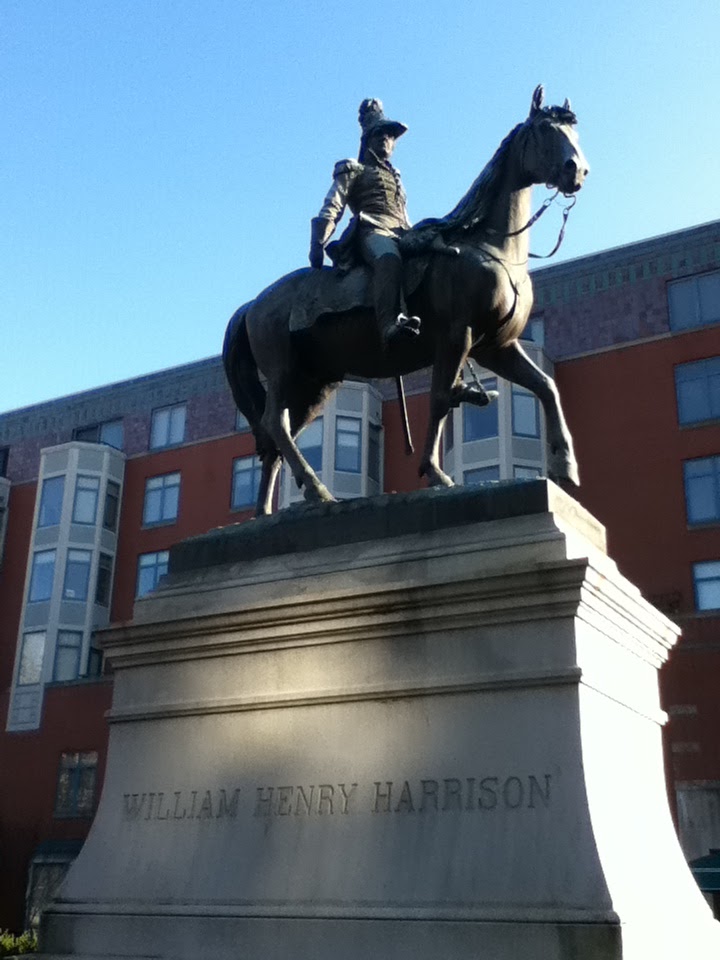
General Harrison statue
in Cincinnati
1812 - The Siege of Fort Wayne began in the Indiana Territory on September 5th led by Potawatomi and Miami Indians. Future 9th President General William Henry Harrison's Kentucky militia from Newport Barracks (across the Ohio River from Cincinnati) joined Ohio militia on September 8th and arrived at the fort September 12th. Known in advance of the approaching superior force the Indians led by Chief Winimac abandoned their attack.
Although born in Virginia and Governor of the Indiana Territory, Harrison would adopt Ohio as his home state, serving in various Ohio political offices and residing in North Bend OH when he became President. I've probably written more blog posts about Harrison than any sane person ever would. Here is a short one to match his brief Presidency.

1812 - Hey what do you know, another WHH entry!...On September 17th William Henry Harrison is made Major General of the US Regular Army by President Madison. Harrison would later defend Ohio from Indian and British advances by building Fort Meigs near Toledo in the War of 1812.

Hendricks is the only VP on US money
1819 - One of three Ohio born US Vice Presidents, Thomas A. Hendricks, 1st VP under Grover Cleveland was born on September 7th in Muskingum County OH. Having spent most of his life as a Hoosier and served as its 16th Governor, he ran with Indiana as his home state in the 1884 election. Hendricks is the only VP whose portrait appears on US paper currency, the $10 silver certificate of 1886. Hendricks died unexpectedly in his sleep just 8 months after being sworn in as Vice President in 1885.

grade school book
about Woodhull
1838 - Suffragette Victoria Woodhull is born September 23rd in Homer OH. Who? In 1872 she was the first woman to run for President and she couldn't even vote for herself. It wasn't just because she was a woman, but she was also in jail on election day. Oh, and black abolitionist Frederick Douglass was named as her running mate by her Equal Rights Party. One problem. Douglass was, in fact, supporting Grant. There’s also no record of how many votes the Woodhull/Douglass ticket received because they apparently weren't even counted. As you can deduce, this Presidential run was more of a protest.

I have to admit I didn't know much about Hendricks or Woodhull before researching for this post. I definitely would like to read more about Woodhull. Notorious Victoria by Mary Gabriel is on my Goodreads to do list.

I have several blog posts about the next four items which are linked in the text.

1855 - Illinois lawyer Abraham Lincoln Rudely was rudely greeted in Cincinnati on September 20th. One of the impolite greeters was Steubenville OH born Edwin Stanton who would later become Secretary of War seven years later under President Lincoln during the Civil War. Politics makes strange bedfellows they say. Upon Lincoln’s death in 1865, it was Stanton who tearfully said the famous words “Now he belongs to the ages.” 

Taft birthplace in Cincinnati
1857 - Speaking of Cincinnati, 27th  President William Howard Taft was born September 15th in the suburb Mt Auburn. Taft would finish his term unlike many Ohio Presidents, but not get re-elected to a second one mainly due to a public dispute with Teddy Roosevelt. He was the only former POTUS to become a member of the SCOTUS.
Random thought: If Hillary Clinton becomes President in 2016, she will have become the first FLOTUS to become POTUS. Bill would become the first...FGOTUS? Anyway...

Garfield Tomb in Cleveland
1880 - Arriving in San Francisco by train on September 8th, 19th US President Rutherford B. Hayes became the first US President to visit the West Coast while in office. I never had a whole post about Hayes but he gets a mention here. This is the only Ohio President who I've never visited the birthplace or grave site. I understand his Delaware OH birthplace is now the site of a BP gas station. At least there is a plaque. The more substantial Hayes Presidential Center and grave is on my Ohio bucket list. Hayes was also Ohio's 29th and 32nd Governor.

1881 - On September 19th, Moreland Hills OH born 20th President James Garfield succumbed to his bad doctors one excruciating month after an attempted assassination. I recommend reading the riveting Destiny of the Republic by Candace Millard which is all about that. It's a great book and one of my favorites. I've read it twice!

McKinley Tomb in Canton

1901 - Well we made it to the 20th century! Just 20 years after Garfield, on September 14th, 25th US President William McKinley died after being shot by an assassin eight days earlier in Buffalo NY while headed to Cleveland. McKinley was born in Niles OH and spent most of his life in Canton where his tomb is. He was the 39th governor of Ohio from 1892 to 1896. Rutherford B Hayes was McKinley's commanding officer during the Civil War in the 23rd Ohio Regiment and were both at the Battle of Antietam on September 17, 1862. For more on McKinley's assassination, I recommend The President and the Assassin by Scott Miller.


Sunday, July 31, 2016

Ohio's Mint Condition

obverse
Did you know Ohio is home to America's oldest private mint? It's also only 6 miles from my house.
Here's the story.
A few months ago I ran across an item on eBay and ended up purchasing it for about $12.
It's a mint condition 62mm (2 ½ inch), 16-gram (.5 ounce) 1953 brushed aluminum medal commemorating the sesquicentennial of Ohio statehood.
The obverse features the Ohio State Seal surrounded by busts of the eight Ohio US Presidents:
William Henry Harrison (9th), Ulysses S. Grant (18th), Rutherford B. Hayes (19th), James Garfield (20th), Benjamin Harrison (23rd), William McKinley (25th), William Howard Taft (27th), and Warren G. Harding (29th).
The reverse notes the company and location "Osborne Coinage Co. Cin. 25, O." At first, I didn't know what the "25" signified. I discovered that it references the zip code of the company location which would be "Cincinnati Ohio, 45225" in the Camp Washington area.

reverse
The medal was struck by the Osborne Coinage Company of Cincinnati, OH which happens to be the oldest private mint in the US and still in operation today. I checked with them but unfortunately, they didn't have any further information on the history of this item, such as how many were made or who specifically it was created for. The early 1950s produced many Ohio Statehood promotional items to gear up for the 150th anniversary. As far as this coin goes, it doesn't show up on eBay much. Another site, which I lost the link to, was selling one and said they'd only seen two of these in twenty years. I don't think it's valuable or anything but I am happy with the price I paid.

Osborne traces its beginning back to 1835 as the Z. Bisbee Co. originally located on 5th Street in downtown Cincinnati a few miles from Osborne's present location in Camp Washington.
During its 181 year history, Osborne produced everything from campaign coins for eight presidents including Lincoln and FDR, food ration tokens in WWII, subway tokens, Alcoholic Anonymous sobriety coins, casino coins, commemorative sports coins, and Chuck E. Cheese tokens. In other words, pretty much anything that was coin-like and wasn't legal tender.

If you need a custom coin, head over to Osborne and tell then Gehio sent you.

related Gehio posts:
- Happy 58th Birthday to our 49th State...Ohio!
- Ohio Statehood Day!
- Ohio History on a Stick

other sources:
- 1997 LA Times article on the Osborne Coinage Co.

Monday, July 13, 2015

The Fool and The Buckeye

Arthur St. Clair doodle
On this day in 1787, the Northwest Ordinance was enacted forming the Northwest Territory

People tend to think of history as some sort of concrete timeline where the occasional revisionist meddles with the facts. While that may be true at times, the fact is, some history just gets lost. Original sources like books, documents, paintings, etc turn up missing or get destroyed. Sometimes the original source is found to be wrong or subsequent authors didn't have access to good sources. Then folks use that as a source. You get the idea.

Back in the 18th century, seals were all the rage. Not the adorable trick-performing fish-eating mammals but rather the circular emblem type with a Latin motto. It made things all official-ly looking. The Old Northwest Territory, which would give birth to six US States had its own official seal designed by my favorite terrible frontier General and Governor Arthur St. Clair himself. I hadn't really thought about the Seal of the Northwest Territory too much until I ran across a funny reference to it in a 1939 book called "Cincinnati: Story of the Queen City" by Clara Longworth de Chambrun.

Arthur St. Clair
The man who runs the Dust Jacket, a collectible bookstore in Mt Lookout in Cincinnati told me a little about the author. Clara was a Longworth, one of Cincinnati's first and richest families, related to Teddy Roosevelt and Marquis de Lafayette. That's pretty good breeding. She had lived just up the road and said the book had some "real gossipy stuff". I was intrigued. After reading it I understood more of what he meant. It wasn't scandalous like TMZ or something, it was full of unsourced and anecdotal historical stories. Don't get me wrong though, she meant well and it's still a very interesting and worthy book with lots of good local material and illustrations. Just don't take everything she says as the last word.

Clara Longworth de Chambrun
Clara Longworth de Chambrun states that the seal design by "Saint Clair" (her odd spelling) represents the planting of a buckeye among the stumps of the fallen forest. She says that the design was criticized by people insisting "the Fool had cut down a good apple tree and replaced it with a worthless buckeye" (her quotes). She goes on to say that many felt no seal was needed since statehood was in sight. This was accompanied by an image of the seal. Notice she also spells "St. Clair" as "Saint Clair". I guess she really was a blue-blood Francophile. I think she just took a shine to the original French spelling of this surname. While there were variations, Arthur definitely spelled it "St. Clair" in his signature and I've never seen spelled any other way. Most historians pronounce it "Sinclair" too.

At any rate, as funny as I thought that "worthless buckeye" comment was, something didn't quite sit right with her apocryphal statement. She makes it sound like the seal was only in use very briefly. While St Clair certainly made his mistakes, he was a scholarly and educated man. The Old Northwest Territory existed from 1787–1803. The seal's first recorded use was in a proclamation made on July 26, 1788, by Arthur St. Clair himself. Statehood certainly was not in sight in 1788. That wouldn't happen until 1803. So it was in use for at least 15 years. In the image, there also seems to be no way to tell what kind of tree that is in the design.

William Hayden English
In the late 19th century a man named William Hayden English (a one time 1880 VP Democratic candidate who lost to the Garfield team) did some research while serving as the President of the Indiana Historical Society. He found that no official record existed on the full description or on the symbolism of the seal. In fact, it was difficult finding a copy of it that had all parts of it distinctly shown. Remember, these were nearly 100-year-old papers and they weren't exactly stored in a sealed climate controlled room. English basically recreated it from six photographs of documents and a lead rubbing of an impression of the seal.

His research was published in the 1896 book, Conquest of the Country Northwest of the River Ohio, 1778-1783 and concluded:

The coiled snake in the foreground and the boats in the middle distance; the rising sun, the forest tree felled by the ax and cut into logs, succeeded, apparently, by an apple tree laden with fruit; the Latin inscription, "Meliorem lapsa locavit," "he has planted a better than the fallen," all combine forcibly to express the idea that a wild and savage condition is to be superseded by a higher and better civilization.

I believe what English came up with reconciles with what someone like Arthur St Clair had in mind. White men civilizing nature and "savage" Indian country. Also, English's book was published over 60 years prior to de Chambrun's. Whatever image Clara was looking at was the one re-created by English's research. As amusing that remark is about the fool and the buckeye is, and as much as I wanted it to be true, I think I have to go with English's more mundane interpretation. But where did Clara Longworth de Chambrun's notion come from? I guess that's the story lost to time.

Friday, June 13, 2014

Garfield documentary coming in February 2015

Who knew a book on an obscure Ohio born US President could be so excellent? Even I had my doubts. However, "Destiny of the Republic" by Candice Millard turned out to be one of my favorite history books. I wrote a blog post about President James A. Garfield after I read her NY Times best-selling book last year and I was blown away by her engaging and gripping style that really brought these characters to life like a novel without any speculative padding. That's tough to do with history, which we all know can be a bit dry and tedious at times. Anyone could enjoy this book, not just history nerds. Needless to say, I was ecstatic when I  learned a PBS American Experience documentary is being filmed for a scheduled release of February 2015. How exciting is that?

Even though her first book "River of Doubt" regarding Teddy Roosevelt's trip to the Amazon has nothing to do with Ohio history, I highly recommend that one as well. It is written in the same colorful and suspenseful style as her Garfield book. As I understand it Candice Millard is currently working on a book about Winston Churchill. I will definitely be looking forward to that. Now I wonder if I can talk her into a book about William Henry Harrison?....

Monday, February 17, 2014

Breaking Buckeye

Billy's Tomb in North bend OH
I've written a few posts about our Ohio Presidents including another general one for President's Day. Having a 50% mortality rate of the eight Ohio Presidents along with the poor showing of the survivors is not a great legacy but an interesting one at least. They were also all Republicans with one Whig. Draw your own conclusions there. Just kidding. Republicans in those days barely resembled the modern GOP and both the Republican and Democratic parties have produced fine Presidents. That is the closest I will get to modern political commentary on Gehio.

#9 William Henry Harrison died of pneumonia (and his treatment no doubt) 32 days into his 1st term. I have written about Billy (his friends really called him that) a few times on Gehio. OK, he is an adopted Buckeye (like me!). He was born in the colony of Virginia but spent nearly his entire adult life in the Ohio Valley when there was no opportunity for him in the failing Virginian planter class economy. He had an impressive political and military resume (Governor of the Indiana Territory and General in the Northwest Indian Wars and War of 1812) and decided to get back into politics late in life. At age 67 when he ran in 1840, they said he was too old and sickly to be President. They were right.

Now here comes the triple threat Civil War General, Ohio President domination from 1869-1881...

Grant's ironic sign near his birthplace
in Point Pleasant OH
#18 U.S. Grant was the only Ohio president to be elected to 2 (scandal-ridden) terms and sought a 3rd later (Garfield became the nominee in 1880 instead). The end of his life wasn't as grand as his deserved war hero status from the Civil War. Good warriors do not always make good Presidents.

#19 Rutherford B. Hayes chose not to run for a 2nd (a campaign pledge). It's a good thing I guess. Hayes actually lost the popular vote and there was a backroom deal to decide disputed electoral votes similar to Gore v. Bush in 2000. His presidential legacy will always be known for that rather than anything else he did.

Garfield preaching it
in Cincinnati OH
#20 James Garfield finished out the Ohio Presidential hat-trick but was shot by an angry office seeker named Charles J. Guiteau and died 6 months into his 1st term from infections caused by his poor medical treatment. This was standard at the time. In my opinion, he could have been a truly great President but who knows? Maybe he would be led down the path of power and corruption like many others. Read more about James' fascinating life in Destiny of the Republic by Candace Millard. It should be noted that this could have been Grant's 3rd term and he may have been killed by Guiteau himself. Grant did die in 1885 when he would have been finishing that 3rd term. So no matter what, I think #20 was doomed.

After that hot mess, we go in twos from 1889-1923...

#23 Benjamin Harrison, William's grandson lost re-election for his 2nd term. Another Civil War General. He was sandwiched in between the two Cleveland wins. I guess people felt they made a big mistake with Ben. The Harrison's just couldn't catch a break in the state they helped create.

#25 William McKinley was shot by an anarchist named Leon Czolgosz 6 months into in his 2nd term. he was a Major in the Civil War. Believe it or not, it wasn't until McKinley was President that Ohio got a state flag (1902) and the first place it was flown was where he was shot and killed. Coincidence?
McKinley's not so modest tomb
in Canton OH

#27 William Howard Taft of Cincinnati lost his re-election thanks in part to Teddy Roosevelt's 3rd party run that siphoned off votes. The first Ohio president to have no military service. He was appointed a Supreme Court Justice later so he did pretty well for himself compared to the other Ohio guys. I am obligated to point out that he was very fat.

#29 Warren G. Harding ran and won against another Ohioan, a Democrat named James Cox. I believe that was the first Ohio vs. Ohio match-up. Then he died of congestive heart failure 2 years into his 1st term. Harding also had no military service.  My Great Grandfather sent a telegram of congratulations on his win in 1920. They were both from Marion OH. There are lots of weird things about Harding's Presidency and death.

Eight Buckeye's to a plate
Then that’s it. The end of the Ohio Presidents.
Americans gave up on Ohio after that. Too risky. Other Ohioans such as Dennis Kucinich have sought their party nomination and there has been talk of Senator Rob Portman or current Governor Kasich having a go but there has never been another major party nominee from the Buckeye State since 1920.  Ohio still plays a key role in modern presidential politics and her electoral votes are much coveted as no Republican has ever been elected President without winning Ohio. If I were a politician from Ohio thinking about a Presidential run, I would take a deep breath consider the legacy thus far.


Tuesday, November 19, 2013

Garfield & Friends

beginning
 James Abram Garfield, was born on this day November 19th 1831 in Moreland Hills, Ohio, near Cleveland. He rose from abject poverty, by a widowed Mother, worked as a janitor to attend college and became our nations 20th US President. He was shot in 1881 four months into his first term and died two months later from the treatment of his wounds ending up with the second shortest US Presidency and the second US president to die in office. That's usually all anyone knows about him.

Like William Henry Harrison, his legacy will mostly be his death, a mere footnote in history, one for the trivia games. That's too bad as he was a remarkable man. A Civil War veteran, a preacher and highly educated, it was said that Garfield could "write Greek with one hand while writing Latin with the other."  If it weren't for a rotten political system and a lunatic with a gun you probably would know more about him.

It turns out Garfield wasn't even planning on running for President. The 1880 Republican Convention was split into 2 factions, the Half-Breed moderate faction wanted James G. Blaine, while the Stalwart conservative faction supported an unprecedented third term for former President U.S. Grant. Garfield gave a speech nominating an alternate Half-Breed candidate John Sherman. Because of the splits in the party, no one was getting the required number of votes in the nomination process. After 35 voting rounds, Blaine and his supporters along with Sherman and his supporters decided to band together and nominate a compromise candidate, James A. Garfield, a Major General Civil War veteran and nine-term Congressman from Ohio who eventually would go on to win the 1880 election. To make peace within the party, a Stalwart, Chester Arthur was nominated as VP.

middle
In the 19th century, it was common practice for government office seekers to seek jobs via the Spoils System whereby the President would hire people based on their political and personal relationships and little or no regard to qualifications. Basically with no oversight whatsoever, if you were a big supporter or a family member you would likely get a cushy job. The system was rife with corruption and incompetence. People would line up by the dozens to beg for jobs at the White House which consumed much of the Presidents time. Garfield dreaded it and thought that should change.

Charles J. Guiteau, a Stalwart, was one of these office seekers who initially supported Grant but then switched to Garfield and somehow had the grand illusion that he was a major reason for Garfield's election. He felt he was owed a political appointment and became furious when he was rejected. Guiteau purchased a revolver and began stalking the President with the intention of killing him so the Stalwart VP could become President. But let's be clear, most of the folks that encountered him including his own family found him to be a bit a loon. In fact, the free love commune he belonged to in the 1860s found him quite annoying. They called him Charles Git Out. True story.

On July 2, 1881, Guiteau got his chance and shot Garfield twice in the abdomen on a train platform in Washington DC. He was quickly apprehended as he attempted no escape and shouted, "I am a Stalwart of the Stalwarts. .. Arthur is president now!". Oddly, Guiteau later wrote Arthur and demanded a pardon and a job. He was eventually hanged.

end
Garfield was severely wounded but modern doctors speculate he would have survived if they just left him alone. It was fairly normal after the Civil War for men to be walking around with a slug somewhere in their body.  Erroneously thinking the bullet may be near a vital organ (it really wasn't), the American doctors who had not yet adopted Joseph Lister's new antiseptic techniques being practiced in Europe subjected him to much prodding and poking with unsterilized equipment and fingers which eventually led to multiple infections and then his death on September 19th 1881. The use of antiseptics was quickly accepted by American doctors after this event.

We will never know what would have been but as far as I can tell he may have been one of the most honest and incorruptible men that held the office of the Presidency. Or maybe corruption would have found him. It seems to happen to most people of power. Ironically one of his lasting legacies was his initiative for Civil Service reform which would away with the Spoils System, the very system that contributed to his death. It was that assassination by the disgruntled office seeker that eventually led to President Chester Arthur signing the bi-partisan Pendleton Civil Service Reform Act which handed out appointments based on merit rather than privilege or political party.

Another part of his legacy will be his support of civil rights by supporting education for black southerners and appointing several African-Americans including Frederick Douglas (who as a US Marshall also presided over the inauguration of Garfield) to government positions.

Garfield was laid to rest in in Cleveland Ohio's Lakeview Cemetery.

Here is a fun fact: Abraham Lincoln's son Robert Todd Lincoln was present for three Presidential shootings. He witnessed his father's assassination in 1865. Then as a cabinet member, he was present during Garfield's shooting. He also witnessed the murder of President McKinley 20 years later. Strange.

For more information on Garfield, especially surrounding his assassination and death I highly recommend  "Destiny of the Republic" by Candace Millard, a 2012 bestseller that got rave reviews. It is a highly engaging narrative account that reads like a novel. I was actually kind of shocked at how fun this book was to read.

6/13/2014 Update: A documentary based on Destiny of the Republic is scheduled to be aired on PBS in February 2015

Thursday, March 14, 2013

Lucretia, My Reflection


Prior to a week or so ago, I had never heard of Lucretia "Crete" Randolf Garfield. I mean why would I?  Her husband James Garfield, the 20th US President, was shot in 1881 four months into his first term and died two months later from the treatment of his wounds. The second shortest presidency ever. Another one for trivia night.
I was at the library recently and I picked up a book published in 2012 called "Destiny of the Republic" about James Garfield, a best seller that got rave reviews. I thought this was odd since it is about such an obscure forgotten President. I won't review the book here but let me say that the reviews are well deserved. It is written in a nice narrative style which makes it as engaging as a novel. It was here I met Lucretia.

Today, March 14th is the anniversary of the death of former First Lady Lucretia Garfield born in Garrettsville, Ohio in 1832. She died in 1918 at age 85. People like this always amaze me because of the changes they saw during their lives. When she was born the US was only about 60 years old and the horse was the only way to travel or get messages across long distances. By the time she died the US was well past its Centennial and she had seen the invention of the telephone and the first airplane.
Lucretia met her husband at school in Ohio and they married in 1856. James admits in his diary that he was attracted to her for her intellect rather than just her physical beauty. Together they had seven children. 

After Garfield's Presidential election she began to rehab the very run down White House when she contracted malaria from "bad air" (they hadn't made the connection to mosquitoes yet) and nearly died. Her doctors had her travel to the New Jersey coast to finish recuperating believing that the salt air would be better for her.
together again
Having mostly recovered, Crete was informed that her husband had been shot. She hopped the next train to be near him and await his fate. During the trip, the train she was on broke a piston and nearly derailed which likely would have killed everyone on board. Because of her frail health, James was concerned greatly about her even as he lay there with a bullet in his abdomen.
After James died, she and her family moved near Cleveland OH and lived off a trust fund set up for her. Crete lived a mostly private life from then on. That was fine with her, she preferred that sort of life vs. the protocols of political life.
Years later in 1918 while visiting in California she died from undisclosed causes at age 85 and is laid to rest in the Garfield Monument with her husband in Cleveland OH.

Oh, and what's up with the "Lucretia, My Reflection" title? Prior to this, the only Lucretia I ever knew was the 1988 Sister of Mercy song. It's not about her but it starts playing in my head every time I hear the name.