Showing posts with label Lincoln. Show all posts

Saturday, September 3, 2016

Ohio History Harvest

September is rich and abundant in Ohio Presidential trivia goodness. Here is a crop of nine savory nuggets from our ninth month. Let's start with the early adventures of our 9th President.

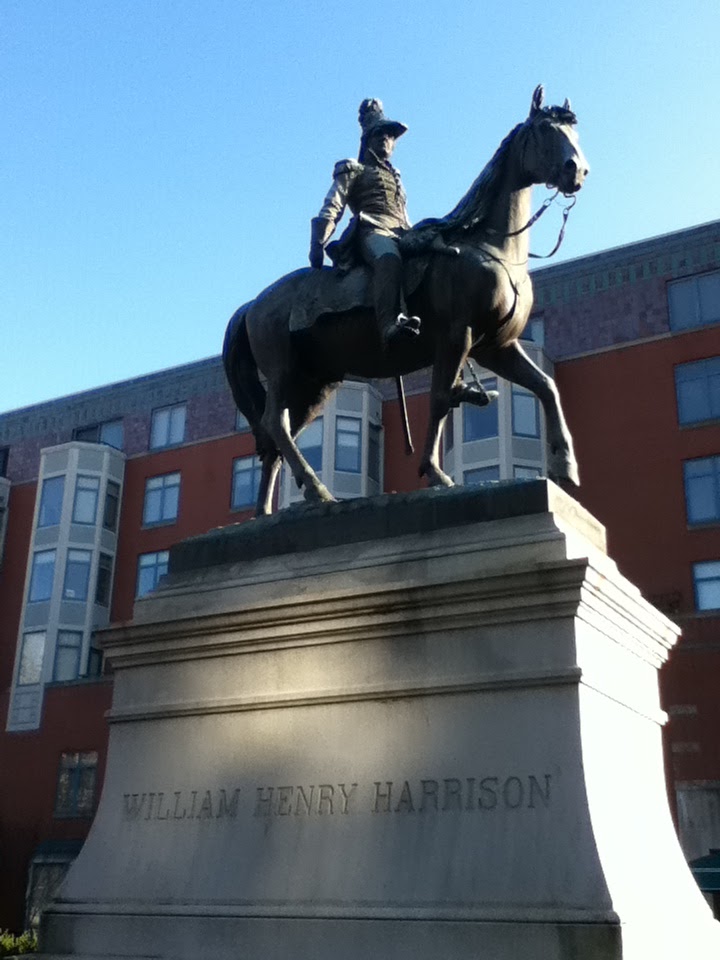
General Harrison statue
in Cincinnati
1812 - The Siege of Fort Wayne began in the Indiana Territory on September 5th led by Potawatomi and Miami Indians. Future 9th President General William Henry Harrison's Kentucky militia from Newport Barracks (across the Ohio River from Cincinnati) joined Ohio militia on September 8th and arrived at the fort September 12th. Known in advance of the approaching superior force the Indians led by Chief Winimac abandoned their attack.
Although born in Virginia and Governor of the Indiana Territory, Harrison would adopt Ohio as his home state, serving in various Ohio political offices and residing in North Bend OH when he became President. I've probably written more blog posts about Harrison than any sane person ever would. Here is a short one to match his brief Presidency.

1812 - Hey what do you know, another WHH entry!...On September 17th William Henry Harrison is made Major General of the US Regular Army by President Madison. Harrison would later defend Ohio from Indian and British advances by building Fort Meigs near Toledo in the War of 1812.

Hendricks is the only VP on US money
1819 - One of three Ohio born US Vice Presidents, Thomas A. Hendricks, 1st VP under Grover Cleveland was born on September 7th in Muskingum County OH. Having spent most of his life as a Hoosier and served as its 16th Governor, he ran with Indiana as his home state in the 1884 election. Hendricks is the only VP whose portrait appears on US paper currency, the $10 silver certificate of 1886. Hendricks died unexpectedly in his sleep just 8 months after being sworn in as Vice President in 1885.

grade school book
about Woodhull
1838 - Suffragette Victoria Woodhull is born September 23rd in Homer OH. Who? In 1872 she was the first woman to run for President and she couldn't even vote for herself. It wasn't just because she was a woman, but she was also in jail on election day. Oh, and black abolitionist Frederick Douglass was named as her running mate by her Equal Rights Party. One problem. Douglass was, in fact, supporting Grant. There’s also no record of how many votes the Woodhull/Douglass ticket received because they apparently weren't even counted. As you can deduce, this Presidential run was more of a protest.

I have to admit I didn't know much about Hendricks or Woodhull before researching for this post. I definitely would like to read more about Woodhull. Notorious Victoria by Mary Gabriel is on my Goodreads to do list.

I have several blog posts about the next four items which are linked in the text.

1855 - Illinois lawyer Abraham Lincoln Rudely was rudely greeted in Cincinnati on September 20th. One of the impolite greeters was Steubenville OH born Edwin Stanton who would later become Secretary of War seven years later under President Lincoln during the Civil War. Politics makes strange bedfellows they say. Upon Lincoln’s death in 1865, it was Stanton who tearfully said the famous words “Now he belongs to the ages.” 

Taft birthplace in Cincinnati
1857 - Speaking of Cincinnati, 27th  President William Howard Taft was born September 15th in the suburb Mt Auburn. Taft would finish his term unlike many Ohio Presidents, but not get re-elected to a second one mainly due to a public dispute with Teddy Roosevelt. He was the only former POTUS to become a member of the SCOTUS.
Random thought: If Hillary Clinton becomes President in 2016, she will have become the first FLOTUS to become POTUS. Bill would become the first...FGOTUS? Anyway...

Garfield Tomb in Cleveland
1880 - Arriving in San Francisco by train on September 8th, 19th US President Rutherford B. Hayes became the first US President to visit the West Coast while in office. I never had a whole post about Hayes but he gets a mention here. This is the only Ohio President who I've never visited the birthplace or grave site. I understand his Delaware OH birthplace is now the site of a BP gas station. At least there is a plaque. The more substantial Hayes Presidential Center and grave is on my Ohio bucket list. Hayes was also Ohio's 29th and 32nd Governor.

1881 - On September 19th, Moreland Hills OH born 20th President James Garfield succumbed to his bad doctors one excruciating month after an attempted assassination. I recommend reading the riveting Destiny of the Republic by Candace Millard which is all about that. It's a great book and one of my favorites. I've read it twice!

McKinley Tomb in Canton

1901 - Well we made it to the 20th century! Just 20 years after Garfield, on September 14th, 25th US President William McKinley died after being shot by an assassin eight days earlier in Buffalo NY while headed to Cleveland. McKinley was born in Niles OH and spent most of his life in Canton where his tomb is. He was the 39th governor of Ohio from 1892 to 1896. Rutherford B Hayes was McKinley's commanding officer during the Civil War in the 23rd Ohio Regiment and were both at the Battle of Antietam on September 17, 1862. For more on McKinley's assassination, I recommend The President and the Assassin by Scott Miller.


Sunday, September 20, 2015

The 180 Pound Gorilla

beardless lanky Ape-raham in Lytle Park, Cincinnati
We have notions that our beloved leaders from the past were always admired. We tend to think that gentleman in ye olde days were more civil and less obnoxious than we are now with all the screaming and yelling on cable news shows. It's kind of always been that way.

In 1855 a young patent lawyer was hired to hear an infringement case in Illinois on a new reaper that was about to revolutionize farming. The trial was moved to Cincinnati so the young lawyer and former Congressman traveled there to meet with the new team. On this day in 1855, he was met by one of the most prominent attorneys of the day named Edwin Stanton. As you may have guessed by now, the visiting lawyer was Abraham Lincoln. He was treated rudely and dismissively by members of his own team. Stanton was unimpressed and regarded Lincoln as an ill-schooled rube and called him a "long-armed ape". He went on to remark that Lincoln was a “long, lank creature from Illinois, wearing a dirty linen duster for a coat and the back of which perspiration had splotched with wide stains that resembled a map of the continent.” At least the insults then were more eloquent. Lincoln was shut out of the proceedings. They wouldn't even read his brief. With nothing to do,  Abraham Lincoln spent most of his time touring Cincinnati. His team won the case and he was paid but he tried to return the fee since he hadn't really done anything.  He ended up accepting half of the fee which he then split with his partner in Illinois. Lincoln admitted he did not enjoy his stay in Cincinnati.

a long way in 10 years
Lincoln, of course, went on to become the 16th President of the United States overseeing a critical point in US history. Who did he choose for Secretary of War as the Civil War got underway? The man who snubbed and insulted him seven years prior but who Lincoln felt was best suited for the job, Edwin Stanton. They sometimes remained at odds but Stanton eventually became one of Lincoln's closest friends and advisors. Upon Lincoln’s death in 1865, it was Stanton who tearfully said the famous words “Now he belongs to the ages.” 

sources: 
Lincoln’s lousy week in Cincinnati
Lincoln in Ohio

Monday, December 1, 2014

Pvt. Issac F. Cosbey - Typos and Typhoid


“We must disenthrall ourselves, and then we shall save our country. Fellow-citizens, we cannot escape history.....In giving freedom to the slave we assure freedom to the free--honorable alike in what we give and what we preserve. We shall nobly save or meanly lose the last best hope of earth.” 
- Abraham Lincoln's State of the Union message December 1st, 1862

While geocaching I see the graves of many soldiers. This one caught my eye since a new plaque was placed in front of it and I noticed that Pvt. Issac F. Cosbey died during the Civil War. Many times the soldiers that died during the Civil War were buried near where they died, typically far from Ohio, so this one seemed unusual.

Researching Private Cosbey was difficult at first. I thought he was in the 82nd because it says so on the newer plaque but I wasn't coming up with much.


The older original stone reads:
PVT CO A, 83rd REG OHIO INFANTRY CIVIL WAR
Aged 19y, 4m, & 8d
Died in the service of his country at Memphis, Tennessee.

The newer marker reads:
PVT CO A 82 REGT OHIO INF

The 83rd Regiment Ohio Volunteer Infantry roster shows that an Isaac E Crosby age 18, was a member of the 83rd Co A. Issac entered the service on August 13th, 1862 and died on December 1st, 1862 at a hospital in Memphis TN. It then states Issac T Cosby as the name in the hospital. Aside from some typos on the middle initial and last name, this all seemed to fit.

I did some more checking on the 83rds movements to make sure things matched up.
Camp Dennison, six miles East of the grave
The 83rd was made up of seven companies and organized at Camp Dennison near Cincinnati OH August - September 1862. The 83rd left Camp Dennison September 3rd for the Defense of Cincinnati. After relocating to support other units and participating in minor skirmishes the 83rd was moved via the Ohio and Mississippi Rivers from Louisville KY to Memphis TN on November 23, 1862. Since Issac died December 1st, this fits in well with his whereabouts at the time of his death in Memphis. I have to assume at this point that the "82nd" in the newer plaque is a mistake since none of the 82nd history matched up with Issac.

So here we have this kid who volunteers for the Union cause, doesn't really take on any action, likely acquired some awful disease like dysentery or typhoid while being transported on the river journey and then died 110 days after joining up. His fate was not the exception either. The reality is 2/3rds of casualties in the Civil War were due to disease instead of glorious movie-like battle. In fact, during the 83rds service, 56 men died in battle while 163 men died of disease or accidents. A reminder of the grim reality of war in those older times.

sources:
Sycamore Township Memorial Cemetery
FindAGrave
83rd Regiment Ohio Infantry History


Friday, August 29, 2014

Confederate Spies in Kentucky

On March 12th, 2012 near Mentor KY in Campbell County, while geocaching I ran into something I never see in SW Ohio, the grave of a Confederate Officer.

Confederate officer Lt. Thomas Jefferson McGraw was arrested by Union troops as a spy for actively recruiting men in KY for the Confederate Army. He was taken to Cincinnati on April 23, 1863, tried and found guilty. He expected to be taken as POW but was instead sent to Johnsons Island on Lake Erie for execution on May 15th, 1863. Abraham Lincoln himself rejected a family plea for a pardon. McGraw was blindfolded and sat on the edge of his coffin so that the gunfire would push him back into the coffin for easy disposal. McGraw's body was then returned and buried at Flagg Spring Cemetery in Kentucky.
The monument here was placed by the United Daughters of the Confederacy in 1914.


sources:
- FindaGrave.com
- KnowSouthernHistory.com

Wednesday, June 11, 2014

Something rank in Ripley

Ripley OH: an abolitionist stronghold.
This is the restored home of John P. Parker,
a noted African-American abolitionist
I agree somewhat that the American Civil War was about States rights, but one must remember that the main right the Southern states wanted to preserve was the right to own black people as property while the Northern states were making progress to end the practice. If the South had won the war, we would have had a separate country to the south of the US called the Confederate States of America where slavery remained legal for at least several decades longer. The end result of this war was preserving the Union and the 13th Amendment abolishing slavery in one of the last holdouts in the Western Hemisphere. It was a great leap forward for human rights in the US, which we all know is supposed to be the land of the free.

top to bottom:
1st (Stars and Bars),
2nd, 3rd National flags
of the CSA. The rebel
battle flag is last.

So too bad about the Confederate flag. This is a good time to point out that this flag was never the official national flag of the CSA, it was the battle flag used by the Army of Northern Virginia under General Lee and the Army of Tennessee, the largest CSA field army. The first national flag was the Stars and Bars. The second national flag did incorporate the more familiar rebel flag as did the third.
People that display the rebel flag in modern times like to say "it's about heritage, not hate". Maybe the flag had noble origins to some but that doesn't really matter now. The Southern states dashed that notion when they started a war which cost the lives of 750,000 people. The Ku Klux Klan and other white supremacist groups also dashed that notion when they used this flag to terrorize and murder African-Americans in post-Antebellum America.  The states of Mississippi and Georgia yet again dashed that notion when it was used as a protest against school integration in the 1950s. The Confederate flag flew over the Alabama state capitol from 1961-1993. On June 11th, 1963 the University of Alabama was desegregated by Federal force while Gov. George "segregation forever" Wallace, protested in front of the school doors and 5 years later used the Confederate flag in his Presidential bid. Wow, that's some heritage! I hate to invoke Godwin's Law but the swastika was a perfectly acceptable symbol to many cultures for centuries until the Nazis appropriated it. Same thing. No one is walking around with a swastika on their shirt or truck unless they want to be known as a white supremacist. So Mississippi, follow Georgia's lead and get the rebel battle flag of oppression off your US State flag. Oh also, enough with the passive aggressive license plates, 10 US States offer the flag as an option. I realize you think that this is the good old days but please stop. It's embarrassing y'all.

Rankin House
So what does this have to do with Ohio history?

On a beautiful sunny Easter weekend in April 2014 I visited the Ohio towns of Point Pleasant, Ripley and Georgetown. My main objective was geocaching but the route I planned had an unplanned common thread. In the 19th century, Southwest Ohio and towns along the Ohio River were a hotbed of Underground Railroad activity, there are signs and markers everywhere and many of the structures still stand or have been restored. This was also the area that future President US Grant was born and raised. You've probably heard of him. He helped win that Civil War that some Southerners are still mad about losing.

from KY across the Ohio to freedom
The Rankin House in Ripley is probably the most famous stop on the Underground Railroad. For 40 years, Reverend John Rankin, at risk of imprisonment himself due to the 1850 Fugitive Slave Act, helped over 2000 slaves flee the US to Canada. One of these escaped slave stories inspired Harriet Beecher Stowe's Uncle Toms Cabin, about which Lincoln famously remarked upon meeting the author, "So you're the little woman who wrote the book that made this great war!" A nearby marker in town states that a Confederate General wanted to burn this "abolitionist hell hole of Ripley" to the ground. Everyone knew what happened in Ripley. So the town bought a cannon as a defense against any Confederates who decided to invade. It turns out that they didn't have to use it since the infamous Rebels known as Morgan's Raid only got within a mile of Ripley. They still have the cannon proudly displayed in front of their library. The town of Ripley has built up quite a heritage tourism industry around its role in abolition and they should be proud of it. America should be proud of it. Everyone that lives or passes through Ripley surely knows these things.

despicable display
As I approach one of the many signs pointing the way to the famous Rankin House perched 300 feet high upon a hill overlooking the Ohio River, something catches my eye. It's a Confederate flag flapping from the front porch of a tiny home not 200 feet from the only road up the hill to the house. In this context, this is not about heritage, the person that lives here is clearly making a statement. I started thinking of all the African-Americans that have passed by here to see the land where their ancestors first saw hope for freedom... and this is what they will see when they arrive. This mocking display thumbs its nose at the bloody struggle that occurred over 150 years ago. What else is anyone supposed to think when they see this well-defined symbol of racism fluttering on this hallowed ground? So get the rebel Confederate battle flag off your porch, it's embarrassing.


Thursday, June 14, 2012

Happy Birthday to Harriet Beecher Stowe


Happy 201st Birthday to Harriet Beecher Stowe (1811-1896) whose 1852 book Uncle Tom's Cabin was a catalyst for the anti-slavery movement in the US.
President Lincoln met her in 1862 and supposedly greeted her with "so you are the little woman who wrote the book that started this great war?" 
The Harriet Beecher Stowe House in the Cincinnati neighborhood of Walnut Hills was owned by her abolitionist Father and is where she lived from 1833-1836.
The home is now a museum focusing on Harriet Beecher Stowe, the Underground Railroad, and African-American history.

Thursday, July 14, 2011

French Indian(a) Territory and Lincoln's Corpse Train

Gehio is about all history of the Old Northwest and on the weekend of July 9th my family and I went to visit friends in Porter County in northern Indiana which allowed me to do a little geocaching and history sightseeing in Ohio's neighbor to the West.

Part of Porter County was called Indian Island in the 17th and 18th centuries and was a high spot in the Great Kankakee Marsh. The surrounding lands were a forested swamp, which was a great area to obtain food and natural supplies for the Potawatomi (pronounced Poh-tuh-WAH-toh-mee) Indians. The name Potawatomi is derived from the name they had for themselves, Bodewadmi, which like many other Native American Tribe names meant original people in their language.

Tassinong was a French trading post in present-day Porter County near Indiana Route 49. In the front yard of a home there is a marker placed by the Historical Society of Porter County which reads:

Tassinong
Site of Tassinong 
Oldest Village in Northern Indiana
A French mission and Trading Post - 1673
Post Office Established - 1837
John Jones, P.M.
Incorporated as a Village 1852
by Joseph Bartholomew and Jesse Spencer

When the French occupied the area from roughly 1670 until the conclusion of the French and Indian War in 1763, the fortified posts they used were called tassements meaning settlement and Tassinong was an English corruption of this word. This settlement would have been used to trade with the Potawatomi and other tribes living in the area at that time. Tassinong was the northern boundary of the Great Kankakee Marsh.
The Indians and the French at that time seemed to have a good cooperative relationship. The French lived among them, took Indian wives and were accepted as tribe members. The French traders, hunters, and trappers didn't seem to exploit the natural resources or the hospitality of the Indians like the other Europeans that came later. I suppose you could say that the French were the best allies that the American Indian tribes ever had. Don't get me wrong, this was very early in this time period and the French certainly were not maintaining good relations with the Indians out of sheer goodwill, but the Indians wanted European goods and the French wanted their furs which could be sold back in Europe for lots of money. I think if the French had not been trying to dislodge the British from North America, things would have been different but they were seen as allies and at least the French seemed to take a much less hostile approach than the Spanish before them and the British and Americans later. The French eventually lost control of North America, forcing the American Indians to choose allies once again.

Nearby, also in Porter County on U.S. 231 was the site of Huakiki, which was an old Potawatomi village until 1838 when the Indian Removal Act started taking effect which resulted in the Potawatomi Trail of Death and was similar to the more infamous and larger scale Trail of Tears Cherokee removal.

Huakiki
Site of Huakiki
Old "Indian Town" Village
Oldest and largest known village
of Pottawatomies.
This was their winter home.
Disbanded in 1838 when the Indians were moved west.


The wording of the marker makes "moved west" sound fairly benign but 40 human beings, most of them children, died of disease and exposure in this 600 mile forced removal to the Kansas territory.

Placed by the Historical Society of Porter County and also on the property of a private residence, the marker didn't say when the village was founded but the Potawatomi were in the area as far back as 1630 trading with the French. After the French mostly left after the French and Indian War ended in 1763 they mostly sided with the British and later were part of  Tecumseh's Pan Indian Confederation in the War of 1812.

Spencer Cemetery is the resting place many of the first settlers in Porter County. Like many other pioneer cemeteries, it started as a family plot, in this case for the Kautz's (later changed to Kouts) who came here to settle from Pennsylvania and Jesse Spencer who incorporates the old village of Tassinong in 1852. There is a geocache here too.

Another interesting historical spot in this region of the Old Northwest was a place I visited last summer in the town of Wanatah IN to the east in LaPorte County. Wanatah Station of the Monon Railroad once stood here. The Lincoln funeral train made a brief stop at this location on the morning of May 1, 1865. The funeral train traveled 1,700 miles on its journey from Washington, DC to Springfield, Illinois, retracing the route taken by Abraham Lincoln on his original campaign trail to Washington.
Lincoln's Corpse Train...feel free to use that as a band name if you want. Just tell everyone that you read it on Gehio.