Showing posts with label Kentucky. Show all posts

Saturday, September 3, 2016

Ohio History Harvest

September is rich and abundant in Ohio Presidential trivia goodness. Here is a crop of nine savory nuggets from our ninth month. Let's start with the early adventures of our 9th President.

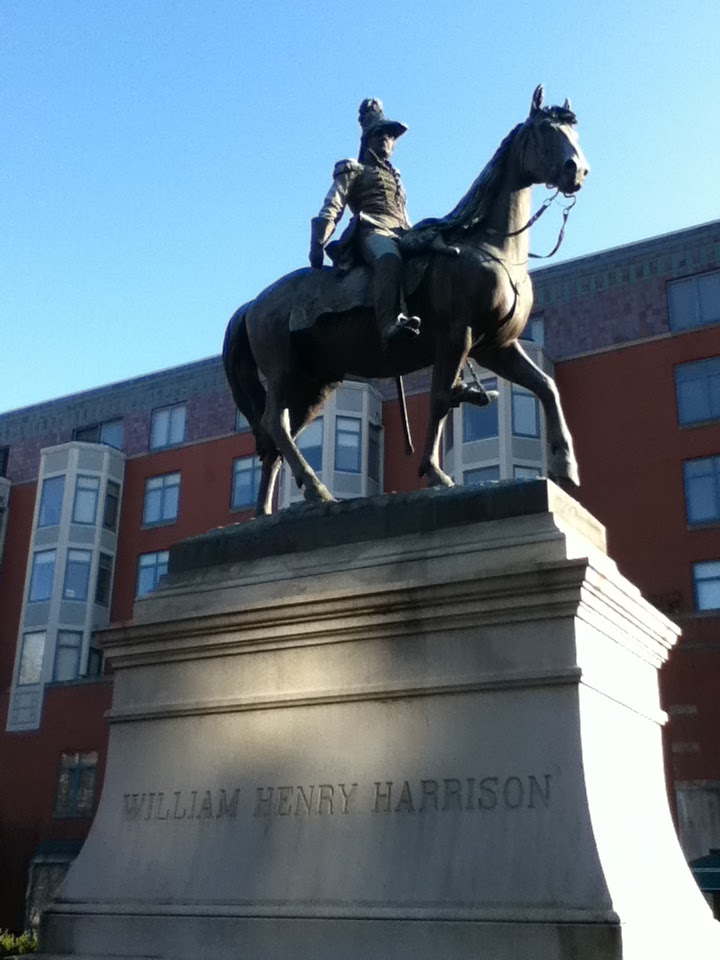
General Harrison statue
in Cincinnati
1812 - The Siege of Fort Wayne began in the Indiana Territory on September 5th led by Potawatomi and Miami Indians. Future 9th President General William Henry Harrison's Kentucky militia from Newport Barracks (across the Ohio River from Cincinnati) joined Ohio militia on September 8th and arrived at the fort September 12th. Known in advance of the approaching superior force the Indians led by Chief Winimac abandoned their attack.
Although born in Virginia and Governor of the Indiana Territory, Harrison would adopt Ohio as his home state, serving in various Ohio political offices and residing in North Bend OH when he became President. I've probably written more blog posts about Harrison than any sane person ever would. Here is a short one to match his brief Presidency.

1812 - Hey what do you know, another WHH entry!...On September 17th William Henry Harrison is made Major General of the US Regular Army by President Madison. Harrison would later defend Ohio from Indian and British advances by building Fort Meigs near Toledo in the War of 1812.

Hendricks is the only VP on US money
1819 - One of three Ohio born US Vice Presidents, Thomas A. Hendricks, 1st VP under Grover Cleveland was born on September 7th in Muskingum County OH. Having spent most of his life as a Hoosier and served as its 16th Governor, he ran with Indiana as his home state in the 1884 election. Hendricks is the only VP whose portrait appears on US paper currency, the $10 silver certificate of 1886. Hendricks died unexpectedly in his sleep just 8 months after being sworn in as Vice President in 1885.

grade school book
about Woodhull
1838 - Suffragette Victoria Woodhull is born September 23rd in Homer OH. Who? In 1872 she was the first woman to run for President and she couldn't even vote for herself. It wasn't just because she was a woman, but she was also in jail on election day. Oh, and black abolitionist Frederick Douglass was named as her running mate by her Equal Rights Party. One problem. Douglass was, in fact, supporting Grant. There’s also no record of how many votes the Woodhull/Douglass ticket received because they apparently weren't even counted. As you can deduce, this Presidential run was more of a protest.

I have to admit I didn't know much about Hendricks or Woodhull before researching for this post. I definitely would like to read more about Woodhull. Notorious Victoria by Mary Gabriel is on my Goodreads to do list.

I have several blog posts about the next four items which are linked in the text.

1855 - Illinois lawyer Abraham Lincoln Rudely was rudely greeted in Cincinnati on September 20th. One of the impolite greeters was Steubenville OH born Edwin Stanton who would later become Secretary of War seven years later under President Lincoln during the Civil War. Politics makes strange bedfellows they say. Upon Lincoln’s death in 1865, it was Stanton who tearfully said the famous words “Now he belongs to the ages.” 

Taft birthplace in Cincinnati
1857 - Speaking of Cincinnati, 27th  President William Howard Taft was born September 15th in the suburb Mt Auburn. Taft would finish his term unlike many Ohio Presidents, but not get re-elected to a second one mainly due to a public dispute with Teddy Roosevelt. He was the only former POTUS to become a member of the SCOTUS.
Random thought: If Hillary Clinton becomes President in 2016, she will have become the first FLOTUS to become POTUS. Bill would become the first...FGOTUS? Anyway...

Garfield Tomb in Cleveland
1880 - Arriving in San Francisco by train on September 8th, 19th US President Rutherford B. Hayes became the first US President to visit the West Coast while in office. I never had a whole post about Hayes but he gets a mention here. This is the only Ohio President who I've never visited the birthplace or grave site. I understand his Delaware OH birthplace is now the site of a BP gas station. At least there is a plaque. The more substantial Hayes Presidential Center and grave is on my Ohio bucket list. Hayes was also Ohio's 29th and 32nd Governor.

1881 - On September 19th, Moreland Hills OH born 20th President James Garfield succumbed to his bad doctors one excruciating month after an attempted assassination. I recommend reading the riveting Destiny of the Republic by Candace Millard which is all about that. It's a great book and one of my favorites. I've read it twice!

McKinley Tomb in Canton

1901 - Well we made it to the 20th century! Just 20 years after Garfield, on September 14th, 25th US President William McKinley died after being shot by an assassin eight days earlier in Buffalo NY while headed to Cleveland. McKinley was born in Niles OH and spent most of his life in Canton where his tomb is. He was the 39th governor of Ohio from 1892 to 1896. Rutherford B Hayes was McKinley's commanding officer during the Civil War in the 23rd Ohio Regiment and were both at the Battle of Antietam on September 17, 1862. For more on McKinley's assassination, I recommend The President and the Assassin by Scott Miller.


Friday, January 22, 2016

Heart(land) of Glass

 Over the last several years I've collected various history-related trinkets and ephemera. I think they gain an insight into the culture of the time and what folks in the past thought was important to emphasize. Sometimes they just look nice on a shelf.

I have three glass tumblers that were part of several series of US State drinking glass sets in the 1950s. Naturally, I am drawn to the ones that depict Ohio. I found these at Ohio Valley Antique Mall. Let me say that despite my interest in Ohio history, I never thought I'd be writing a blog post about drinking glasses. I've since discovered that these have a bigger connection to the Buckeye State than just the name on the tumbler. Did you know that Ohio was once a leader in the US glass industry and several museums are devoted to that fact? Before plastic was invented and in widespread use, glass was used for many items. Over 70 glass companies operated in Ohio between 1880 and 1920.

Hazel-Atlas marking
The first two glasses are from a major glass manufacturer called Hazel-Atlas based in Wheeling WV since 1885. The company operated under that name until 1964. Hazel-Atlas made everything from medicine bottles to food jars and lamps to dinnerware, and of course drinking glasses. By the 1920s most American homes had something made by Hazel-Atlas. By the 1930s they had 15 plants, one of which was in Zanesville OH. They were most famous for so-called Depression Glass items. This was low-cost Depression-era glassware, much of which was made in the Ohio River Valley and is highly collectible now.

The blue and mostly clear Ohio glass pictured on the left is 5 1/4" tall. A map of Ohio depicts the Columbus State House, Fort Meigs near Toledo, and the Cleveland Terminal Tower. The music and lyrics of "Down By The Ohio", composed in 1920 and popularized in 1940 by the Andrew Sisters are on the reverse.
These glasses sold as promotional items by Big Top Peanut Butter of Lexington KY. They were originally filled with delicious peanut butter and sold in grocery stores. Not a bad deal. Buy peanut butter for the kids, get a free highball glass for Dad! Big Top Peanut Butter was bought out by Proctor & Gamble of Cincinnati OH in 1955 and re-sold as Jif Peanut Butter. I am uncertain if the glass painting was outsourced or done by the glass company itself. I do know that a lot of Hazel-Atlas glassware was painted by Gay Fad Studios of Lancaster OH like the next item.

The yellow painted and frosted "Ohio The Buckeye State" glass tumbler was also made by Hazel-Atlas. This glass measures 5 inches tall. A large map depicts 20+ Ohio cities, the State Flag, and a compass.
This was sold in roadside souvenir shops. During the post-WWII boom, the turnpikes and Interstate Highways developed. The middle class grew and more Americans were now driving around the country on vacations. Collecting the glasses was a way to show your friends back home were you've been. Think of it like t-shirts, refrigerator magnets, and bumper stickers today.
The glass decorating itself was sometimes done by another company, which was the case here. Fran Taylor’s Gay Fad Studios in Lancaster OH was the most famous of the glass decorating companies.

The red painted and frosted "OHIO Buckeye State" glass tumbler was made by The Federal Glass Company of Columbus OH and operated between 1900 and 1979.  The glass stands at 4 3/4" tall. Supposedly Federal Glass Co. items were faked over the years. In this case, the Federal Glass Co logo, a capital F inside a shield is on the bottom so it's the real deal. This was likely painted by an in-house decorating department.
This glass illustrates cities along an Ohio Turnpike map at the top. Also represented are Terminal Tower in Cleveland, Perry's Monument, Schoenbrunn Village, the State Bird, the State Flower, the Ohio River, the State Capitol, and Fountain Square/Carew Tower in Cincinnati.
The Federal Glass Co state glasses were also sold at souvenir shops across the nation during the 1940's through 1960's.

Federal Glass marking
All of these tumblers depict important Ohio connections to the past. Pioneer villages, War of 1812 sites, monuments and such. They also feature state symbols, maps, and city landmarks. Aside from the song, after 50 years, these references remain relevant. I wonder what song a modern glass-maker would choose? Several prominent "Ohio" songs in the rock era exist but highlight unfortunate turns in Ohio history such as "Ohio" by Crosby Stills and Nash or "My City Was Gone" by The Pretenders. Otherwise both fine songs, but I nominate O-H-I-O by the Ohio Players. The lyrics are also easy to remember if you can spell Ohio.


Now if this were Antiques Roadshow, here is where I would reveal my estimate at auction. If this were Pawn Stars maybe Rick would call an Ohio glass buddy he knows. The truth is, they aren't worth much money. On eBay, I've seen people try to sell these for inflated prices. Someone listed the yellow one for nearly $70 and described the paint as a decal. Needless to say, it didn't sell.  The reality is, I don't think I've ever seen any of these types of glasses sell for more than $10. With shipping.
I only paid five bucks.

other sources:
- Santa Fe Trading Post
- Hazel-Atlas Glass Database
- Federal Glass Company Database

Friday, August 29, 2014

Confederate Spies in Kentucky

On March 12th, 2012 near Mentor KY in Campbell County, while geocaching I ran into something I never see in SW Ohio, the grave of a Confederate Officer.

Confederate officer Lt. Thomas Jefferson McGraw was arrested by Union troops as a spy for actively recruiting men in KY for the Confederate Army. He was taken to Cincinnati on April 23, 1863, tried and found guilty. He expected to be taken as POW but was instead sent to Johnsons Island on Lake Erie for execution on May 15th, 1863. Abraham Lincoln himself rejected a family plea for a pardon. McGraw was blindfolded and sat on the edge of his coffin so that the gunfire would push him back into the coffin for easy disposal. McGraw's body was then returned and buried at Flagg Spring Cemetery in Kentucky.
The monument here was placed by the United Daughters of the Confederacy in 1914.


sources:
- FindaGrave.com
- KnowSouthernHistory.com

Friday, May 2, 2014

Ohio's Aunt Jemima

Rosa Washington Riles 1901 - 1969
File under: "Cool stuff you learn while geocaching"

I almost didn't stop at this old cemetery on my April 19th, 2014 trek through Ohio's abolition country. I was headed from Ripley toward the boyhood home of US Grant in Georgetown. But it's so hard to resist the lure of geocaches in old cemeteries as I nearly always find something interesting. This was no exception.

At first, I thought this was an impostor buried along U.S. 68/62. Maybe someone who had the head bandanna look down pat, cooked a mean stack of flapjacks, and got a cool nickname out of it. I even called my wife and she confirmed via Google that the original Aunt Jemima was Nancy Green, a former slave born in KY who died in 1923. Oh well. I kind of forgot about all this until I went through my photos from that day and decided to Google the name on the gravestone.

I learned there were multiple Aunt Jemimas through the years and Rosa Washington Riles was one of them. Born (and buried) in Red Oak OH, Rosa was recruited by Quaker Oats in the 1950s and traveled around the country making public appearances portraying Aunt Jemima. Every year a pancake breakfast is even held at the early 19th century Presbyterian church on the same property. The proceeds are used for the upkeep of the old part of the cemetery next to the church where several Revolutionary War veterans are buried.
AJ: Buckeye version

She isn't officially acknowledged as one of the Aunt Jemimas by Quaker Oats I suppose because by the 1950s multiple people were portraying her, but this article on Jim Crow Propaganda (warning: old-timey racist imagery ahead) has a copy of a 2001 article in the comments section with some more information on Ohio's very own Aunt Jemima. Also, check out this article on the history of the old church and cemetery and its role in abolition and the Underground Railroad.

Geocaching and history, my chocolate and peanut butter as I always say! In this case, my pancakes and syrup.

Wednesday, September 26, 2012

Daniel Boone was a man...with two graves


Grave #1 in Missouri

Daniel Boone died on this day September 26th, 1820 at the age of 85 in Missouri.
Everyone knows who Daniel Boone was right? He was that big buckskin-clad, coonskin cap-wearing Indian killer, right?
Not quite. Boone dressed like a regular 18th-century gentleman, he never wore a coonskin cap and was of an average build for his day. He also told his son he only knowingly killed three Indians and he felt bad about it too. Boone was an actual complicated human being, not some frontier superhero it turns out. So thank you very much TV and movies and bad biographers. While the TV series that ran from 1964-1970 reinforced many of the folktales, this wasn't solely a modern fable, it started when he was alive in hugely popular 1787 biography by John Filson. Boone once humbly stated later: "Many heroic actions and chivalrous adventures are related of me which exist only in the regions of fancy. With me the world has taken great liberties, and yet I have been but a common man." 

Boone was, of course, a longtime resident of Kentucky. They named a lot of stuff after him in the state he left when it got "too crowded" as the legends say. In reality, while he was skilled frontiersman and hunter he was a very bad land surveyor and businessman. He was also nearly convicted of treason at one point. Most of his KY property was sold off to settle lawsuits and he left for MO on bad terms. He said he would never return to Kentucky. It turned out he did. Maybe. I can't go into his whole story here. If you want that I highly recommend the 2007 book, "Boone: A Biography" by Robert Morgan. This post is really about what happened to his body after he died. It turns out to be just as interesting and unique as his real-life story.

Grave #2 in Kentucky
Daniel Boone has two graves, not two monuments but two actual grave sites that claim to contain his body. Or parts of his body at least. There is one in MO and another in KY.
It seems that 25 years after he died, the people of KY wanted their hero back so they had Boone exhumed from Marthasville MO and reburied in Frankfort KY. The problem is they didn't, at least not all of him...or maybe none of him. The whole issue was in great dispute for years. MO even claimed that KY dug up the wrong body because the grave was improperly marked (a common issue in those days). Meanwhile, KY said they had the right bones the whole time. This went on and on with different variances until 2010 when the Friends of Daniel Boone's Burial Site in Missouri conceded that only some of Boone's bones were removed. Now that wasn't very scientific and didn't really settle the issue. If you want to pay your respects, to be safe, just visit them both, it's only a 6.5-hour drive between the two.

Monday, July 9, 2012

President Taylor expelled from orifice

1968 Shell Oil Mr. President Coin Game piece #12
I found on a river bank.
This is probably what he felt like on 07/09/1850


On this day in history July 9th, 1850, the 12th US President Zachary Taylor after 16 months in office died of bilious cholera. Folks, that's massive super flu-like diarrhea caused by the cholera disease that was sweeping the nation at that time. In fact, some of my German immigrant relatives died of cholera one month after arriving in the US in the 1850s. Fun times. As was common in those days the President was treated with the very latest medical technology which was bleeding, blistering and opiates. He died and was buried in the Taylor family plot in Louisville KY.
In the 20th century, a conspiracy theory formed maintaining that Zachary was poisoned but this was disproved when they examined his corpse in the 1990s. Much to the embarrassment of the conspiracy theorists, the tests showed he did indeed eat contaminated food and died of cholera. Then they buried him again. I'm sure the treatment methods accelerated the cause of death somewhat as well.

Prior to his Presidency, Zach Taylor, a Kentucky resident, and military man participated in many various Indian Wars up until the 1830s and successfully defended Fort Harrison in the Indiana Territory during the War of 1812 from an attack by Indians under the command of the Shawnee chief Tecumseh. Things like this really helped him get elected.

Incidentally, Taylor was the just the second US president to die in office, the first being William Henry Harrison, the 9th President who died nine years earlier from pneumonia and pleurisy after one month in office. WHH was also mainly elected for his military victories against the Indians, specifically the battle at Tippecanoe IN against Tecumseh's Prophet brother Tenskwatawa, his defense against Tecumseh and the British at Ft Meigs in Toledo OH and the defeat of Tecumseh in Canada during the War of 1812. I don't know the full origin of the supposed curse leveled against the American Presidency by Tecumseh and/or his brother, but I would venture to guess that the 2nd President to die in office in less than 10 years would give birth to this especially since both Presidents were adversaries of  Tecumseh's Confederation.

Wednesday, February 29, 2012

James Bradley paid the actual price of freedom

James reads and I consult my notes in Covington KY
It was $700.

The statue of James Bradley, honoring anti-slavery activity in Kentucky, is one of the several statues along the scenic Covington Kentucky Riverwalk portraying persons having a strong association with the Ohio River and its history.

In Bradley's autobiographical letter, he was about 3 years old “when the soul-destroyers tore me from my mother’s arms, somewhere in Africa, far back from the sea”.

Sometime around 1819, he was taken to a plantation in South Carolina where he was given his name James Bradley after the surname of the man who purchased him. He recalls being treated physically well there, however, later in his own words he wrote, "...from the time I was fourteen years old, I used to think a great deal about freedom. It was my heart’s desire; I could not keep it out of my mind. Many a sleepless night I have spent in tears, because I was a slave. I looked back on all I had suffered – and when I looked ahead, all was dark and hopeless bondage."
After many years he managed to earn $700, about $15,000 in today's money, by sacrificing precious sleep to do extra work on the plantation and finally bought his freedom in 1833. He headed for the closest free state which was Ohio and crossed the Ohio River near this statue.

Lane Seminary was in Cincinnati's Walnut Hills
In 1834, Bradley learned of Lane Seminary which was run by the father of Harriet Beecher Stowe who later raised US awareness of the plight of slaves in her 1852 book Uncle Tom's Cabin. Bradley was admitted to the school and was the only black person admitted to an American institution of higher learning before the Civil War. He participated in the highly publicized Lane Seminary Debates regarding the cruelty and immorality of slavery which helped shift students and many Americans toward that point of view.

Not much is known of James Bradley after he left the school. Nothing more is written about him. I hope he at least lived to see the day decades later when the end of the US Civil War finally began the process to free his people from, in his words, "the soul destroyers" and "hopeless bondage" of slavery.

The bronze statue to honor him was made and installed in 1988 by sculptor George Danhires as part of Cincinnati's bicentennial.