Showing posts with label Civil War. Show all posts

Sunday, January 1, 2017

Review: Bound for the Promised Land: Harriet Tubman: Portrait of an American Hero

As previously stated, I've decided to post some of my short Goodreads reviews of 4 or 5-star history books I've read over the last several years. Why? Well for one the work is half done and I don't have to edit them that much. Also, it's a good way to showcase how captivating history can be by praising great history authors and their books.

The first post of 2017 has nothing to do with Ohio history although Ohio played a vital role in the Underground Railroad and the abolitionist movement during the 19th century.

Bound for the Promised Land: Harriet Tubman: Portrait of an American HeroBound for the Promised Land: Harriet Tubman: Portrait of an American Hero by Kate Clifford Larson
My rating: 4 of 5 stars

I decided to read this book in May 2016 when it was announced that Harriet Tubman's likeness would share the $20 bill with Andrew Jackson. I really didn't know much about her other than the typical abolition stories most of us get from a grade school history class.

Much of Harriet's story had only been told orally by Tubman and exaggerated by others over the years. Thus, the book is peppered with speculative adverbs such as maybe, possibly, perhaps, etc. I find this to be understandable since Tubman was illiterate, and Larson backs her assertions up with other writers words and letters along with other good source material to fill out the narrative.  The author also debunks some of the long-held beliefs such as putting her number of trips at 13 and 70 slaves feed vs 19 trips and 300 slaves freed. An amazing feat nonetheless. I feel this is a truthful, captivating, and well-written biography, but it's much more than that. It's a story told in context.
Kate Clifford Larson fills in some of the gaps in Harriet's story with explanations of how the class and social system operated in 19th century America. This is crucial in order to understand how enslaved people were able to move about and operate on the Underground Railroad undetected. I think most of us envision the plantation system in the deep South, like Roots. But in Maryland, slaves could be hired out to work on other farms and were even allowed to visit extended family unsupervised for periods of time. Slaves were even permitted to marry free blacks. This wasn't done out of sheer kindness. The children of a slave/freeman marriage still belonged to the slave master. This act was more or less an investment. They knew that if a slave had a strong extended family, they were less likely to run away. If slaves caused trouble, they might be sold to a much crueler master in the deep South away from their family.
As if the moral problems of legal slavery were not bad enough, some slave owners cheated the system as they saw their livelihood slowly disappearing. As abolitionists made progress with Americans on the idea of emancipation, at a certain point selling your own slaves in Northern states became illegal. Instead of freeing or manumitting them at a certain age as the law dictated, some masters would simply sell them to illegal Southern slave dealers and claim they ran away. It was rare for a slave owner to be prosecuted for this.

It is unfortunate that despite Tubman's heroic accomplishments assisting slaves to freedom and later working for the Union Army, she was still quite poor and struggled in her final days and even dismissed by others after her death due to her race and social status. Tubman was a brave courageous woman who did much to help make this country truly "equal". One of America's greatest sins was kicking the can of slavery down the road until finally the lives 600,000 Americans would be sacrificed to end that system.

From what I've read about Jackson, he wouldn't like this one bit, but being famously anti-bank, one wonders how he made it on the $20 bill himself. In fact, you likely would have to get into the second half of the 20th century before you would find a US President who would have been OK with this. Maybe Kennedy, but not with the Jim Crow South in the 1960s. Times and attitudes change and I'll be glad to see Tubman on the $20 bill, even if it is over 100 years after her death.
View all my reviews

Saturday, September 3, 2016

Ohio History Harvest

September is rich and abundant in Ohio Presidential trivia goodness. Here is a crop of nine savory nuggets from our ninth month. Let's start with the early adventures of our 9th President.

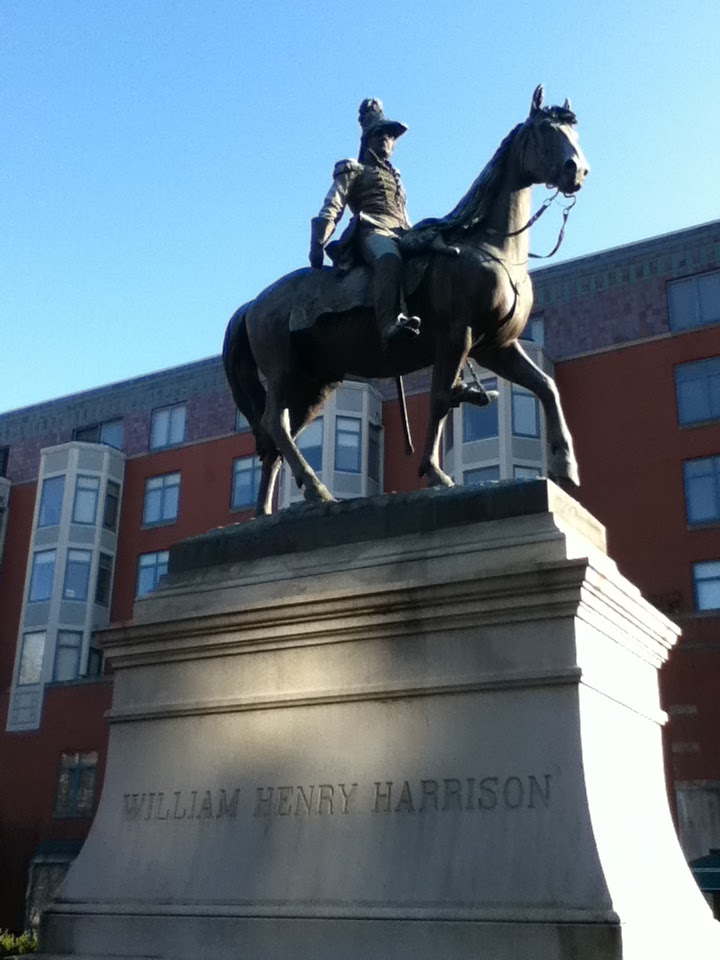
General Harrison statue
in Cincinnati
1812 - The Siege of Fort Wayne began in the Indiana Territory on September 5th led by Potawatomi and Miami Indians. Future 9th President General William Henry Harrison's Kentucky militia from Newport Barracks (across the Ohio River from Cincinnati) joined Ohio militia on September 8th and arrived at the fort September 12th. Known in advance of the approaching superior force the Indians led by Chief Winimac abandoned their attack.
Although born in Virginia and Governor of the Indiana Territory, Harrison would adopt Ohio as his home state, serving in various Ohio political offices and residing in North Bend OH when he became President. I've probably written more blog posts about Harrison than any sane person ever would. Here is a short one to match his brief Presidency.

1812 - Hey what do you know, another WHH entry!...On September 17th William Henry Harrison is made Major General of the US Regular Army by President Madison. Harrison would later defend Ohio from Indian and British advances by building Fort Meigs near Toledo in the War of 1812.

Hendricks is the only VP on US money
1819 - One of three Ohio born US Vice Presidents, Thomas A. Hendricks, 1st VP under Grover Cleveland was born on September 7th in Muskingum County OH. Having spent most of his life as a Hoosier and served as its 16th Governor, he ran with Indiana as his home state in the 1884 election. Hendricks is the only VP whose portrait appears on US paper currency, the $10 silver certificate of 1886. Hendricks died unexpectedly in his sleep just 8 months after being sworn in as Vice President in 1885.

grade school book
about Woodhull
1838 - Suffragette Victoria Woodhull is born September 23rd in Homer OH. Who? In 1872 she was the first woman to run for President and she couldn't even vote for herself. It wasn't just because she was a woman, but she was also in jail on election day. Oh, and black abolitionist Frederick Douglass was named as her running mate by her Equal Rights Party. One problem. Douglass was, in fact, supporting Grant. There’s also no record of how many votes the Woodhull/Douglass ticket received because they apparently weren't even counted. As you can deduce, this Presidential run was more of a protest.

I have to admit I didn't know much about Hendricks or Woodhull before researching for this post. I definitely would like to read more about Woodhull. Notorious Victoria by Mary Gabriel is on my Goodreads to do list.

I have several blog posts about the next four items which are linked in the text.

1855 - Illinois lawyer Abraham Lincoln Rudely was rudely greeted in Cincinnati on September 20th. One of the impolite greeters was Steubenville OH born Edwin Stanton who would later become Secretary of War seven years later under President Lincoln during the Civil War. Politics makes strange bedfellows they say. Upon Lincoln’s death in 1865, it was Stanton who tearfully said the famous words “Now he belongs to the ages.” 

Taft birthplace in Cincinnati
1857 - Speaking of Cincinnati, 27th  President William Howard Taft was born September 15th in the suburb Mt Auburn. Taft would finish his term unlike many Ohio Presidents, but not get re-elected to a second one mainly due to a public dispute with Teddy Roosevelt. He was the only former POTUS to become a member of the SCOTUS.
Random thought: If Hillary Clinton becomes President in 2016, she will have become the first FLOTUS to become POTUS. Bill would become the first...FGOTUS? Anyway...

Garfield Tomb in Cleveland
1880 - Arriving in San Francisco by train on September 8th, 19th US President Rutherford B. Hayes became the first US President to visit the West Coast while in office. I never had a whole post about Hayes but he gets a mention here. This is the only Ohio President who I've never visited the birthplace or grave site. I understand his Delaware OH birthplace is now the site of a BP gas station. At least there is a plaque. The more substantial Hayes Presidential Center and grave is on my Ohio bucket list. Hayes was also Ohio's 29th and 32nd Governor.

1881 - On September 19th, Moreland Hills OH born 20th President James Garfield succumbed to his bad doctors one excruciating month after an attempted assassination. I recommend reading the riveting Destiny of the Republic by Candace Millard which is all about that. It's a great book and one of my favorites. I've read it twice!

McKinley Tomb in Canton

1901 - Well we made it to the 20th century! Just 20 years after Garfield, on September 14th, 25th US President William McKinley died after being shot by an assassin eight days earlier in Buffalo NY while headed to Cleveland. McKinley was born in Niles OH and spent most of his life in Canton where his tomb is. He was the 39th governor of Ohio from 1892 to 1896. Rutherford B Hayes was McKinley's commanding officer during the Civil War in the 23rd Ohio Regiment and were both at the Battle of Antietam on September 17, 1862. For more on McKinley's assassination, I recommend The President and the Assassin by Scott Miller.


Friday, February 5, 2016

Ohio - Birthplace of Motion Picture

Today we celebrate the great Ohioan who invented motion picture on this date in history 1861! Thomas Alva Edison of Milan OH...right?
Sorry. Nope. Edison was 14 in 1861. Tom did his thing 30 years later. 

Samuel D. Goodale
I'm talking about Samuel D. Goodale of Cincinnati OH! 

Most folks tend to think of inventions as having a sole inventor. We envision an eccentric man with crazy hair doing experiments who finally has the "eureka" moment. He unveils it to the world. Fame and fortune result! Conventional wisdom states that the Wright Brothers invented the airplane. Edison invented the light bulb. Marconi invented the radio. Doc Brown invented time travel. Right? OK, maybe that last one is a movie stereotype and partly why we believe these things.

As usual, the story is not so simple. Typically what happens is the world hits a technological zeitgeist. Let's take a quick look at the development of the airplane as an example. The invention and popularity of the safety bicycle was instrumental in funding the bicycle shop owning Wright Brothers research. It furthered their ability to control their glider too. If a light enough internal combustion engine had not been invented, the Wrights never could have powered that glider. Ergo, no controlled powered flight by the Wrights. Dayton Ohio would have had to come up with different people to name everything after. The fact is the person who gets the credit is usually the one who patents the invention and makes it commercially viable. People didn't even believe the Wright Brothers claims at first. The Dayton news didn't report on it in 1903. After more tinkering, Orville and Wilbur patented their "flying machine" in 1906 three years after Kitty Hawk. This resulted in a patent war with competitors and there were many lawsuits. Someone even joked that if a person jumped in the air and waved his arms, the Wrights would sue. 
Goodale's 1861 Stereoscope patent

If you Google "who invented motion picture", you will get various results. Thomas Edison, Louis Lumiere, or Eadweard Muybridge, all top out the list from the late 19th century. These men certainly made their contributions but they built on the work of now forgotten pioneers.
Decades earlier, as the US Civil War was beginning and as photography was being perfected and optics were getting better, several different inventors experimented with viewers or scopes that provided an individual photographic "peep show" of simulated motion.
The first patent, US #31,310, for one of these "moving picture" devices was granted on February 5th, 1861 to a Cincinnati inventor named Samuel D. Goodale. He called his invention a Stereoscope, the crank-driven machine that used flickering photographic cards to simulate motion to a single viewer. This was just one of many similar devices patented around that time. I suppose there was a patent war going on here too because Coleman Sellers' device, called the Kinematoscope, was patented 47 numbers later the very same day as US #31,357. Sellers, who tends to get more credit in this history, also lived in Cincinnati in the 1850s before moving to Philadelphia. Sellers and Goodale had to of known of each others work, right? Hmm. Was this perhaps the VHS vs Betamax War of the era?

Edison's 1895 Kinetoscope
looks like Goodale's
Stereoscope and named
similar to Sellers'
Kinematoscope. Hmm.
Nine years later, in 1870 on...February 5th (remember Goodale and Sellers?) in Philadelphia (remember Sellers, again?), inventor Henry Heyl demonstrated his Phasmatrope (what a great name). 1,500 theatergoers were treated to the sight of Heyl and his niece dancing on a big screen as a 40-piece orchestra accompanied the moving images with a waltz. I'd like to think the February 5th date was planned as a nod to Goodale and/or Sellers but it's likely happenstance. Inventors generally don't like to share credit.

Now granted, it varies on what one might consider a "motion picture". Magic lanterns and novelty toys that gave the illusion of motion to the viewer were in use as early as the 17th century but it was photography that kicked things into gear. The point here is to illustrate that no single person invented the "motion picture". It was a process and some inventors simply got left out of the narrative altogether. So, let's settle the timeline a bit:

1861 - Goodale's Stereoscope (& Sellers' Kinematoscope) is patented.
1870 - Heyl's Phasmatrope debuts to the public (patented in 1867).
1878 - Muybridge's famous "A Horse in Motion" is shown with his Zoopraxiscope.
1891 - Edison's Kinetoscope is demonstrated (not patented until 1897).
1895 - Lumiere's Cinematographe is patented and shows a film to the public.

Did you notice that a generation and a half separate Goodale from Edison? One thing is true. The names of those things are just awesome. Phasmatrope? Zoopraxiscope? That's good stuff. Edison is known to have begun working on motion pictures after seeing a lecture by Eadweard Muybridge who no doubt knew of the others. Like the Wright's, Thomas Edison filed many infringement lawsuits against his competitors in the late 19th century. The courts ruled he had an unfair monopoly. By 1918 Edison abandoned his involvement with motion picture. 

And what of Samuel D. Goodale? I can't even find a photo of him or his invention, just the patent drawing. He barely gets a mention, or he is left out entirely of the history of cinema altogether. He doesn't get a Wikipedia entry. 
1876 toy pistol patent
But I believe I cracked the Goodale case just a little. 
I found a reference to a "Samuel Dexter Goodale" born in Massachusetts on May 11th, 1817. Samuel Dexter Goodale was also granted a toy pistol patent in February 1876 while living in Du Quoin IL. He is listed as "Samuel D.Goodale" in another patent publication for the toy pistol. 
According to the OCR text of the Sunday, April 6, 1884, Cincinnati Enquirer a "Samuel D. Goodale" died in Du Quoin IL in 1884. The obituary mentions an event in Texas (which seceded Feb 1 1861): "during the early part of the war he had a personal encounter with a Texan, growing out of a political discussion, which resulted in his receiving a wound in the leg. As soon as he was able to walk he returned to Cincinnati, and engaged in business here as an optician until he retired a few years ago from active pursuits, and went to Du Quoin to live. The paralysis which caused his death was ascribed to the wound in his leg." This S.D.G. was moved to Spring Grove Cemetery in Cincinnati by his family in 1918. Records there confirm his cause of death as "paralysis - effect of a gun shot wound". Are these two Samuel D. Goodale's one in the same? The name, age, years, locations, and occupations certainly seem to suggest this. Perhaps his injury and resulting paralysis in the early 1860s is why his legacy faded. Also noteworthy is that the infamous Cincinnati Courthouse Riots occurred in late March 1884, a week before Goodale's death. The Hamilton County Courthouse and all of its important records were burned in that event. Cincinnati lost a lot of history that day.

artist rendering of a wound up Texan
Nevertheless, we do know a Cincinnatian named Samuel D. Goodale is an unsung pioneer in the development of motion pictures. He just didn't get any of the glory thanks to Edison and possibly a wound up Texan with a real pistol.

Friday, October 30, 2015

The Darke County Poorhouse Cemetery

The original infirmary c.1868
when Annie Oakley was a resident
The Darke County Infirmary opened in 1854. It was one of the many 19th century Ohio poorhouses that took care of the destitute (or just their children), mentally ill, and elderly. Residents were referred to as "paupers" in the register. Sometimes parents under financial burdens would send their children to places like this. Eight-year-old Ohioan Annie Oakley was sent to this infirmary by her widowed Mother and lived there for 2 years in the 1860's until she was hired out by a family to do chores. Annie never got paid by the abusive family and ran away. She returned to the home and was eventually reunited with her Mother by age 12. It's hard to imagine a life like that.
the second infirmary, from a 1915 postcard
The original infirmary building was struck by lightning on June 2, 1897. It burned to the ground and another one was built. It also was hit by lightning and burned. Since 1978 another Darke County Home still operates as a modern nursing facility. To my knowledge, it has not been struck by lightning.

The county home also had its own cemetery located to the east of the intersection of US-127 and OH-49 outside Greenville OH.

Most of the marble markers in the infirmary cemetery have no names, just numbers. I guess that cost extra and this was the poorhouse after all. There are records online that list the names and dates of the deceased although several are still listed as "unknown". Many of the markers with names seem to have been military veterans or recent burials. There are at least eight Civil War veterans and one WWII veteran interred in the cemetery. It's kind of sad knowing that some of our nation's veterans ended up in a place like this, alone or too ill to care for themselves.

When I was in the area geocaching on October 22, 2011, grave No. 26 happened to catch my eye since it was also marked with a name. James Perry was a Private in the 7th Independent Company, Ohio Sharpshooters mustered in on January 27, 1863, at Camp Cleveland, OH in the US Civil War. Records show he likely fought in the Battle of Atlanta, Peachtree Creek, and Kennesaw Mountain. Perry was buried here in 1917 at the age of 75.


But wait, there's more!

This post was originally going to end there. Then I learned a few sad stories as I looked through the online records.

George Henry Davis has several aliases listed. He was killed in 1936 during his attempted poolroom holdup in Greenville. His occupation is listed as "robber" and cause of death, "justifiable homicide". He was identified by fingerprints and was buried under marker number 104 which is now gone. It's almost as if he never existed.

unmarked, numbered gravestone
Katie Melissa McNutt was born at the home in 1911 and died 22 days later. Several members of the McNutt family are buried here.

Grave no. 139 is listed as "unknown". This was a child found in a ditch east of Castine OH in 1947.

Partheria Mullen lived at the home for 6 years. She died in 1909 at age 46 due to "softening of the brain". I had to Google that one. I think it is an archaic term they used for senile dementia caused by a cerebral hemorrhage. She was just left and forgotten. The records state that no one ever visited her during her stay.

But possibly the most tragic of all is the story of the Jane Doe buried here.
A nude body was discovered on October 11, 1970, in a cornfield in nearby Arcanum OH. The condition of the body was so bad that photos or fingerprints could not make a match to anyone. The identity of this young woman remained unsolved for 39 years. In 2009 DNA testing revealed this to be Jeanne Marie Melville, an 18-year-old missing person from Green Bay WI. Sadly, Jeanne's mother died the year before, never knowing what happened to her daughter. The murder case itself is still unsolved. Use the links for more info. It breaks my heart to look at this young woman's photo.

I'm not sure if this place is haunted, but it should be.

other sources:
- Records of the Darke County Infirmary
- Asylumprojects.org 
- Annie Oakley: Darke county’s favorite daughter
- Darke County Home Cemetery (more photos)
- This Dark County

Sunday, September 20, 2015

The 180 Pound Gorilla

beardless lanky Ape-raham in Lytle Park, Cincinnati
We have notions that our beloved leaders from the past were always admired. We tend to think that gentleman in ye olde days were more civil and less obnoxious than we are now with all the screaming and yelling on cable news shows. It's kind of always been that way.

In 1855 a young patent lawyer was hired to hear an infringement case in Illinois on a new reaper that was about to revolutionize farming. The trial was moved to Cincinnati so the young lawyer and former Congressman traveled there to meet with the new team. On this day in 1855, he was met by one of the most prominent attorneys of the day named Edwin Stanton. As you may have guessed by now, the visiting lawyer was Abraham Lincoln. He was treated rudely and dismissively by members of his own team. Stanton was unimpressed and regarded Lincoln as an ill-schooled rube and called him a "long-armed ape". He went on to remark that Lincoln was a “long, lank creature from Illinois, wearing a dirty linen duster for a coat and the back of which perspiration had splotched with wide stains that resembled a map of the continent.” At least the insults then were more eloquent. Lincoln was shut out of the proceedings. They wouldn't even read his brief. With nothing to do,  Abraham Lincoln spent most of his time touring Cincinnati. His team won the case and he was paid but he tried to return the fee since he hadn't really done anything.  He ended up accepting half of the fee which he then split with his partner in Illinois. Lincoln admitted he did not enjoy his stay in Cincinnati.

a long way in 10 years
Lincoln, of course, went on to become the 16th President of the United States overseeing a critical point in US history. Who did he choose for Secretary of War as the Civil War got underway? The man who snubbed and insulted him seven years prior but who Lincoln felt was best suited for the job, Edwin Stanton. They sometimes remained at odds but Stanton eventually became one of Lincoln's closest friends and advisors. Upon Lincoln’s death in 1865, it was Stanton who tearfully said the famous words “Now he belongs to the ages.” 

sources: 
- Lincoln’s lousy week in Cincinnati
- Lincoln in Ohio

Friday, August 21, 2015

Little Phil

Sheridan in his Civil War prime
History is full of great people who did wonderful things but flawed in other ways. I sometimes wonder how Washington, Jefferson, Lincoln, FDR, etc would fair in today's hyper-critical sound bite world. The Founding Fathers kicked the slavery issue down the road, Lincoln was called a tyrant by half the country, FDR ordered internment camps for the Japanese-Americans. Imagine if they had Twitter or cable news then. Those were different times we always say. Future generations will no doubt say the same thing about us.

I never know what to think of guys like General Philip Henry Sheridan.  He certainly isn't a Jefferson or FDR but he was a major figure in preserving the Union during the Civil War which also ended the institution of slavery. That in itself is a noble thing. But he isn't really remembered for that so much. With the Union intact, the US looked again to the West. Sheridan and his peers resumed American expansionism with the exploitation and near genocide of the indigenous people of America. He is mostly remembered for an infamous (mis)quote "the only good Indian is a dead Indian."

Sheridan Monument in Somerset OH
March 6th, 1831 is considered to be Philip Henry Sheridan's birthday and I meant to post something on that day. 2015 is also the 150th anniversary of the end of the American Civil War. I had thought Sheridan was born in Ohio which is why I decided to write up something about him. In history, even the simplest things can be quite murky.

It turns out Sheridan, who earned his "Little Phil" nickname from his 5'5" stature, either didn't know where he was born or lied about it because he had early Presidential aspirations. He is on the record as saying Somerset OH at one point, Albany NY another time, and even Massachusetts. In all likelihood, he was born in Ireland or possibly on the ship from Ireland to the US. The dates of his parent's immigration seem to suggest this. The city of Somerset OH claimed him as early as 1888 and erected a statue of him in 1905. The memorial is the only Civil War equestrian statue in Ohio. His Mother is also on Team Somerset but said his birth certificate was burned in a fire. Convenient. We do know he spent his early childhood there. For the record, Albany NY claims him as well. For more on all this check out this link with telegrams and articles from February 1888.

During the Plains Indian Wars in the last half of the 19th century, they had a tough time determining a friendly or a "good" Indian vs a hostile or "bad" Indian. Some "good" Indians assisted Americans soldiers as scouts and provided intelligence on other Indians. It got complicated. Some bands or individuals within the same tribes had differing allegiances. To most Americans on the Plains, there was no distinction. "The only good Indian is a dead Indian."

The original "dead Indian" story has Comanche Chief Tosahwi identifying himself to Sheridan in 1869 at Fort Cobb in present-day Oklahoma as a "good" Indian meaning he was cooperative and not hostile to US goals. Sheridan supposedly replied,  "The only good Indians I ever saw were dead." Sheridan denies he ever said such a thing.

Post Civil War diplomacy in the 1860s and 1870s seemed to be shoot first and...who the hell cares about asking any questions, just shoot! Entire villages, women and children too, could be easily mowed down by the new automatic Hotchkiss guns. Keep in mind, many whites at that time considered Indians as an inferior savage race. Even good old George Washington stated a hundred years prior “Indians and wolves are both beasts of prey, tho’ they differ in shape". Dee Brown's "Bury My Heart at Wounded Knee," tells the 1867 account of Colonel Maynadier and a local "good" Indian named Spotted Tail. He was shocked to see Spotted Tail cry upon hearing the news of his daughter's death. The Colonel was raised to believe Indians didn't really have human emotions like whites.

Little Big Phil Sheridan in 1876
Several witnesses claim Sheridan did make his remark in some form. If true, given the climate of the time, I'm not sure why he would deny it. Some have argued that the "dead Indian" statement was a message of regret and not an insult. Supposedly opponents of the General changed it to the infamous quote to smear Phil politically. I don't know about that. While not as catchy as the dead Indian statement, he is known to have said, "If a village is attacked and women and children killed, the responsibility is not with the soldiers but with the people whose crimes necessitated the attack." In essence, "kill em all, let God sort em out."
So, if he denied the quote why wasn't he taking credit and bragging rights? Or for that matter, if it was a statement of regret, why not just say that? No one seems to know. The General died in August 1888 from heart failure at the age of 57. Ironic, right?  If he ever wrote about it we'll never know. His personal papers were burned in the 1871 Chicago Fire. I assume this was the same fire that destroyed his birth certificate.
I suppose it makes no difference if he said it or not. While the quote is apocryphal it certainly embodied the spirit of his attitude and the general American outlook in the late 19th century. At the end of the day, even though his name and image adorn towns, counties, tanks, mountains, stamps and old bank notes, the "quote" will always be his legacy.
Happy late belated birthday. I guess.

other sources:
Philip Henry Sheridan at PBS.org
Philip Sheridan at History.com
Colonial Williamsburg - The Indian War

Collection of 1888 articles & telegrams claiming and disputing Sheridans birthplace

Monday, January 5, 2015

Finney & Sprong - Forgotten Pioneers, Forgotten Cemetery


The first Gehio post of 2015! I'll try to get some more non-cemetery traditional posts together for the new year so this doesn't turn into just a graveyard blog! Eh. Mebbe.

Finneytown OH was founded by Ebenezer Ward Finney and his son-in-law David Sprong in 1798. The area of land had been acquired by their families after the Revolutionary War from John Cleves Symmes.  Personally, I wish they called it Sprongtown! I do like the sound of that! "Finney & Sprong" also sounds like a fine bluegrass duo.

Pvts. Finney and Sprong are buried in what is now a hidden little cemetery that's had several names over the years. The Old Wesleyan or Old Finneytown Cemetery was also known as Winton Ridge Lane Cemetery and God's Half Acre Cemetery. Ironically, per Google Maps, the 1802 cemetery sits just outside the border of Finneytown in what is now College Hill.
The six foot tall by fifty-foot wide mound in the center is a c.800 BCE Adena Indian burial mound. Seen in the last two photo, next to the graveyard, is the top of the immense 1930s era  Winton Road Water Reservoir. I believe it is unused now but I wasn't able to find additional information.  You can clearly see it in the overhead and street view maps in the link above. If anyone knows anything more about the reservoir I'd love to know! I'd hate to see it torn down. Maybe it can be a skate park!

For a great deal of time, no one knew who owned the old cemetery and as a consequence became overgrown and run down. This actually happens quite a bit. It is especially sad here not only because the founders of the community are buried here but also because 59 other early settlers and several veterans of the Revolutionary War and the War of 1812 vets are interred here as well. Then, of course, there are the prehistoric Adena Indians buried in the mound. So much history in this half acre!

Finney and Sprong with their consorts
In 1935, President Roosevelt started the Work Project Administration or WPA to create jobs during the Great Depression. By then many old cemeteries, especially veteran cemeteries, were in sorry shape due to neglect. One WPA project was to record all the graves nationwide of those who served in all the US wars up until then. This cemetery and its occupants were recorded at that time along with the "old Indian Mound". I have a feeling that this place would have been lost forever without the WPAs involvement.

Since it still had no official caretaker or owner, the burial ground was pretty much forgotten about again for 50 more years.
In 1982, the Adena mound was rediscovered and partially excavated, but then was once again forgotten. We never seem to learn, do we?

Over the years, such as in 1995 and 2004 Boy Scouts and other civic groups have cleaned up the cemetery grounds. They have replaced or fixed some of the stones and even rededicated it.

the grounds with the Indian mound
and the reservoir to the right
Unfortunately, in early 2009 the grounds became associated with a heinous crime. The burned body of murdered teenager Esme Kenney was found near here.

The current state of the grounds seems to depend on when you visit as it relies on volunteer help. I had been here on two occasions in the last several years. On one visit it was nearly impossible to see the mound because the weeds were so high. By the second visit, I could clearly see the mound and the gravestones.
I don't believe in curses and am not typically creeped out by graveyards. However, seeing this mostly rundown cemetery with its nearly forgotten pioneers and ancient people, resting in the shadow of the hulking unused reservoir and then knowing about the horrible crime here certainly gave me pause and a major case of the willies.

Special thanks to the Prell Geneology Website for all the research of this property! Update 2022: the Prell website is gone but I found a copy from 2013 in the Wayback Machine…  https://web.archive.org/web/20131028111827/http://members.nuvox.net/~zt.jprell/

Sources:
- FindAGrave
- History of Finneytown 
- 2012 Cincinnati Enquirer article 
- Genealogical information and article on the cemetery re-dedication. (Includes maps,photos and archaeological information by a descendant of Finney and Sprong.)

Monday, December 1, 2014

Pvt. Issac F. Cosbey - Typos and Typhoid


“We must disenthrall ourselves, and then we shall save our country. Fellow-citizens, we cannot escape history.....In giving freedom to the slave we assure freedom to the free--honorable alike in what we give and what we preserve. We shall nobly save or meanly lose the last best hope of earth.” 
- Abraham Lincoln's State of the Union message December 1st, 1862

While geocaching I see the graves of many soldiers. This one caught my eye since a new plaque was placed in front of it and I noticed that Pvt. Issac F. Cosbey died during the Civil War. Many times the soldiers that died during the Civil War were buried near where they died, typically far from Ohio, so this one seemed unusual.

Researching Private Cosbey was difficult at first. I thought he was in the 82nd because it says so on the newer plaque but I wasn't coming up with much.


The older original stone reads:
PVT CO A, 83rd REG OHIO INFANTRY CIVIL WAR
Aged 19y, 4m, & 8d
Died in the service of his country at Memphis, Tennessee.

The newer marker reads:
PVT CO A 82 REGT OHIO INF

The 83rd Regiment Ohio Volunteer Infantry roster shows that an Isaac E Crosby age 18, was a member of the 83rd Co A. Issac entered the service on August 13th, 1862 and died on December 1st, 1862 at a hospital in Memphis TN. It then states Issac T Cosby as the name in the hospital. Aside from some typos on the middle initial and last name, this all seemed to fit.

I did some more checking on the 83rds movements to make sure things matched up.
Camp Dennison, six miles East of the grave
The 83rd was made up of seven companies and organized at Camp Dennison near Cincinnati OH August - September 1862. The 83rd left Camp Dennison September 3rd for the Defense of Cincinnati. After relocating to support other units and participating in minor skirmishes the 83rd was moved via the Ohio and Mississippi Rivers from Louisville KY to Memphis TN on November 23, 1862. Since Issac died December 1st, this fits in well with his whereabouts at the time of his death in Memphis. I have to assume at this point that the "82nd" in the newer plaque is a mistake since none of the 82nd history matched up with Issac.

So here we have this kid who volunteers for the Union cause, doesn't really take on any action, likely acquired some awful disease like dysentery or typhoid while being transported on the river journey and then died 110 days after joining up. His fate was not the exception either. The reality is 2/3rds of casualties in the Civil War were due to disease instead of glorious movie-like battle. In fact, during the 83rds service, 56 men died in battle while 163 men died of disease or accidents. A reminder of the grim reality of war in those older times.

sources:
Sycamore Township Memorial Cemetery
FindAGrave
83rd Regiment Ohio Infantry History


Friday, August 29, 2014

Confederate Spies in Kentucky

On March 12th, 2012 near Mentor KY in Campbell County, while geocaching I ran into something I never see in SW Ohio, the grave of a Confederate Officer.

Confederate officer Lt. Thomas Jefferson McGraw was arrested by Union troops as a spy for actively recruiting men in KY for the Confederate Army. He was taken to Cincinnati on April 23, 1863, tried and found guilty. He expected to be taken as POW but was instead sent to Johnsons Island on Lake Erie for execution on May 15th, 1863. Abraham Lincoln himself rejected a family plea for a pardon. McGraw was blindfolded and sat on the edge of his coffin so that the gunfire would push him back into the coffin for easy disposal. McGraw's body was then returned and buried at Flagg Spring Cemetery in Kentucky.
The monument here was placed by the United Daughters of the Confederacy in 1914.


sources:
- FindaGrave.com
- KnowSouthernHistory.com

Tuesday, November 19, 2013

Garfield & Friends

beginning
 James Abram Garfield, was born on this day November 19th 1831 in Moreland Hills, Ohio, near Cleveland. He rose from abject poverty, by a widowed Mother, worked as a janitor to attend college and became our nations 20th US President. He was shot in 1881 four months into his first term and died two months later from the treatment of his wounds ending up with the second shortest US Presidency and the second US president to die in office. That's usually all anyone knows about him.

Like William Henry Harrison, his legacy will mostly be his death, a mere footnote in history, one for the trivia games. That's too bad as he was a remarkable man. A Civil War veteran, a preacher and highly educated, it was said that Garfield could "write Greek with one hand while writing Latin with the other."  If it weren't for a rotten political system and a lunatic with a gun you probably would know more about him.

It turns out Garfield wasn't even planning on running for President. The 1880 Republican Convention was split into 2 factions, the Half-Breed moderate faction wanted James G. Blaine, while the Stalwart conservative faction supported an unprecedented third term for former President U.S. Grant. Garfield gave a speech nominating an alternate Half-Breed candidate John Sherman. Because of the splits in the party, no one was getting the required number of votes in the nomination process. After 35 voting rounds, Blaine and his supporters along with Sherman and his supporters decided to band together and nominate a compromise candidate, James A. Garfield, a Major General Civil War veteran and nine-term Congressman from Ohio who eventually would go on to win the 1880 election. To make peace within the party, a Stalwart, Chester Arthur was nominated as VP.

middle
In the 19th century, it was common practice for government office seekers to seek jobs via the Spoils System whereby the President would hire people based on their political and personal relationships and little or no regard to qualifications. Basically with no oversight whatsoever, if you were a big supporter or a family member you would likely get a cushy job. The system was rife with corruption and incompetence. People would line up by the dozens to beg for jobs at the White House which consumed much of the Presidents time. Garfield dreaded it and thought that should change.

Charles J. Guiteau, a Stalwart, was one of these office seekers who initially supported Grant but then switched to Garfield and somehow had the grand illusion that he was a major reason for Garfield's election. He felt he was owed a political appointment and became furious when he was rejected. Guiteau purchased a revolver and began stalking the President with the intention of killing him so the Stalwart VP could become President. But let's be clear, most of the folks that encountered him including his own family found him to be a bit a loon. In fact, the free love commune he belonged to in the 1860s found him quite annoying. They called him Charles Git Out. True story.

On July 2, 1881, Guiteau got his chance and shot Garfield twice in the abdomen on a train platform in Washington DC. He was quickly apprehended as he attempted no escape and shouted, "I am a Stalwart of the Stalwarts. .. Arthur is president now!". Oddly, Guiteau later wrote Arthur and demanded a pardon and a job. He was eventually hanged.

end
Garfield was severely wounded but modern doctors speculate he would have survived if they just left him alone. It was fairly normal after the Civil War for men to be walking around with a slug somewhere in their body.  Erroneously thinking the bullet may be near a vital organ (it really wasn't), the American doctors who had not yet adopted Joseph Lister's new antiseptic techniques being practiced in Europe subjected him to much prodding and poking with unsterilized equipment and fingers which eventually led to multiple infections and then his death on September 19th 1881. The use of antiseptics was quickly accepted by American doctors after this event.

We will never know what would have been but as far as I can tell he may have been one of the most honest and incorruptible men that held the office of the Presidency. Or maybe corruption would have found him. It seems to happen to most people of power. Ironically one of his lasting legacies was his initiative for Civil Service reform which would away with the Spoils System, the very system that contributed to his death. It was that assassination by the disgruntled office seeker that eventually led to President Chester Arthur signing the bi-partisan Pendleton Civil Service Reform Act which handed out appointments based on merit rather than privilege or political party.

Another part of his legacy will be his support of civil rights by supporting education for black southerners and appointing several African-Americans including Frederick Douglas (who as a US Marshall also presided over the inauguration of Garfield) to government positions.

Garfield was laid to rest in in Cleveland Ohio's Lakeview Cemetery.

Here is a fun fact: Abraham Lincoln's son Robert Todd Lincoln was present for three Presidential shootings. He witnessed his father's assassination in 1865. Then as a cabinet member, he was present during Garfield's shooting. He also witnessed the murder of President McKinley 20 years later. Strange.

For more information on Garfield, especially surrounding his assassination and death I highly recommend  "Destiny of the Republic" by Candace Millard, a 2012 bestseller that got rave reviews. It is a highly engaging narrative account that reads like a novel. I was actually kind of shocked at how fun this book was to read.

6/13/2014 Update: A documentary based on Destiny of the Republic is scheduled to be aired on PBS in February 2015