Showing posts with label US Presidents. Show all posts

Friday, May 25, 2018

Oxbows, Books, and Geocaches

This update has all the things that named my blog  "Gehio", Geocaching+History+Ohio

Thanks to the person who got me into geocaching, Mark Fischer, I was invited to speak at the Oxbow Tuesday Lecture on October 9th to discuss a local history subject of my choosing. The Oxbow is a wildlife conservation group in SE Indiana. Mark recently did a lecture on Geocaching which I attended. My name got mentioned as a local early area history expert for possible upcoming topics.  I haven’t firmed up my material yet but it will be in some way shape or form about William Henry Harrison regarding some myths and legends about his life and ties to the area. I'm going to have to brush up on some public speaking skills!

My reading has slowed down as the weather warmed up. I typically read on my lunch breaks and to be honest there have been lots of new geocaches near my office, so I’ve been indulging in that instead. I’m currently about 3/4 into an interesting book from the 1980s on Tekamthi called God Gave Us This Country. I ran across it by accident at the library.  Who the hell is Tekamthi??? The author insists on using what is believed to be Tecumseh’s Shawnee name before it became anglicized. The Shawnee language is actually a bit lispy and European speakers would remove this from the pronunciation as being somewhat effeminate. Ironic since the Shawnee were pretty fierce. One thing that is a bit jarring is the author insists on using the term “reds” and “red men” throughout the book. These are terms all considered dated and a bit derogatory to modern ears. Otherwise, despite the terrible cover and title, it’s a great read and well-sourced book that was previously unknown to me. In fact, I went ahead and bought a copy of my own just for the source notes. I've already made note of some Harrison info I wasn't aware of that will come in handy for the aforementioned lecture.

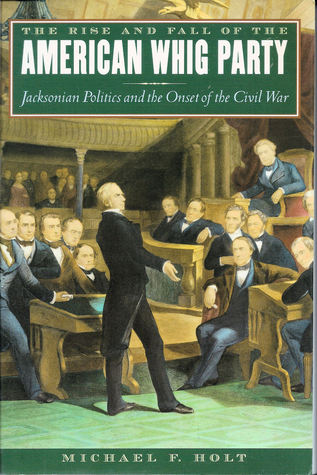
On my to-do list is another book I recently became aware of called The Rise and Fall of the American Whig Party: Jacksonian Politics and the Onset of the Civil War. I guess it could be titled “Everything You’ve Always Wanted to Know About the Whigs But Were Afraid To Ask”. It’s 1300 pages! Oh, and the print is tiny. At the rate I read it may take me as long as the Whig party existed to finish it. So far, everyone I know that has this book never read the whole thing. Regardless, this doorstop will at least serve well as reference material. Oh and a tip to used book buyers.

I also picked up an interesting old title called The Intimate Letters of John Cleves Symmes and His Family. I've seen reference to this early 20th-century book many times where Cleves is mentioned. Don't get too excited. These aren't like the Harding letters. "Intimate" in this case just means "personal". No extensive bio of this important man to the history of the Ohio Valley exists due to most of his letters and journals being burned in a fire. Some say it was arson. There were many lawsuits against the man due to his questionable land business dealings.  The letters that do exist were compiled here from some of his recipient's collections that survived. It sort of humanizes a person that tends to be just a static character in the story of others without any idea of his personal thoughts. One weird thing I learned. Cleves kept referring to a daughter he called "Nancy". He only had one daughter named "Anna" (who married William Henry Harrison) so that was confusing. It turns out "Nancy" was originally a nickname for "Anna". I never knew that.
I got this and the Whigs Tecumseh from AbeBooks for just a few dollars each with free shipping. Ironically I've learned this has been owned by Amazon since 2008 but Amazon's used prices were very high for each of these. I'll be shopping there more often for good used book deals!


Speaking of geocaching, the reason so many new caches are getting published around town and my reading has slowed is that a major Geocaching event called GeoWoodstock 2018 will be held May 26th, 2018 at Coney Island in Cincinnati. This event is expected to bring over 5000 geocachers from all over the world. In fact, a geocacher from France contacted me about carpooling from their Airbnb since I have a cache near the event. I had to politely decline as I don’t really know my full schedule for that day, but I will be attending! How could I not be with "my people" that day?

In personal geocaching news, I'm currently sitting at find 6,408 and have had some interesting cache runs lately. Lot’s of new FTF’s (First To Finds), including a Wherigo (a first FTF of this type if you will). That makes FTF 101 for me. Mark Fisher and I hit not one or two, but three “tunnel” caches in so many weeks. These are caches where you go into a large drainage tunnel, usually with a flashlight. The photo to the left is (eventually) 400' into a tunnel and about that many feet below I-74. I used to be pretty adverse to doing these. In one of them, I was ankle deep in water. Those were some fun adventures!

See you in June!

Friday, February 9, 2018

Wishing (If I Had a Photograph of WHH)


not the 1841 photo or the 1850 copy you think it is
 For many years I was under the impression that William Henry Harrison was the first President to be photographed while in office. While this is true, all is not as it seems or what we have been led to believe.

I've been looking so long at these pictures of you
That I almost believe that they're real - The Cure

A daguerreotype (an early form of photography introduced in 1839) WAS in fact taken of the new President at the US Capitol on inauguration day March 4, 1841. According to the photographer Justus F. Moore, President Harrison was “delighted with the results.” We'll have to take his word on that since it was never seen again and no known copy exists. The image often implied and misreported to be an 1850 photographic copy of that lost image is likely a daguerreotype made by Albert Southworth of an oil portrait by Albert Gallatin Hoit that Harrison sat for in 1840.
One might wonder, perhaps the painting was done from the photo? Good question!...but according to a Salmon P Chase diary entry, Hoit (sometimes spelled Hoyt) traveled from Boston to North Bend OH in May 1840 to paint this portrait of Harrison, then a candidate for President, for the Boston Whig Association.

I have seen the digital version of the painting and the 1850 photo previously and while it occurred to me they are very similar it hadn't dawned on me that they are basically the same image. Everything seems to match up. The photo seems to be tilted a bit counterclockwise from the original. and the early crude photographic process adds some slight variances. Just like an Instagram filter, it also produces some shadowing and contrast changes which give the daguerreotype a more life-like three-dimensional appearance. It's no wonder this myth came to be. It looks very much like a photo and not a photo of a painting. Other engravings were also based on the painting such as this one.

Every picture tells a story, don't it? - Rod Stewart

the 1840 Hoit painting used for the photo 
I asked my new friend over at Harrison Podcast about the matter thinking I'd just been mistaken all along (can you believe there is a bigger Harrison fan than I?) and he was also unaware of any of this and is respectfully not completely convinced of my findings. He takes a much more measured and scholarly approach to such things and would like to examine this more before reaching a final conclusion, although I think I have him leaning my way. I respect his work and look forward to any new evidence and will report back as needed. However, for now, I feel that the visual evidence, as well as the dated journal entry by Chase, confirm my findings.
So alas, while Harrison does indeed get the honor to be the first President to be photographed in while in office, no one has seen it since 1841 and what we often see credited as an 1850 copy of that photo is an 1850 photo of an 1840 painting.

Sorry to break the news on William Henry Harrison' s 245th birthday, born on this day 1773. President's Day is on the 3rd Monday of February. Did you know only four US Presidents were born in February? Washington, Harrison, Lincoln, and Reagan.

In case you are wondering, the oldest surviving original photo of a sitting US President is that of James Polk from 1849. The oldest surviving photograph of a US President, recently discovered, is that of elderly John Quincy Adams taken in 1843, well after his time in office.

If I had a photograph of you
It's something to remind me
I wouldn't spend my life just wishing - Flock of Seagulls

A note about the images used. The daguerreotype was taken directly from the Metropolitan Museum of Art website and while slightly cropped by me to match the size of the painting is otherwise an untouched image. Retouched versions of this photo with the scratches and marks removed routinely appear online. 
The Hoit portrait image was taken from a general internet image search also resized and cropped by me for comparison purposes.  The original painting and image can be seen at the Smithsonian National Portrait Gallery


Saturday, September 30, 2017

Frosted Ohio Presidents

Never in my life did I think I would get excited about mid 20th-century frosted glass tumblers, but here I am blogging about it. Again. I now have several different sets of Ohio related drink-ware and I've posted about one them before. I learned from my previous research that Ohio was a leader in the glass industry from the late 1800's to the mid 20th century so there are many Ohio themed glasses from that period.

I started this next set of  "Presidents From Ohio" glass tumblers by picking up three of them for a good price at an antique mall several years ago. I've seen the rest on eBay but at $8-14 a piece plus several dollars for shipping that was going to set me back a bit to get the entire set of eight. I'm kind of a cheapskate. Another website had an incomplete set of 6 for $120. Ouch.

Thanks to the sharp eye of an old friend browsing at a local antique mall who sent up the Gehio signal (he texted me), yours truly is now the proud owner of an entire eight-piece set. The best part? Only $35!

This series was designed by Fran Taylor and produced by her company, Gay Fad Studios of Lancaster, OH which was open from 1945-1962. Fran obtained blank glassware from various Ohio manufacturers such as Hazel Atlas Glass in Zanesville and Federal Glass in Columbus. Another was Anchor Hocking which was a few doors down from Fran's Pierce Avenue studio. The blanks were then stenciled and hand-painted. Because I had duplicates, I compared them. I noticed that the coloring on the birthplaces is somewhat different. That makes each one is unique.

The 12-ounce frosted glass tumblers are 5" high with a rim diameter or 2-3/4". The front of each President’s glass features his portrait, a facsimile of his signature, and his years in office (or year of the month in W. H. Harrison's case) with “Presidents From Ohio” above, all in brown, while the back shows his birthplace* in brown with colorful accents. In all my research I've never been able to determine the exact year these were made. Perhaps the secret is contained within the two-volume 610 page book published in 2011, Gay Fad: Fran Taylor’s Extraordinary Legacy by Donna McGrady. At $150 that's too rich for my blood to find out. I'm not so much obsessed with Fran's entire impressive career and work as I am about this particular set of glasses. It would be nice to know how many were made since as I stated before, being hand painted, they are all slightly different.

*Since I am William Henry Harrison obsessed, I noticed that being a Virginian by birth, Harrison's is not a birthplace, but a home in Ohio when he was elected. However, he never lived in a home that looked like a log cabin. The same scene is used in grandson Ben Harrison's birthplace. Ben was born on William's farm in North Bend OH but it was more like a mansion. All the others seem pretty accurate.

I have a couple of other full Ohio related glassware sets to write about waiting in the wings, so look for that...

Friday, March 17, 2017

Presidential Profile Wax


The Ohio Irish Five
Happy St. Patrick's Day! Did you know that 22 U.S. Presidents had Irish roots? Five of them were from Ohio! More than any other state. I know what you are thinking though. You see Ben Harrison to the left and are wondering why William Henry isn't there. Ben was Irish on his Mothers side.
This concludes the Irish portion of the post. Feel free to use this trivia at your St. Patrick's Day shindig tonight.

Last Summer I became aware of a collection of 35 “Presidential Profiles” 7-inch vinyl 33 1/3 RPM records from 1966 that were released with their very own coin! This was very exciting.
Each one commemorates President’s Washington through Lyndon Johnson. Johnson was POTUS #36 but non-consecutive Grover Cleveland was included once. As he should be.
Being a fan of oddball Presidential items, I managed to score a set (minus the original medallions) for the low low price of $22.49. That was a pretty good buy since a single record seemed to be selling anywhere from $5 to $25. The pricier ones were usually sealed and contained the 1.25-inch high relief bronze medallion. Each coin has a profile of the President on the obverse and an eagle and the words “Presidential Commemorative Medallion” on the reverse. Still yearning for a sampling of the coins I found a lot of 12 being sold separately for $10.95. That would have to do. So $33 bucks overall and some change still wasn't bad.
For as many of these I found on eBay, there was very little information found online about them but I did manage to dig up some details.
William Henry Harrison reverse
These were given out to children as promotional items by savings and loan banks. I guess this was to get kids interested in opening savings accounts and making going to the bank with their parents exciting by studying Presidential history. It's hard to believe this didn't catch fire. "Get the new Beatles record or go to the bank with Mom?...hmmm"

The recently martyred Kennedy kicked off the series in April 1966 and then it's random batches, Jackson, B Harrison, Jefferson, JQ Adams, Grant, Tyler, etc. I suppose the release order was chosen to prevent a run on the "big" Presidents like Washington, Adams, Jefferson, etc. and then have a drop off for more obscure Presidents like Harrison, Tyler, Polk, etc. This went on until ending with the current LBJ in July 1966.

The records were released by a company named Kayson’s International Ltd. I can’t find much info on Kaysons but they seemed to be a Japanese based company that also sold china in the 1960s. This may have been the company's only foray into record distribution as I don’t see any other titles with their label other than this series.

The material itself was written by Walter C. Dallenbach (1937-2014) who later became the Southern California Press Secretary for Senator Eugene McCarthy in his '68 Presidential Campaign. He eventually broke into Hollywood and wrote scripts for hit shows such as Adam-12, Rockford Files, Law and Order. Based on the time-line, this stuff was probably some of Walter's first script writing.
bronze coins included with each record

The narration was done by the then well-known Art Baker (1898-1966) who appeared in over 40 films but was best remembered as the host of the 1950s television program "You Asked for It". It looks like Art died the year they were released making this his swan song.

The foldout sleeve includes important dates in the president’s life and while in office. Each record had an original color portrait of the President painted by Reynold Brown (1917-1991). Mr. Brown produced US Government posters during WWII and over 250 movie posters between1951 and 1970 such as Mutiny on the Bounty and Creature from the Black Lagoon. When you look at the posters you can definitely see that influence and style. Have a look at them all here.

I had to borrow a turntable to listen to them so I went ahead and converted them to MP3s while I did that. Now you can listen to them too! I wish I kept better notes along the way but hearing them was like stepping back in time to those old grade school documentaries. Overall the audio style was very atypical of their period with the lordly narration and corny music. I didn't denote any political bias of any particular President. One thing I jotted down in a scribbled note was the complete lack of any mention of Andrew Jackson's Indian Removal policy. Not a word.
Each track follows the same pattern where we eventually hear, as the subtitle suggests, each president "speak". Other than Art's narration no one is credited for the other voice work and we don't hear the actual President's voice until Hoover. The first President to be recorded was in fact  Benjamin Harrison in 1889. I imagine there wasn't enough material or good quality material until the 1920s.
1975 Bicentennial LP re-issue
There are a few mistakes in the liner notes. Again with Jackson, he was "Old Hickory" not "Old Rough and Ready", which was Zachary Taylor. Andrew Johnson is listed as a Republican. While Johnson was the VP for Republican Lincoln, Johnson was a Democrat. This was a choice to help ease tension with the South. That seemed like a pretty big mistake on both counts.

In researching I learned that the records were repackaged in 1975 as twelve LPs or cassettes (with no medallions) for the upcoming US 1776 Bicentennial with the tagline "American Revolution Bicentennial 1776-1976". Featured prominently on the originals, there is no mention of Art Baker on the 1975 LPs. That made me kind of sad to discover but I suppose they didn't want these 10-year-old records to seem so dated for a new generation. Kids must have wondered what happened to Nixon and Ford.
This was a fun little project. I always enjoy seeing how history was portrayed in other time periods. As I mentioned before, it was interesting that Jackson's Indian Removal policy was not mentioned in his legacy. This was 1966 after all. While some controversies were noted, these biographies do read, or rather listen, a bit like the safe naiveté of a pasteurized 1950s era textbook.
In case you missed the links above, listen to the MP3s here and view the full gallery here.


Saturday, December 10, 2016

Shuller's Wigwam


Shuller's Wigwam (originally called Shuller's Restaurant) was on the NE corner of Hamilton Avenue and North Bend Road in Cincinnati for 78 years from 1922-2000. Max Shuller, a Russian immigrant started the place in 1922 after a few years of selling food from a cart in Downtown Cincinnati.

People from the area have fond memories of the popular College Hill eatery and I found many articles but I was hard-pressed to find many good photos of Shuller's online.


I have a couple of memories of my own.
inside the Wigwam

I was very late to the scene but I remember bringing a date here in the mid-1980s as it was the fanciest place I could afford. I kind of wonder now how I even found the place as it was a pretty good distance from West Chester. At age 20 I wasn't hip to nice restaurants so I recall when they brought out the dessert tray, I picked something different than my date because I thought we were limited to the ones on the tray. We had a good laugh about that one. I don't recall thinking of this as an old place at the time.
In the late 1990s, I moved to the area and came here again a couple of times with family toward the end of Shuller's run. This time, 14 years later, I thought of it as very old-timey with dim lighting, dark wood, and Naugahyde seats. Almost museum-like. Something you just didn't see anymore. They had photos and newspaper clippings on the lobby walls from its golden era. At that point, it really seemed like a relic but the food was still pretty good. I was sad when I learned it was closing. One of my cousins visited again a few years later and asked if we could go back but it was closed by then.
Max's son Leo Shuller at the table in the 1960s lounge
Unfortunately, no one from the Shuller family wanted to take over the business in part due to dwindling crowds, aging clientèle, and new competition. The restaurant closed in 2000 and the building was razed in 2006. Mixed-use development of the property was promised then but fell through but brand new re-development is underway once again by the College Hill Community Urban Redevelopment Corporation. By this time next year, there should be new mixed-use buildings at this intersection. It's nice to see this area start to spring back after a period of decline.

1920s pre-wigwam original
So back to the Wigwam...and what's with the "wigwam" anyway?
The original 1922 building was added on to in 1932. The addition was shaped like a tee-pee and customers thought it looked like a wigwam, so it became Shuller's Wigwam and they just ran with the pseudo-American Indian theme. I wasn't able to locate any pictures of the tee-pee shaped building. There was another Shuller's Restaurant (and motel) on Reading Road in Roselawn in the 1940s. It's possible folks started calling the one on Hamilton Avenue "wigwam" to differentiate between the two. As I understand it,  the owners were cousins but the businesses were unaffiliated. If anyone has more info on that, please contact me.

1954 un-wigwam like remodel
The tee-pee shaped addition and the original building was torn down in 1954 and a larger more modern looking restaurant was built which looked nothing like a wigwam but the name stayed put. Up until the 1970s, the sign out front had a wigwam shape, but again, I couldn't find any photos online.
Inside, from 1954 to 1980 there were several Indian Village murals on the walls that were painted by a woman named Ruth Listerman. It's too bad these weren't preserved somehow. I was able to locate one photo with one in the background.

interior view with one of
Listerman's Indian murals visible
In keeping with the theme, the menu at one point featured items such as the Mohican French-fried Seafood Platter Deluxe and the 12-ounce Squaw Steak Special. On the kid's menu, there was PB&J on Toast called a Pocahontas. Oh, and there is a Fire Water cocktail menu for the grownups. The names of these items would certainly raise an eyebrow these days.
I wish I had a better photo of the menu, but you get the idea
History must be viewed in context. This, as they say, was a different time...and times change. I'm sure they considered it as an homage in the by-gone days of radio, movie and TV Westerns.
1940s Bailey-Walker China, made in Bedford, OH
Other menu choices from days of old rarely seen today included liver and onions, turkey croquettes, herring salad and hot slaw with bacon. Aside from eating liver as a kid, I've never eaten any of those things but I must say that the hot slaw with bacon sounds pretty good. Here is the real deal recipe straight from Leo Shuller himself if you want to try it out.
Reagan and a fan at Shuller's
Many celebrities such as Perry Como, William Holden, Woody Hayes, Doris Day, Edie Adams, and Foster Brooks came to dine at Shuller's during its glory days. Actor and future US President Ronald Reagan visited when he was in town with the General Electric Theatre.

Jean Shepard broadcasting from Shuller's
From 1950-1954 Jean Shepard, co-author and "adult Ralphie" narrator of the 1983 movie A Christmas Story, was a WSAI disc jockey and did shows from the restaurant.

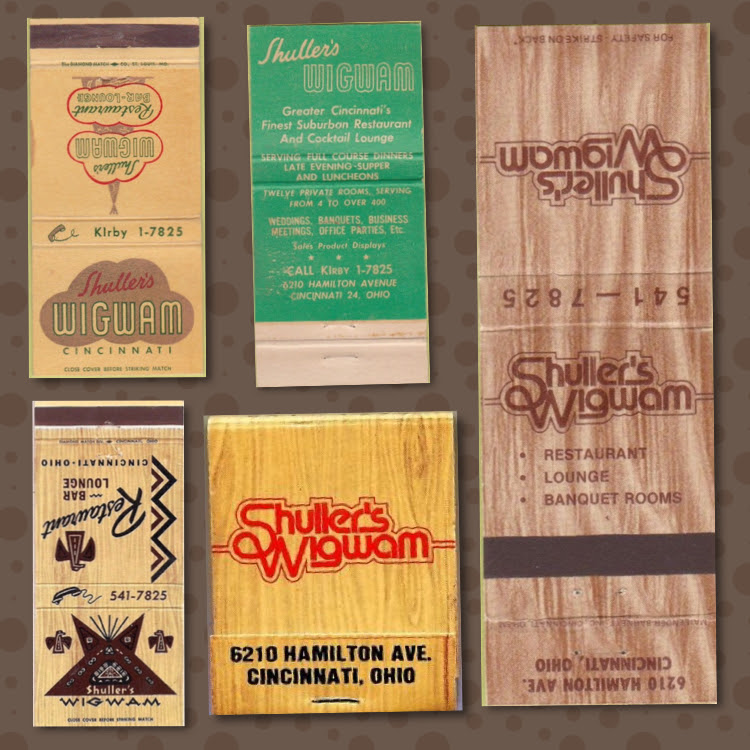
matchbooks through the ages
Jer-ry, Jer-ry!
(Bob Shreve to his left & #13 on the podium)
Now here is the oddball stuff I like...
Every January beginning in 1980 and lasting for about seven years, a shindig was held by The Chopped Liver and Wine Society in celebration of the mediocrity of 13th President Millard Fillmore. They called themselves Fillmorons. Fillmore was from Buffalo, New York. The only President from Cincinnati was mediocre William Howard Taft but I guess they didn't want to offend the prominent Taft family. Also, you don't get to have that funny nickname. The first event was emceed by former Cincinnati Mayor, Channel 5 anchor, and future tabloid talk show host Jerry Springer. It figures.

If anyone has a photo of the actual namesake wigwam building or the sign outside, I'd love to see them! I've already scoured the internet. eBay seems to always have some nice matchbooks from the restaurant's different eras. Also, if you are a geocacher, I placed a cache on the property in September 2016.

UPDATE 6/26/2017: Ken Shuller contacted me and provide a couple of old photos. One is the "wigwam" building and another is the neon sign from the 70s.


newspaper ad from 1950

sources:
A Little Piece of Paradise - College Hill, Ohio by Betty Ann Smiddy
College Hill - Images of America By Gail Deibler Finke
Historic Restaurants of Cincinnati: The Queen City's Tasty History By Dann Woellert
- Old Photos of Cincinnati
Cincinnati Enquirer January 2, 1982
Cincinnati Magazine July 1990
Cincinnati Magazine May 1987
Cincinnati Magazine March 1980


Saturday, October 1, 2016

19th Century Booze News You Can Use

WHH never slept here
In the election of 1840, Democrat incumbent President Martin Van Buren and his re-election team attempted to smear his Whig opponent William Henry Harrison by portraying him as a hard cider drunk and a hayseed. It didn't matter that WHH was once a US Ambassador, US Congressman (both kinds), Governor of the Indiana Territory, Secretary of Northwest Territory, a US Army General and a celebrated war hero. He had an impressive resume, was college educated, and came from a wealthy family just like Van Buren and most politicians of that era.  I'm not entirely sure what Harrison’s drinking habits were as a younger man. Most men back then drank quite a bit. Supposedly he was a teetotaler later in life.

What Would WHH Do?

1840 campaign medal
Harrison's team embraced the attempted slander and adopted a log cabin as his campaign symbol, the symbol of frontier rustic-ness, and portrayed himself as a regular "Jebidiah the Blacksmith" every-man who enjoyed his Bud Light, I mean hard cider. This tactic was no different than politicians now that put on those plaid shirts for the camera and walk around a farm with their family or don a hard hat and shake hands with factory workers to connect with the common man. It's all political spin and 1840 was no different. Ironically this populist strategy is also what got former War of 1812 General and war hero Andrew Jackson elected as the 7th US President when he ran against incumbent John Quincy Adams. It was Henry Clay's Democratic-Republicans opposition to Jackson and his policies that gave birth to the Whig party in 1833.
The truth is, Harrison never once lived in a log cabin. His campaign team, again taking a page from Jackson, accented the old General's War of 1812 war hero status by coming up with the very first presidential campaign slogan and song "Tippecanoe and Tyler Too" emphasizing his win at the Battle of Tippecanoe. The Log Cabin and Hard Cider Campaign was on, complete with cups, plates, flags, and sewing boxes made with his image on them.

Booz...but not from the 1840s

Back to the booze...

Now it is known that there were variants of the word “booze” associated with drunkenness going back to the 14th-century Dutch word “búsen” and even in early America, adjectives such as “boosy” meant "drunk". It has been said that Harrison's Presidential campaign popularized the term again in 1840. It's serendipitous to note that Martin Van Buren was of Dutch ancestry and spoke Dutch as his first language. He later learned English in school.

As the legend goes on to say, WHH commissioned the E.G. Booz Distillery (erroneously listed as E.C. Booz at times) in Philadelphia to make log cabin shaped whiskey bottles with the “Booz” surname featured prominently. Harrison allegedly gave away this free booz(e) at campaign stops to potential voters. I've seen this mentioned in an antique glass bottle book from 1920. It's even in the 1941 biography William Henry Harrison, His Life and Times by James A. Green and repeated in many other publications. I myself believed the boozy tale and even wrote about it here*.

Not so fast...

It would be interesting to find the earliest mention of the booze story. I know for example that the Harrison speech/hat and coat/pneumonia story doesn't appear in print until 1939 in the Freeman Cleaves biography "Old Tippecanoe", long considered the go-to book on WHH which incidentally doesn't mention the "booz" story at all, whereas Green's 1941 book does. Hmmm.

Edmund G. Booz was born in 1824, which would make him only 16 years old in 1840. As it turns out, Edmund didn't start selling log cabin shaped whiskey bottles embossed with his family name until 1858. This was at a time when the brand new Republican Party, founded by former Whigs, was gaining popularity with another up and coming log cabin guy named Abraham Lincoln. Since Harrison, the first Whig President, had the famous Log Cabin campaign with lots of other swag, Mr. Booz likely stamped one of them with the 1840 year as a tribute...or possibly as a deception. Either way, this allusion apparently led folks to believe the bottle was from 1840 election and the tale developed from there. I've also learned that Clevenger Brothers Glass made reproductions of the bottles in the 1930s. Sometimes these are sold mistakenly as 19th-century originals. This leads me to believe that the story originated not in the 1850s but in the 1930s, which is around the time Green wrote his book.
So while it is feasible Harrison gave out free booze or hard cider (in regular type bottles with no "booz") in 1840 to lubricate thirsty voters and E. G. Booz, with his convenient, name re-popularized an old term for alcohol in the 1860s, it’s just not possible that William Henry Harrison or his campaign had anything to do with it in 1840.

Myth.Busted.


*Note: This is a rewrite of a post from December 2011 that originally credited the 1840 Harrison campaign with popularizing the term "booze". As explained above, new information had come to my attention that indicates this wasn't true. 

Saturday, September 3, 2016

Ohio History Harvest

September is rich and abundant in Ohio Presidential trivia goodness. Here is a crop of nine savory nuggets from our ninth month. Let's start with the early adventures of our 9th President.

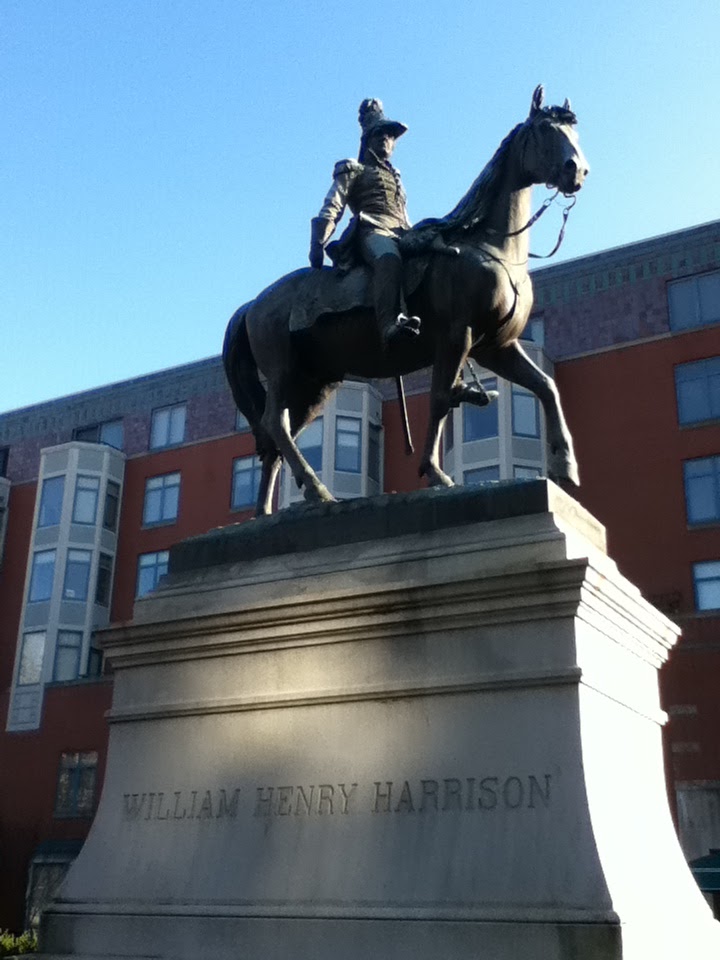
General Harrison statue
in Cincinnati
1812 - The Siege of Fort Wayne began in the Indiana Territory on September 5th led by Potawatomi and Miami Indians. Future 9th President General William Henry Harrison's Kentucky militia from Newport Barracks (across the Ohio River from Cincinnati) joined Ohio militia on September 8th and arrived at the fort September 12th. Known in advance of the approaching superior force the Indians led by Chief Winimac abandoned their attack.
Although born in Virginia and Governor of the Indiana Territory, Harrison would adopt Ohio as his home state, serving in various Ohio political offices and residing in North Bend OH when he became President. I've probably written more blog posts about Harrison than any sane person ever would. Here is a short one to match his brief Presidency.

1812 - Hey what do you know, another WHH entry!...On September 17th William Henry Harrison is made Major General of the US Regular Army by President Madison. Harrison would later defend Ohio from Indian and British advances by building Fort Meigs near Toledo in the War of 1812.

Hendricks is the only VP on US money
1819 - One of three Ohio born US Vice Presidents, Thomas A. Hendricks, 1st VP under Grover Cleveland was born on September 7th in Muskingum County OH. Having spent most of his life as a Hoosier and served as its 16th Governor, he ran with Indiana as his home state in the 1884 election. Hendricks is the only VP whose portrait appears on US paper currency, the $10 silver certificate of 1886. Hendricks died unexpectedly in his sleep just 8 months after being sworn in as Vice President in 1885.

grade school book
about Woodhull
1838 - Suffragette Victoria Woodhull is born September 23rd in Homer OH. Who? In 1872 she was the first woman to run for President and she couldn't even vote for herself. It wasn't just because she was a woman, but she was also in jail on election day. Oh, and black abolitionist Frederick Douglass was named as her running mate by her Equal Rights Party. One problem. Douglass was, in fact, supporting Grant. There’s also no record of how many votes the Woodhull/Douglass ticket received because they apparently weren't even counted. As you can deduce, this Presidential run was more of a protest.

I have to admit I didn't know much about Hendricks or Woodhull before researching for this post. I definitely would like to read more about Woodhull. Notorious Victoria by Mary Gabriel is on my Goodreads to do list.

I have several blog posts about the next four items which are linked in the text.

1855 - Illinois lawyer Abraham Lincoln Rudely was rudely greeted in Cincinnati on September 20th. One of the impolite greeters was Steubenville OH born Edwin Stanton who would later become Secretary of War seven years later under President Lincoln during the Civil War. Politics makes strange bedfellows they say. Upon Lincoln’s death in 1865, it was Stanton who tearfully said the famous words “Now he belongs to the ages.” 

Taft birthplace in Cincinnati
1857 - Speaking of Cincinnati, 27th  President William Howard Taft was born September 15th in the suburb Mt Auburn. Taft would finish his term unlike many Ohio Presidents, but not get re-elected to a second one mainly due to a public dispute with Teddy Roosevelt. He was the only former POTUS to become a member of the SCOTUS.
Random thought: If Hillary Clinton becomes President in 2016, she will have become the first FLOTUS to become POTUS. Bill would become the first...FGOTUS? Anyway...

Garfield Tomb in Cleveland
1880 - Arriving in San Francisco by train on September 8th, 19th US President Rutherford B. Hayes became the first US President to visit the West Coast while in office. I never had a whole post about Hayes but he gets a mention here. This is the only Ohio President who I've never visited the birthplace or grave site. I understand his Delaware OH birthplace is now the site of a BP gas station. At least there is a plaque. The more substantial Hayes Presidential Center and grave is on my Ohio bucket list. Hayes was also Ohio's 29th and 32nd Governor.

1881 - On September 19th, Moreland Hills OH born 20th President James Garfield succumbed to his bad doctors one excruciating month after an attempted assassination. I recommend reading the riveting Destiny of the Republic by Candace Millard which is all about that. It's a great book and one of my favorites. I've read it twice!

McKinley Tomb in Canton

1901 - Well we made it to the 20th century! Just 20 years after Garfield, on September 14th, 25th US President William McKinley died after being shot by an assassin eight days earlier in Buffalo NY while headed to Cleveland. McKinley was born in Niles OH and spent most of his life in Canton where his tomb is. He was the 39th governor of Ohio from 1892 to 1896. Rutherford B Hayes was McKinley's commanding officer during the Civil War in the 23rd Ohio Regiment and were both at the Battle of Antietam on September 17, 1862. For more on McKinley's assassination, I recommend The President and the Assassin by Scott Miller.


Sunday, July 31, 2016

Ohio's Mint Condition

obverse
Did you know Ohio is home to America's oldest private mint? It's also only 6 miles from my house.
Here's the story.
A few months ago I ran across an item on eBay and ended up purchasing it for about $12.
It's a mint condition 62mm (2 ½ inch), 16-gram (.5 ounce) 1953 brushed aluminum medal commemorating the sesquicentennial of Ohio statehood.
The obverse features the Ohio State Seal surrounded by busts of the eight Ohio US Presidents:
William Henry Harrison (9th), Ulysses S. Grant (18th), Rutherford B. Hayes (19th), James Garfield (20th), Benjamin Harrison (23rd), William McKinley (25th), William Howard Taft (27th), and Warren G. Harding (29th).
The reverse notes the company and location "Osborne Coinage Co. Cin. 25, O." At first, I didn't know what the "25" signified. I discovered that it references the zip code of the company location which would be "Cincinnati Ohio, 45225" in the Camp Washington area.

reverse
The medal was struck by the Osborne Coinage Company of Cincinnati, OH which happens to be the oldest private mint in the US and still in operation today. I checked with them but unfortunately, they didn't have any further information on the history of this item, such as how many were made or who specifically it was created for. The early 1950s produced many Ohio Statehood promotional items to gear up for the 150th anniversary. As far as this coin goes, it doesn't show up on eBay much. Another site, which I lost the link to, was selling one and said they'd only seen two of these in twenty years. I don't think it's valuable or anything but I am happy with the price I paid.

Osborne traces its beginning back to 1835 as the Z. Bisbee Co. originally located on 5th Street in downtown Cincinnati a few miles from Osborne's present location in Camp Washington.
During its 181 year history, Osborne produced everything from campaign coins for eight presidents including Lincoln and FDR, food ration tokens in WWII, subway tokens, Alcoholic Anonymous sobriety coins, casino coins, commemorative sports coins, and Chuck E. Cheese tokens. In other words, pretty much anything that was coin-like and wasn't legal tender.

If you need a custom coin, head over to Osborne and tell then Gehio sent you.

related Gehio posts:
Happy 58th Birthday to our 49th State...Ohio!
Ohio Statehood Day!
Ohio History on a Stick

other sources:
1997 LA Times article on the Osborne Coinage Co.

Sunday, May 1, 2016

Ohio History on a Stick

moth and flame in Xenia OH
#3-29 (alleged) Birthplace of Tecumseh
I am drawn to the prominent brown and gold Ohio Historical Markers like a moth to a flame. In fact, I almost called this blog "History on a Stick" instead of Gehio. My kids have even pointed out the prominent signs from the car which can cause me to make a wild u-turn to go back and gawk and get my photo op like a victorious safari hunter. Sometimes they have interesting stories. Other times, I must admit they seem a bit inane. I am sort of surprised they are not vandalized more often. In fact, the only time I can recall any real damage was one blasted by the sun and decorated with bullet holes.

a simpler time, when history was blue and white
The Ohio Historical Society is in charge of the markers program. It began in 1953 with the blue and white Ohio shaped markers. You still see those around. They were brief at 13 words and erected at the corporate limits of towns and villages. By 1957 the modern marker program began with a new design that was able to contain more information, sometimes with maps and images. This is the familiar brown and gold type you see today throughout Ohio.

The new-fangled markers have a number series in the lower right corner such as "14-31".  The second number represents one of the alphabetical 88 Ohio counties.  The first number is the order of the sign's unveiling. If you see a marker that says "2-1", this is the 2nd marker erected in Adams County. "4-88" would be the 4th marker in Wyandot County.
If you are in the Cincinnati area, you are in Hamilton County which is 31st alphabetically. So when you come across a marker that has "14-31", this is the 14th marker erected in Hamilton County. Easy.
Speaking of Hamilton County... did you know that it was Ohio's 2nd county created on January 2, 1790, and named by Governor Arthur St. Clair for Alexander Hamilton? He was a fellow Federalist and 1st Secretary of the Treasury under George Washington. You've seen him on the $10 bill and is also the guy that Vice President Aaron Burr shot to death in a duel. Secretary Hamilton also the subject of a hit Broadway musical. Maybe that should be on a sign!

new and improved, double-sided with graphics!
#4-19 Treaty of Greenville
There are currently about 1500 Ohio Historical Markers across Ohio's 88 counties.
The first of these Ohio markers placed was in 1957 in Summit Co, Akron OH. #1-77 "Portage Path" denotes the significance of the route between the Cuyahoga and Tuscarawas rivers. This path was important to the Indians and French and English traders in the 18th century.

One of the more recent markers is #15-83 General Charles Clark, Confederate States of America, placed in November 2014 in Lebanon OH. Clark was a Yankee born Kentucky lawyer who decided to go with the South in the Civil War.

More Ohio county trivia: Washington County was the first Ohio county on July 27, 1788, also named by Arthur St. Clair after President Washington. As you can tell, the Governor of the Northwest Territory adored the Father of the Country. St. Clair also belonged to an organization called the Society of the Cincinnati. This was a club for Revolutionary War Veterans, a tribute to George Washington, a farmer turned leader turned farmer just like the Roman statesman Cincinnatus. St. Clair renamed Losantiville to Cincinnati after this group.

fun for the kids!
#23-31 Cincinnati Observatory
(John Quincy Adams spoke here)
Washington Co. is the location of Marietta, Ohio's first organized permanent settlement by Europeans. It seems fitting that Ohio's markers get made here. Constructed of cast aluminum by Sewah Studios, who also make markers for 25 other states. They cost an average of $2000 to produce. A sponsor is required and there is a grant program to help defray costs. If you have an idea for a marker, here is more information about the process and program. All in all, this is an excellent state historical sign program, probably the best I've seen in my history and geocaching travels in 13 US States. I do have a couple of ideas for new Ohio signs but I'm keeping them to myself for the time being.

Monday, April 4, 2016

William Henry Stemwinder

March 4th, 1841
William Henry Harrison gets a bad rap. Conventional wisdom states that our 9th President must have been a blustery egotistical old fool to give a speech that lasted nearly two hours in the cold rain. Maybe he was but while it's true that his inaugural speech was twice as long as any of his eight predecessors, it was common to give lengthy speeches in those days. In our modern sound bite world, the thought of a speech like that generates gasps and ridicule. Most movies aren't even that long. But this was 1841, not 2016.

Oratory skills in the 19th century were highly prized. They especially came in handy for Harrison during his old frontier Governor days. He became a seasoned negotiator with Native American tribes who relied on verbal tradition and valued such speaking skills. WHH was also well read and idolized Plato and Cicero so much so that he emulated and referenced them in his public speeches. In the 1800s a term was coined for a long rousing speech, a stem-winder. This was slang for speeches so long that listeners had to rewind their watches during its course. And it was a compliment! Lincoln is famous for his short two-minute address at Gettysburg but the speech that preceded it by former Secretary of State Edward Everett was two hours. People thought that was too short. American poet Ralph Waldo Emerson once exclaimed "The highest bribes of society are all at the feet of the successful orator. All other fame must hush before his. He is the true potentate."
Practicing oratory skills with Tecumseh in 1810
The bottom line is, while still a tad bit lengthy, it was shorter than Harrison's original. Future Harrison/Tyler US Secretary of State Daniel Webster (a contemporary of Emerson) had edited down the President elect's speech in February 1841 killing "seventeen Roman proconsuls", Webster boasted. Still, none of this had any bearing on his cause of death. Harrison probably died from a deadly combo of typhoid and early 19th-century medical treatment, not just the pneumonia that is often cited. A cold can irritate the lungs creating an environment where the bacteria that cause pneumonia can thrive, but one doesn't catch a cold from dressing poorly in the cold. That's common knowledge now. Also, Harrison complained of no symptoms until March 27th. That was 23 days after the speech. 

I doubt his cause of death will ever be corrected (or fully known) in the history books. It's repeated so much so that it is now the "truth" much like other moments in history that make great stories. Daniel Boone wore a coonskin cap (only on TV). Paul Revere yelled, "the British are coming" (he didn't). Al Gore claimed he invented the internet (he didn't really say that). 
April 4th, 1841
Could Harrison have given a 20-minute speech and survived?  Maybe. But his death certainly wasn't caused by ego-driven fashion choices on a cold and damp March day. In fact, the idea that the weather and the length of the speech is what killed him didn't appear until the 1939 Harrison bio "Old Tippecanoe". Yes, NINETEEN thirty-nine.
It seems to me that at the age of 68 and environmental factors he would have contracted some sort of malady. Bacteria-infested drinking water caused by open sewage was literally everywhere in DC. No matter what he got sick from, Harrison would have likely died anyway given the state of medicine in 1841. 
Harrison's doctors did what they thought was best in their day for their high profile patient. Yet...they did have another option. Instead of leeching, cupping, and enemas along with cocktails of mercury, opiates, and brandy, they could have just done nothing and let whatever was ailing him run its course. Oddly, had he not been the President, this is what a doctor may have prescribed for a mere citizen. Non-treatment was even prescribed for gunshot victims in those days. As long as the shrapnel wasn't endangering an organ or bleeding someone out, leave them be. The crude medical treatments here were, in fact, weakening the 68-year-old President even further. Harrison died a week later on April 4th, 1841 at 12:30 AM. The official cause of death was listed as "bilious pleurisy", known now as pneumonia, which was really a secondary diagnosis from a few days earlier.

Hey, it sure has been good fodder for one and a half centuries. Let's stop now.