Thursday, July 12, 2012

Gehio - The Travel Bug


Today is a glorious day in geocaching and Ohio history!
This one-year-old blog name "Gehio" comes from combining the words geocaching and Ohio Valley history. It seemed like time to really combine the two.

I proudly present the first ever Gehio Travel Bug! Please hold your applause...

On July 12th, 2012, I released the first trackable geocaching item bearing the name of Gehio.
Crafted lovingly by combining a serial numbered dog tag known as a "travel bug" from geocaching.com and a wooden coin bearing the logo of the Ohio Historical Society and the Great Seal of the State of Ohio it shall traverse this nation and perhaps the world, from geocache to geocache....or maybe it will just get lost in a few days...but until then, gaze upon its buckeye beauty. Your thoughts will give it strength on its exciting adventures.

For more about "trackables" please watch this fine video from the folks at geocaching.com:

Monday, July 9, 2012

President Taylor expelled from orifice

1968 Shell Oil Mr. President Coin Game piece #12
I found on a river bank.
This is probably what he felt like on 07/09/1850


On this day in history July 9th, 1850, the 12th US President Zachary Taylor after 16 months in office died of bilious cholera. Folks, that's massive super flu-like diarrhea caused by the cholera disease that was sweeping the nation at that time. In fact, some of my German immigrant relatives died of cholera one month after arriving in the US in the 1850s. Fun times. As was common in those days the President was treated with the very latest medical technology which was bleeding, blistering and opiates. He died and was buried in the Taylor family plot in Louisville KY.
In the 20th century, a conspiracy theory formed maintaining that Zachary was poisoned but this was disproved when they examined his corpse in the 1990s. Much to the embarrassment of the conspiracy theorists, the tests showed he did indeed eat contaminated food and died of cholera. Then they buried him again. I'm sure the treatment methods accelerated the cause of death somewhat as well.

Prior to his Presidency, Zach Taylor, a Kentucky resident, and military man participated in many various Indian Wars up until the 1830s and successfully defended Fort Harrison in the Indiana Territory during the War of 1812 from an attack by Indians under the command of the Shawnee chief Tecumseh. Things like this really helped him get elected.

Incidentally, Taylor was the just the second US president to die in office, the first being William Henry Harrison, the 9th President who died nine years earlier from pneumonia and pleurisy after one month in office. WHH was also mainly elected for his military victories against the Indians, specifically the battle at Tippecanoe IN against Tecumseh's Prophet brother Tenskwatawa, his defense against Tecumseh and the British at Ft Meigs in Toledo OH and the defeat of Tecumseh in Canada during the War of 1812. I don't know the full origin of the supposed curse leveled against the American Presidency by Tecumseh and/or his brother, but I would venture to guess that the 2nd President to die in office in less than 10 years would give birth to this especially since both Presidents were adversaries of  Tecumseh's Confederation.

Thursday, June 21, 2012

Fast Times at Big Mac Bridge


want fries with that?
The Daniel Carter Beard I-471 bridge built in the early 1970s crosses the Ohio River and connects Eastern Cincinnati with Newport KY. No one calls it by its official name. It has been called the “Big Mac Bridge” right from the start because the shape and yellow color reminded the people of OH and KY of the McDonald’s Golden Arches, one of the most iconic American symbols recognized worldwide. McDonald’s even planned to build a floating diabetes and heart attack center they call a “restaurant” at the base of the bridge in the 1980s but it never coagulated. In case you didn't know, Cincinnati is listed as one of the fattest cities in the US according to the Centers for Disease Control. One in three Cincinnatians are overweight. No wonder the bridge looks like wonderful fast food arches to its citizens.

We all know what McDonald's is, but who the $%&# is Daniel Beard? 

Uncle Daniel Carter Beard
Beard founded the Sons of Daniel Boone in 1905, a precursor to the Boy Scouts. The club honored American frontiersman such as Daniel Boone, Simon Kenton, Kit Carson, James Audubon, Johnny Appleseed, Davey Crocket and George Catlin. He started the boys club to teach city boys about pioneer living skills which encouraged the children to stay fit via outdoor recreation such as swimming, camping, hunting, and fishing. Uncle Dan's handbook even taught boys how to build their own gym. There were other activities in the book that simulated aspects of frontier life such as Running the Gauntlet and Defending a Snow Fort Against Indians. Not really practical skills but I suppose it was fun in 1905 to engage in mock torture and simulated encroachment rather than toil in a factory or a mine. This was a time in the US when child labor was a fact of life for the poor, and most kids never finished school beyond 8th grade. It was probably good for these kids to spend some time in the outdoors. Some things never change.

Aloha. My name is Mr. Hand
Beard, a ringer for History Teacher Mr. Hand in Fast Times at Ridgemont High if I ever saw one, was born in Cincinnati on this day on June 21st, 1850. He lived in Covington KY where his boyhood home is on the National Register of Historic Places. Dan was a land surveyor and also illustrated many books including Mark Twain's “A Connecticut Yankee in King Arthur's Court”.
Beard left the area in 1878 and moved to move to New York City where he lived out his days until the age of 90, an age that frequent eaters of Big Macs will likely never see.

I don't think Beard would be "Lovin' It™" to learn that the bridge honoring his legacy derives its nickname from a company that is responsible for the fast food industry as we know it. An industry that peddles a steady diet of fat, corn syrup, and sodium to kids worldwide. However, I'll bet Beard WOULD approve of that stern Mr. Hand who did not allow Spicoli access to that pizza delivered to his classroom.

In conclusion, read "Fast Food Nation" but skip the movie version.

Tuesday, June 19, 2012

Happy 246th Birthday Edward Tiffin*


Ohio's First Governor
Most Ohioans have no idea who Dr. Edward Tiffin is. I wouldn't either except that I visited Tiffin OH for one of my kids gymnastic meets and as usual I got to do a little geocaching and studied up on the history as well.

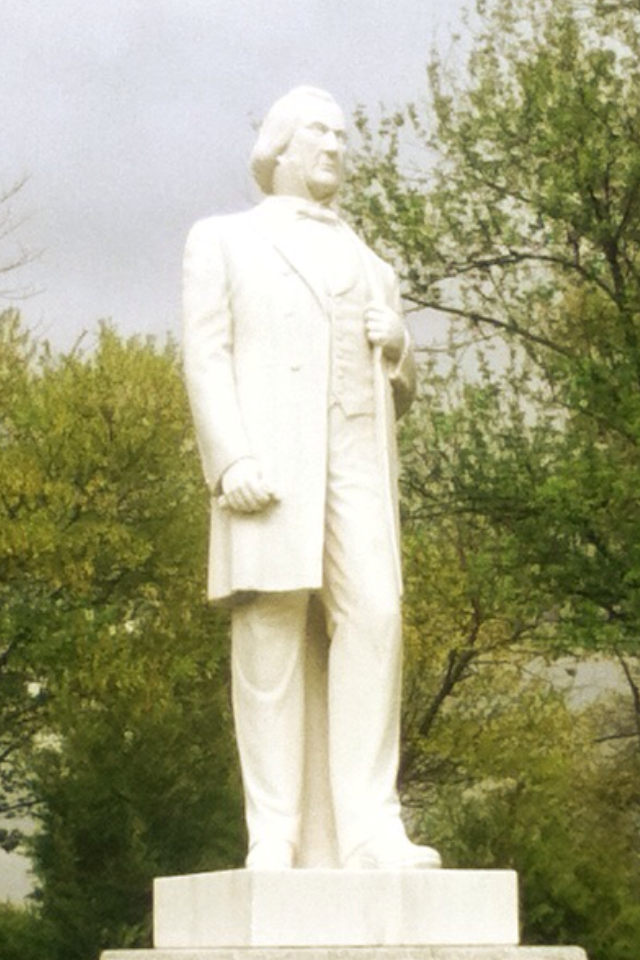
The small NW Ohio college town of Tiffin was named after the English born man who served as the first Governor of the Buckeye State from 1803-1807 and was one of the biggest players in early Ohio politics. Ed also did something pretty important in the War of 1812 but not as a soldier. You wouldn't know any of this if you walked around Tiffin OH. I didn't see one statue of this man or anything informational about him at all. I did see a buttery looking statue of Josiah Hedges (below) who founded the town in 1820. Maybe they have a statue or a sign hidden somewhere for Edward Tiffin but I didn't see any. Don't get me wrong, Tiffin OH has some other nice history that is featured but I would have thought they would have honored their namesake a little more prominently.

Edward Tiffin was born in England on June 19th, 1766. His family emigrated to Virginia in 1789 where he then married Mary Worthington, the sister of Thomas Worthington who another future Governor of OH and known as the Father of Ohio Statehood.

I Can't Believe It's Not Tiffin!
Tiffin's family eventually moved to the Northwest Territory in 1798 and settled in Chillicothe OH where Edward Tiffin, a trained medical doctor also became involved in the Democratic-Republican Party along with his brother-in-law Thomas Worthington.  The Democratic-Republican Party was at odds with the Federalist Party of whom Arthur St. Clair, the Governor of the NW Territory, was a member. St. Clair opposed Ohio Statehood on the grounds that his own party would lose power in the US Senate if this was allowed to occur. President Thomas Jefferson, another Democratic-Republican Party member dismissed St. Clair which cleared OH for Statehood thus tipping the balance of power. Tiffin was elected without opposition. He was later elected to the US Senate representing his adopted home state and also served in other various political positions for the State of Ohio. Tiffin was also responsible for removing important Federal records from Washington DC prior to it being burned and sacked by the British in 1814 during the War of 1812.

Tiffin served out his final years as the US Surveyor General until his death in 1829 at the age of 63 never stepping foot in the town that bears his name.

You may be wondering, why does Ohio's 6th Governor, Thomas Worthington a peer of Tiffin's, get to be known as "the Father of Ohio Statehood" and Tiffin gets squat?
*Why is Tiffin just an asterisk in Ohio history?
Location, location, location. It seems that Tiffin's home in Chillicothe no longer exists while Worthington's Adena Mansion stands to this day as an historic tourist attraction that happens to be where the first mound of a previously unknown culture of Native Americans was discovered in 1901. This 800 BC to AD 100 AD period was named the Adena Culture after the name of Worthington's estate. I guess if you are going to be remembered, have a nice house in a good part of town and name it something memorable. It will help if you build it on something undiscovered too.

Monday, June 18, 2012

The War to End All Indian Wars

say hello to Kelsey's little friend at Ft Meigs
The US officially declared war on Great Britain on this day in 1812 launching the two and half year War of 1812. I don't think many people understand the effect this war had on our nation's history. It generally gets only a brief mention in history class mainly for inspiring the lyrics to what would become the US National Anthem.
But it wasn't just a conflict between two nations with a grudge. Tecumseh's Indian Confederacy allied itself with the British in this war and fought alongside British soldiers in battles such as the two 1813 sieges of Fort Meigs near Toledo OH. Tecumseh was even supposedly offered a commission as a Brigadier General in the British army which despite the alliance he refused. Tecumseh's death at the Battle of the Thames in 1813 effectively killed his demoralized coalition. The final US victory in early 1815 resulted in Native Americans without a foreign ally for the first time in over 200 years. There were Indian tribes such as the Cherokee that sided with the Americans in this conflict. For this, they were at first tolerated as landowners in Georgia but we know how that turned out.


War of 1812 vet Pvt Sam Deneen in Reilly OH
I couldn't possibly go into all the details of this forgotten war in a blog post. That would be silly. There are many great books on the subject such as this one.  If you want to watch a shockingly bad and misleading account of the War of 1812, watch the History Channel documentary which focuses a lot on the naval war with the British and hardly mentions the Native American involvement at all. However if you want to see a great account of the War of 1812, watch this great PBS documentary instead.

Now of course, it not "end all Indian Wars" any more than WWI ended further European conflicts. It just changed the game dramatically since the Native Americans were now on their own. The next 80 something years after the War of 1812 would see hundreds of smaller US-Indian conflicts. Rapid American expansion and land grabs beyond the Mississippi River aided by a policies of massacres, forced treaties, removal acts and the reservation system would continue, slowed only somewhat and briefly by the US Civil War. The last major confrontation between the US and American Indians in what be known as the Wounded Knee Massacre in 1890 part of which was dramatized in HBO's great movie adaptation of the book Bury My Heart At Wounded Knee.


Thursday, June 14, 2012

Happy Birthday to Harriet Beecher Stowe


Happy 201st Birthday to Harriet Beecher Stowe (1811-1896) whose 1852 book Uncle Tom's Cabin was a catalyst for the anti-slavery movement in the US.
President Lincoln met her in 1862 and supposedly greeted her with "so you are the little woman who wrote the book that started this great war?" 
The Harriet Beecher Stowe House in the Cincinnati neighborhood of Walnut Hills was owned by her abolitionist Father and is where she lived from 1833-1836.
The home is now a museum focusing on Harriet Beecher Stowe, the Underground Railroad, and African-American history.

Tuesday, June 12, 2012

SOS or Plastic?


not Charles Stilwell

Grocery paper bags are not as popular these days as they once were. Most folks choose plastic or their own reusable sacks, but the next time you visit Kroger or "the Krogers" as we Ohioans say, and decide to choose paper over plastic you can thank a Buckeye for the modern paper bag. It would also be hard to imagine the Unknown Comic or crafty pre-school puppets without this great contribution from a Union Civil War veteran.

On June 12, 1883, Charles Stilwell from Fremont OH was granted his patent for the Self-Opening Sack or SOS for short.

also not Charles Stilwell
 This was a great leap forward in paper bag technology that had been stalled for over a century. Stilwell actually didn't invent the paper bag. Prior to the SOS, the paper bag was simply a paper tube sealed at one end to form a V shape which was unable to stand without some assistance. This inconvenience made folks very unhappy. Stilwell listened to the people and invented a folded, pleated sack that could easily be opened with one swooping motion and its hi-tech flat bottom placed steadily on the counter ready to be filled with items. The next time you go Krogering, remember Charles Stilwell. Or don't.

Another great moment in Ohio history brought to you by Gehio.

Wednesday, May 30, 2012

Q: What is Cincinnati's smallest historic landmark?

A: The 1858 Historic Landmark Flag Pole!

This 50' cross-shaped wooden flagpole sits in the Cincinnati neighborhood of Carthage at 7011 Vine Street. It's been moved a few blocks from it's original location at Seymour and Vine where it stood in front of the Avenue House, a 19th-century hotel and tavern founded by a German immigrant named H.H. Lammers. I'm not sure if he was related to the Nazi War Criminal with the similar name and initials. The nearby plaque didn't say and Google wasn't any help.

The pole sat there being a pole for over 100 years displaying all the different American flags in great fashion starting with the 32 star US flag until the Sun Oil Company wanted to put a gas station in the old hotel's spot. I know you are thinking "boo! bad oil company people! boo!" However, I am happy to report that the Sun Oil Company was a good sport and paid to have it moved up the street to its present location in 1970. The citizens of Carthage then celebrated their fantastic historic wooden flagpole with a big party on Flag Day. I'm sure it was a great celebration.
Then in 1982, it was designated a Cincinnati Neighborhood Landmark, making it the city's smallest historic landmark!

If anyone is working on creating "Trivial Pursuit: Cincinnatus Edition" this should definitely be included.

In case you were wondering...nope, there is no geocache here. I was just driving by and saw the sign.

Saturday, May 5, 2012

The Great North Bend Train Robbery

unrelated train car in North Bend w/ unrelated scoundrels
If asked where the first US train robbery occurred you might think it was in the Old West right? Everyone knows that because of movies.
Wrong. It happened in the Old Northwest, if you will, right outside Cincinnati OH on May 5, 1865, in North Bend, OH whose other claims to fame is being the home of two US Presidents named Harrison, as well as the resting place of John Cleves Symmes.

Under cover of darkness, several men apparently removed one rail to stop the 8:00 PM Ohio & Mississippi train that had departed from Cincinnati bound for St Louis MO with over one hundred passengers.

After the train was stopped from the derailment, twenty armed men "with the vilest oaths, demanded the money and valuables of the passengers." The scoundrels then blew open several safes that were said to contain over $30,000 in U.S. bonds.

With no serious injuries to the passengers or the perpetrators, the robbers made off with the loot and fled across the Ohio River into Kentucky. Military troops were called and sent to hunt down the outlaws who were traced south through Verona, Ky., but were never captured.

the Ohio River from North Bend looking toward KY
Another Indiana train robbery a year later in 1866 is sometimes listed as the "first" but because this 1865 North Bend event occurred during the last months of the Civil War and the suspects, although wearing civilian clothes, were thought by some to be members of the Confederate Army, many historians consider this a military action rather than a civilian train robbery. Since no one was ever caught I suppose we will never really know. The infamous brothers Frank and Jesse James were even suspected as the orchestrators of what a Cincinnati newspaper described as “one of the boldest robberies that we have been called upon to chronicle.”

Thursday, May 3, 2012

Meet the Thunder-Skys

The Thunder-Skys...left to right, 
Michael, Chief Thunder-sky and Raymond


The other day I was browsing an online database of famous people buried in Cincinnati. (Everyone does this right?) Mostly it was the familiar local athlete, businessman or politician. Many were surnames that a lot of Cincinnatians would recognize as streets or areas of town like Chase or Groesbeck, etc. As expected, almost all were buried in the beautiful and sprawling historic Spring Grove Cemetery. 

Then an unusual name caught my eye...Chief Richard Brightfire Thunder-Sky.  That's just not the sort of name you expect to discover in Southwest OH. I had to know more of course and lucky for me, this gentleman's grave was just a couple of miles from my house. So I did some research before going for a visit.

Born on St. Regis Mohawk Reservation in Upstate NY in 1911, Chief Richard Brightfire Thunder-Sky was apparently the "last full-blooded hereditary Sachem Chief of the Mohawk Nation". To be honest, I'm not entirely sure what that means. I know a sachem is basically the Chief of Chiefs although I'm not sure what duties he would have had in fulfilling that that role in the 20th century. It's still pretty cool and interesting since the Mohawk were not known to have ever lived in the Cincinnati area.
Chief Thunder-Sky also played parts in several old Westerns such as Gene Autry's 1950 Indian Territory and Tyrone Power's 1952 Pony Soldier. Not bad gigs at a time when many Indian parts were being played by non-Natives such as Italian-Americans for their close physical resemblance or whites with make-up.

Dad

In 1961 Thunder-Sky moved to Cincinnati OH with his wife Irene and two sons Michael and Raymond and helped organize the North American Indian Council which still operates in Mt Healthy OH. His wife of 49 years was Irene Dianna Szalatzky, the daughter of a Hungarian nobleman of the Habsburg Dynasty. 
Richard died in 1989 and is buried at Arlington Memorial Gardens in Mt Healthy OH just outside of Cincinnati a couple miles from my house.
Irene died in 1994 and is also buried at Arlington but I was unable to find her marker.

Here is where the story gets a little more interesting...

If you spent any time in Cincinnati OH in the 1980s and 90s as I did you may have seen a man going about his business wearing a clown suit, donning a construction hat and carrying a toolbox. I didn't know this back then, but the mysterious man was Raymond Hiawatha Thunder-Sky, the eldest son of  Chief Richard Brightfire Thunder-Sky. It turns out that Raymond was autistic and created hundreds of paintings over the years that he kept secret (he kept his art supplies in the toolbox) and revealed to his social worker in 1999 a few years prior to his death from cancer. When he died in 2004, Thunder-Sky, Inc. in Northside was founded to preserve Raymond's artistic legacy. 


Son
Unfortunately, it was difficult to find further information on Chief Richard Brightfire Thunder-Sky to fill in the gaps in his life. It seems the son eclipsed the father. I don't know what brought Richard to Cincinnati or why he quit the movie business. Or what happened to the younger brother Michael. Or how Irene lived out her final years. Even Richard's IMDB entries for his movies were hodgepodge and incomplete due to uncredited roles. However, much has been written about his son Raymond who not only was a half-blooded Mohawk, but also the descendant of Hungarian royalty on his Mother's side. I never would have guessed this as I saw him wandering around town back in the day known only to me as "the Construction Clown". 
I won't delve any more into Raymond's history here. Many nice articles have already been written about this man. If you would like to read more about him, see some photos of him and his artwork, here is a great article from 2010 with further links to other websites. Update 2016: Original link is dead, try this instead.