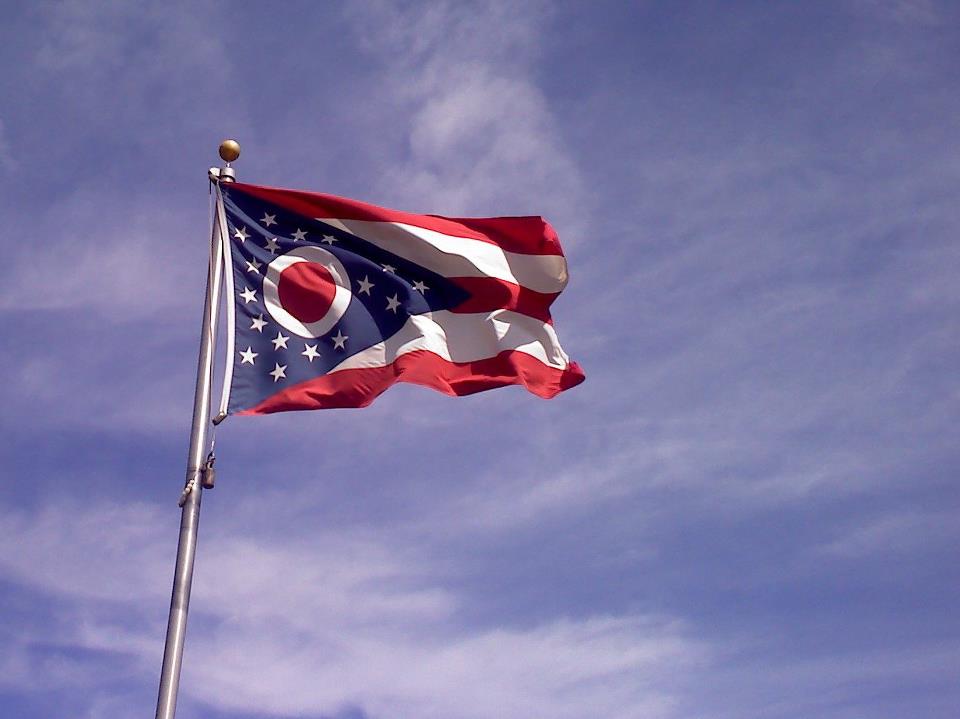
Wednesday, August 28, 2013

NCH, the city formerly known as Clovernook (Part 2/2)

Part Two of my two-part series on North College Hill OH history. In Part One we learned about the earliest history of NCH. Today we continue through the 19th century...

1832 Cary Cottage
Cary Cottage was built in 1832 by the Robert Cary family mentioned earlier. The Cary's were Universalists and held many liberal and reformist religious and political views. I imagine that hundreds of people drive or walk by every day with no real notion of its significance.
Two of the daughters who lived in Cary Cottage, Alice and Phoebe Cary, were well-known poets of their day.
Edgar Allan Poe was a fan of the Cary sisters poetry and called Alice Cary's 1855 'Pictures of Memory', "one of the most musically perfect lyrics in the English language".
In 1903, Florence and Georgia Trader opened the first home in OH for blind women here which became The Clovernook Center For The Blind which still operates on this same property behind the cottage that was placed on the National Register of Historic Places in 1973. I also placed my own geocache here. The Laboiteaux-Cary Cemetery mentioned earlier sits across the street which has many graves from the Cary family. 
Cary Cottage Historical Marker
In 1861 the Isaac Mayer Wise Home and 40-acre farm was built and remained until 1968. Dr. Wise was one of the founders of Reform Judaism in America and the Hebrew Union College. He emigrated here from Austria where Jewish people were not allowed to own land. There is a now a bank and a tiny park with a plaque about the site and Dr. Wise. This also seemed like a good place for a geocache so I placed one here as well.

Issac M. Wise plaque
the former site of the Wise home
It should be noted that the stretch of Galbraith Road that runs through NCH was known for many years as Van Zandt Road, named for the prominent local family of which the Rev. John Van Zandt was the most notable. The good reverend was a local 19th-century abolitionist who served as the inspiration for John Van Trompe in Uncle Tom's Cabin. In 1847 he helped a slave escape and was arrested and tried for the owner's property loss. This case was used to test the constitutionality of slavery in the US. Van Zandt's case, which he unfortunately lost, was defended by Salmon P. Chase, who would later be the Secretary of Treasury for Abe Lincoln and then later served as Chief Justice of the United States Supreme Court.
The road changed names as it went across Cincinnati and was eventually renamed to Galbraith Road in the mid 20th century to honor Frederic W. Galbraith, a WWI veteran who was a Colonel in the Ohio National Guard and one of the founders of the American Legion. I’m not sure why this was done other than to perhaps unify the name to make it less confusing for people. I think they should have just called the whole thing Van Zandt myself!

These two blog posts were not meant to be an all-encompassing history of NCH, just some highlights of the early events. For more information about the city of North College Hill OH and its history, please visit the city website which includes links to the NCH Historical Society newsletters.

Monday, July 29, 2013

NCH, the city formerly known as Clovernook (Part 1 of 2)

Part One of my two-part series on North College Hill OH history...

I don’t actually live in Cincinnati. I live in an older one square mile suburb directly to the north of Cincinnati called North College Hill or NCH for short.

There is a bit of 18th and early 19th Century history in NCH that seems unlikely at first glance...and most of it very well hidden and mostly only mentioned in old obscure books or an out of the way sign.

NCH wasn't even incorporated as a city until 1916, no significant body of water, creek or river runs through it which was a preferable amenity to have in those days before there were roads or plumbing. So what existed in this area that made a community grow up around it? If you go back to the beginning, it was a centuries-old buffalo trail that was later used by the local pre-Columbian Indians. It was easier to use these well worn traveled paths rather than clear new ones. So, in the 18th century, the US Army followed that tradition and used this same trail as a military road up from Cincinnati's Fort Washington through present day NCH to Fort Hamilton and up past Greenville OH to carry supplies, soldiers, build forts and supporting posts as the US expanded into hostile territory. Most people now know this old road as Hamilton Avenue or Route 127

Keen’s Station, 1791 was located in present-day NCH and was one the 40 or so fortified settlements that peppered the Cincinnati area in that time period. It has no sign or marker and no one knows specifically where it was located but a lot can be deduced from various sources and records.

I first learned about Keen's Station in a book called "Stockades in the Wilderness" by Richard Scamyhorn which only stated that this station was located in NCH with no further info given. These stations were not meant to be permanent and were typically torn down and the wood re-used when the area was deemed safe for the settlers. Since there is hardly a mention of this station anywhere in any other historical documents it is assumed that it was never attacked and was only here for a very brief time. Even so, it's very existence makes it noteworthy since this is the first record of any European-American living here.
This station was built by an early pioneer named Captain Peter Keen born in 1761. The Keen family had arrived from New Jersey in the late 1770's. According to a College Hill Historical Society publication, this station was located somewhere near the intersection of  Hamilton and Galbraith Avenues.
Peter Keen and his wife Jemima Gard were married in 1781 by none other than Judge John Cleves Symmes himself, had a daughter Angeline, who is reported to have been the first recorded white child born between the Miami Rivers.
After Keen moved on to Illinois, this section of land was passed around many times until Ephriam Brown acquired it and sold half in 1804 to Peter LaBoiteaux. This land would have been in the vicinity of the present NCH High School at Hamilton and Galbraith, close to the old cemetery that bears Laboiteaux's name. 

Peter Laboiteaux (1737-1813)
Laboiteaux-Cary Cemetery, est. 1805, sits at the corner of Galbraith and Hamilton Avenues and was originally a burial plot for the Laboiteaux family. Peter LaBoiteaux, a Revolutionary War Veteran is buried here. He laid out the town of Mt. Healthy, OH in 1804 one mile north of this location.
In 1813, William Cary purchased most of what is now College Hill to the south. Later that year his nephew Robert Cary laid-out a community called Clovernook, which became North College Hill.
There are many members of these pioneer families buried here including many Carys, Laboiteaux's and at least two other Revolutionary War veterans, Henry Deats and James Kenniston. Also resting here are John and Jemina Runyan, who lived in the nearby Dunlap Station during it's significant and well-documented attack by the Shawnee Chief Blue Jacket and "white renegade" Simon Girty in 1791. I'll have a nice write-up on that important event soon! Jemina was the daughter of Peter Laboiteaux. The last burial in this cemetery was in 1860 and was a bit larger back in those days. When Hamilton Ave was widened in the 20th century, some of the graves were moved to Spring Grove Cemetery. Recently, a nice stone facade was added to the concrete retaining wall that faces the intersection which makes this well-kept pioneer cemetery appear even nicer.

Continue to Part Two...

Friday, June 14, 2013

It's Flag Day

15 Stars and Stripes 1795 design over Ft Meigs


We have Flag Day on June 14th because on that day in 1777 Congress adopted the original 13 Stars and Stripes US flag. However, it wasn't until 1916 that it became officially proclaimed as such by Woodrow Wilson and not until 1949 when Congress approved it as National Flag Day. It is kind of confusing because various communities and States have had Flag Day observances as far back as 1861.

What does this have to do with Ohio Valley history? Not much really but you may be interested to know that Ohio was the 17th state in 1803 and there never was a 17-star flag or a 16-star flag for that matter. The 15 star (and 15 stripe) US flag which added the states of Vermont and Kentucky, pictured here over Ft Meigs in Perrysburg OH stayed in use from 1795 until 1818. This is the flag design that inspired our National Anthem, the Star Spangled Banner, at Ft McHenry during the War of 1812 and was the 3rd longest running design of the US Flag at 23 years.

the actual flag from Fort McHenry
pic taken in the 1870s
In 1818 the stripes were reduced to 13 to represent the original colonies and became a 20-star flag to include the 5 new states of Indiana, Louisiana, Mississippi, Ohio, and Tennessee. After that they added one or two stars like crazy 25 times as new States joined the Union, therefore many of the flag designs were in use for only a year or two in most cases until the 50-star flag became the longest running design for over 50 years since its adoption in 1960.

If you ask me Ohio got cheated out of a 17 star US flag and if Puerto Rico ever gets in as #51 that's possibly going to make the flag look closer to the original 1777 thirteen star Betsy Ross flag.

Wednesday, June 5, 2013

Going Underground on Hamilton Avenue

 Dr. John Witherspoon Scott


Underground Railroad sign
On what appears to be just another struggling storefront in Midwest America at the corner of Compton & Hamilton Ave in Mt. Healthy, is a small wooden sign announcing "a stop on the Underground Railroad in 1840". I decided to check up on that assertion as I really enjoy uncovering more info on forgotten and obscure local history.


It turns out there was an entire Underground Railroad system up and down Hamilton Avenue in the early 19th Century.

The home was built in 1840 in what was then Mount Pleasant by Dr. John Witherspoon Scott (1800-1892), an abolitionist, Presbyterian minister, math Professor, and the first Professor of Science at Miami University in Oxford, OH from 1828-1845. He was fired by Miami U over the issue of slavery in 1845 when folks were choosing sides on this hot topic of the day. It seems that Miami U President George Junkin, also a Presbyterian minister, was supporting slavery on Biblical grounds. After his dismissal, Scott began teaching at a prep school called Farmers College in what would become the Cincinnati neighborhood of College Hill, a couple of miles south of this house. It should be noted that since there was another Mt. Pleasant in Ohio, in 1850 this town was renamed to Mt. Healthy after a cholera epidemic in the area somehow left its citizens unscathed that same year.

Dr. Scott's former home in Mt Healthy
c.late 1800s (left side)
Dr. Scott's former home in Mt Healthy c.2012
Dr. Scott also has a connection to Ohio's US Presidential legacy. Scott was future 23rd President Benjamin Harrison's mentor at Farmers College from 1848-1850. Benjamin, born in North Bend OH and grandson of 9th US President William Henry Harrison became friendly with Scott's daughter Caroline during his many visits to the Scott home and they eventually married in 1853 with the Reverend father-in-law officiating. Dr. Scott later lived with the Harrison's in the White House until he died there in 1892.


So, back to the sign. Was this a stop on the Underground Railroad? Probably. Sometimes these claims are difficult to prove since their actions were illegal in Ohio* and left few records but based on who lived there, the amount of activity of this type in the area and the fact that there are traces of tunnels and hidden rooms inside the home, it seems very likely.

On a related note, Happy 162nd Anniversary to Harriet Beecher Stowe's Uncle Tom's Cabin. It first appeared in an abolitionist periodical on June 5th, 1851 as a series which led to it being published as a book the next year.

*Coincidentally on this same date, June 5th, 1804, one year after Ohio Statehood, the Ohio General Assembly enacted the so-called Black Laws that required African-Americans to prove they were free and anyone harboring an escaped slave could be fined.

Many thanks to the excellent local history book available to read online, A Little Piece of Paradise...College Hill, Ohio by Betty Ann Smiddy as well as the Mount Healthy Historical Society website for information in researching this article. 

Friday, May 17, 2013

West of Chester OH

School District No. 9 Schoolhouse, built in 1900
I lived in West Chester OH, a large suburb north of Cincinnati from 1978-1986 as an awkward teenager with limited social skills. Times have changed. West Chester has grown quite a bit and I am now an awkward 40-something with limited social skills.

I never thought much about the history when I lived there. To me, it seemed like they just built a bunch of subdivisions on farmland and that was the end of it...but I did wonder why they called it West Chester. West of what? Chester? Where is Chester? I don't see a Chester on the map. There is no East Chester either. It's too far north to be considered west of Cincinnati. No one seemed to know. I forgot all about this for about 25 years until I ran across the book, "The History of Union Township, Butler County" by Virginia Shewalter. In case you haven't read it, here's the deal...

In 1824 there was a village in Butler County called Mechanicsburgh. Just to the east of that village was the post office called "Chester". No one knows why. Maybe a guy named Chester worked there. Maybe the horse that helped deliver the mail was named Chester. No one wrote it down. That actually happens more than you think. I even contacted the West Chester Historical Society and they had no idea where the name "Chester" originated.
VOA Bethany Station 1943-1994
Since there was already another Mechanicsburgh OH, folks decided to rename the town. People were already calling the area "Chester" after the post office. So, by 1826 they decided on "West Chester" since the village was west of the Chester post office. That's it.

West Chest is certainly no podunk town anymore. By 1900 there were over 1,700 people living in West Chester and by the 1980s 25,000. In 2000 it had doubled to over 50,000 residents and became West Chester Township. According to the official website, in 2011 there were over 60,000 residents and 3,000 businesses.

concrete platforms for the Bethany antennae array
At one time, West Chester boasted itself as one of the richest suburbs in Ohio, but it has dropped a bit in recent times. Things still look pretty good though as it was just named 97 out of 100 of the best small cities to live by Money Magazine.  It also happens to be the home of the US Speaker of the House John Boehner who being a humble man of the people he serves owns a home in the rich, private gated community of Wetherington.
From 1943-1994 West Chester was also home to the Voice of America Bethany Relay Station that beamed American ideals over the radio airwaves in 44 languages all over the world. The Bethany Station building is slated to become a museum for VOA and the giant tower relays have been removed and the land converted into VOA Park.

Now, can they convert those empty strip malls back into corn fields?

Friday, April 26, 2013

Tales of Brave Ulysses

Grant's birthplace in Point Pleasant OH. It toured the US.

April 27th, 1822 is President U.S. Grant's 191st birthday!
I'm not going to attempt a biography of Grant in a mere blog post. His service during the Civil War is heavily documented. I'll just touch on some items you may not know.
Born in a modest home in Point Pleasant OH and moving a year later to Georgetown OH, his given name was Hiram Ulysses Grant. When he entered West Point at the age of 17, a clerical error made him Ulysses Simpson Grant because his Mother's maiden name was Simpson. Including Grant, there are three US Presidents who were born with different names than the name they were elected under. The other two are Ford and Clinton.

During Grant's military career he developed a reputation for binge drinking which may have been exaggerated by his enemies. Some historians think he probably drank as much as any other 19th-century man which is to say, a lot.
 After the Civil War, he became a huge celebrity and became involved in politics. In 1869 became 18th President of the US serving two terms. His Presidential legacy is marred by a series of corruption scandals and economic crisis' during a violent and pivotal era in post Civil War America but he accomplished several great things such as furthering the rights of African-Americans and overseeing the passage of the 15th amendment. I do kind of get the feeling that Grant could have burned the White House to the ground in a drunken rage and he still would be forgiven because of his service in the Civil War. He was that big of a deal to Americans.

Grant may  have been reported on his own highway
Grant's Presidency began a tripleheader of Republican Ohio born Presidents (Grant, Hayes, Garfield) that controlled the White House from 1861 to 1881. Most people don't know that an attempt was made to nominate Grant for an unprecedented 3rd term in 1880 but the deadlocked and divided Republican convention became enamored by fellow Ohioan James Garfield's speech in support of another contender named James Blaine. Grant lost the nomination to Garfield who was shot 4 months into his term by a crazy lone gunman who had written speeches in favor of Grant. There was, of course, no connection to Grant but it is an interesting fact nonetheless.

In 1884 Grant learned he had throat cancer, a sure death sentence in those days. At the urging of supporters, he decided to write his memoirs which he finished just days before he died. I suppose if Grant did get that third term he very well could have been added to the list of Ohio Presidents who died in office. Those Buckeyes can't catch a break.

Being a national hero and all, after he died on July 23rd, 1885 they put his birthplace cottage on a train and toured it all over the US and then they put it back in Point Pleasant OH. I don't think anyone really cared or knew that he lived there for only a year and really grew up in Georgetown OH.
Grant was laid to rest in New York City. Why wasn't he buried in Ohio? NYC was where he and his wife lived after leaving the White House and Julia, who outlived him by 20 years, wanted him nearby so she could visit.
Grant's Tomb in NYC


So who is buried in Grant's Tomb? No one. Grant and his wife Julie are in an above ground vault.


"Grant was himself the supreme example of American opportunity."
-President and fellow Ohioan Warren G. Harding
speaking in Point Pleasant on the
1922 100th Anniversary of Grant’s birth


Sunday, April 7, 2013

Gateway to the Old Northwest


18th century Marietta

The first permanent American settlement in the Northwest Territory officially began at Marietta, Ohio on April 7, 1788.
General Rufus Putnam and 48 men arrived on flatboats and named the new city "Marietta" after Queen Marie Antoinette in honor of France's support during the Revolutionary War.
21st century Marietta
Hostilities with Native Americans, who had occupied the region for thousands of years, would become a fact of life for the next half-century as treaties were made (and broken). By 1843 no Indian tribes would remain in Ohio. Evidence of the Hopewell culture (100 BC - AD 500) can still be seen in what remains of the Marietta Earthworks.

Marietta flourished during the riverboat and railroad era through the 19th century but surpassed in importance as the era of the interstate and air travel took over. Today Marietta has a flourishing tourism industry because of its significant place in history.

Wednesday, April 3, 2013

The Place of the Devil Wind


National Weather Service photo of the F5 tornado

I didn't live in Ohio when this tragedy happened but the very mention of this event strikes fear in many Southwestern Ohio residents. A super outbreak of 148 tornadoes occurred in 13 states beginning on April 3rd, 1974 and ending on April 4th. It still ranks as one of the largest natural disasters in American history. Xenia OH was the hardest hit community. Half of the city was removed from the map in a matter of minutes.

I remember when I first moved to Cincinnati Ohio in 1979, there was a tornado warning in effect one evening. I was at a friends house whose family was from Dayton OH, which is right next to Xenia. I'd been in tornado warnings before and it is scary but my friend's family was really freaking out. This is why.

What is interesting is that this area was well known by American Indians for severe weather events and warned settlers not to build permanent settlements here. The Shawnee called it  "the place of the devil wind". There have been twenty recorded tornadoes in this area since 1884.


Xenia Tornado
April 3, 1974

OHS marker in front of the 1799 Galloway Log Home
On April 3, 1974, at 4:40 p.m., a devastating tornado touched down here, destroying a large portion of the City of Xenia. The mile-wide tornado entered in the southwest quadrant of the city and did not leave the ground until it had demolished hundreds of homes, schools, and commercial buildings. A total of 34 lives were lost, including two National guardsmen who were in a building when it caught fire. Hundreds of people were injured with property losses exceeding more than $100 million. For weeks following the tornado, the sound of trucks was heard throughout the city carrying the remains of homes, schools, churches, and businesses. This marker stands directly in the path taken by the tornado and serves to remind us that-"Xenia Lives."

more info and photos

Thursday, March 14, 2013

Lucretia, My Reflection


Prior to a week or so ago, I had never heard of Lucretia "Crete" Randolf Garfield. I mean why would I?  Her husband James Garfield, the 20th US President, was shot in 1881 four months into his first term and died two months later from the treatment of his wounds. The second shortest presidency ever. Another one for trivia night.
I was at the library recently and I picked up a book published in 2012 called "Destiny of the Republic" about James Garfield, a best seller that got rave reviews. I thought this was odd since it is about such an obscure forgotten President. I won't review the book here but let me say that the reviews are well deserved. It is written in a nice narrative style which makes it as engaging as a novel. It was here I met Lucretia.

Today, March 14th is the anniversary of the death of former First Lady Lucretia Garfield born in Garrettsville, Ohio in 1832. She died in 1918 at age 85. People like this always amaze me because of the changes they saw during their lives. When she was born the US was only about 60 years old and the horse was the only way to travel or get messages across long distances. By the time she died the US was well past its Centennial and she had seen the invention of the telephone and the first airplane.
Lucretia met her husband at school in Ohio and they married in 1856. James admits in his diary that he was attracted to her for her intellect rather than just her physical beauty. Together they had seven children. 

After Garfield's Presidential election she began to rehab the very run down White House when she contracted malaria from "bad air" (they hadn't made the connection to mosquitoes yet) and nearly died. Her doctors had her travel to the New Jersey coast to finish recuperating believing that the salt air would be better for her.
together again
Having mostly recovered, Crete was informed that her husband had been shot. She hopped the next train to be near him and await his fate. During the trip, the train she was on broke a piston and nearly derailed which likely would have killed everyone on board. Because of her frail health, James was concerned greatly about her even as he lay there with a bullet in his abdomen.
After James died, she and her family moved near Cleveland OH and lived off a trust fund set up for her. Crete lived a mostly private life from then on. That was fine with her, she preferred that sort of life vs. the protocols of political life.
Years later in 1918 while visiting in California she died from undisclosed causes at age 85 and is laid to rest in the Garfield Monument with her husband in Cleveland OH.

Oh, and what's up with the "Lucretia, My Reflection" title? Prior to this, the only Lucretia I ever knew was the 1988 Sister of Mercy song. It's not about her but it starts playing in my head every time I hear the name.


Friday, March 1, 2013

Ohio Statehood Day!

March 1st is Ohio Statehood Day when Ohio became the 17th state in 1803. Happy 210th!

Or did Ohio become a state February 19th, 1803?

Maybe it was it August 7th...1953?

We tend to think of these older historical events as neat and tidy occasions where gentlemen in white wigs have orderly civil debates and sign documents with fancy quill pens by candlelight. The US was a brand new country and everyone had the same goals...right? Not really. The State of Ohio was formed by a power struggle between two political parties.

at a crossroad
In the early 1800s, the esteemed Arthur St. Clair, a Revolutionary War Veteran, and Federalist Party member was the Governor of the NW Territory appointed by his friend George Washington. He even named Cincinnati. Arthur did have that little mishap where he led 3/4 of the US Army to their deaths but even that was forgiven and he remained the NW Territory Governor under Washington. In the late 1700s there were two parties vying for power and by 1800 Democratic-Republican Party had gained control of the House, Senate, and Presidency from the Federalists. Some of the key differences between these two parties are summed up nicely here.

St. Clair proposed new state boundaries for the territory that essentially divided it in two and would prevent Ohio from becoming a state at that time since it did not meet the population criteria for statehood.
the man who busted Arthur
Why did he do this? He wanted to remain the Governor and keep his Federalist party in control of the area by creating two new states instead of one. Many of Ohio's new leaders were members of the opposing Democratic-Republican party...and so was the new US president Thomas Jefferson.

Jefferson was, of course, was eager to add Ohio as the 17th US State to increase his party's control. So, the 7th US Congress rejected St. Clair's plan and in April 1802 passed the Enabling Act which put Ohio on the fast track to becoming a state by new rules that favored the Democratic-Republican Party.

When Ohio's new Constitutional Convention met in Chillicothe St. Clair angrily denounced the Enabling Act. Word got back to Jefferson and the President promptly fired Art and appointed Charles William Byrd as Governor. You can probably guess that the new guy was also a Democratic-Republican.

all St. Clair got was a rock
With St. Clair out of the way, the new State Constitution was passed in November 1802. On February 19th, 1803 the President and Congress approved it and on March 1st, 1803, the Ohio General Assembly met for the first time. March 1st became known as Ohio Statehood Day. Edward Tiffin was elected governor of the state of Ohio on March 3, 1803. I'll bet you can guess Tiffin's party affiliation.

The only thing is, there was a problem. In 1953 (yes nineteen) it was discovered that due to a technicality, Congress did not formally declare Ohio a US State. Eventually, that was resolved and they backdated statehood to March 1st, 1803. More on that here.

What happened to St. Clair? He rode off into the sunset with his gout. It turned out he had loaned much of his fortune to the cash-strapped US government while serving as Governor for 14 years and Congress never paid him back. As a result of all this, one of America's original military and political leaders, a once powerful man, died disgraced, penniless and forgotten in 1818 at his home in PA.

Isn't politics fun?