Showing posts with label Columbus. Show all posts

Friday, January 22, 2016

Heart(land) of Glass

 Over the last several years I've collected various history-related trinkets and ephemera. I think they gain an insight into the culture of the time and what folks in the past thought was important to emphasize. Sometimes they just look nice on a shelf.

I have three glass tumblers that were part of several series of US State drinking glass sets in the 1950s. Naturally, I am drawn to the ones that depict Ohio. I found these at Ohio Valley Antique Mall. Let me say that despite my interest in Ohio history, I never thought I'd be writing a blog post about drinking glasses. I've since discovered that these have a bigger connection to the Buckeye State than just the name on the tumbler. Did you know that Ohio was once a leader in the US glass industry and several museums are devoted to that fact? Before plastic was invented and in widespread use, glass was used for many items. Over 70 glass companies operated in Ohio between 1880 and 1920.

Hazel-Atlas marking
The first two glasses are from a major glass manufacturer called Hazel-Atlas based in Wheeling WV since 1885. The company operated under that name until 1964. Hazel-Atlas made everything from medicine bottles to food jars and lamps to dinnerware, and of course drinking glasses. By the 1920s most American homes had something made by Hazel-Atlas. By the 1930s they had 15 plants, one of which was in Zanesville OH. They were most famous for so-called Depression Glass items. This was low-cost Depression-era glassware, much of which was made in the Ohio River Valley and is highly collectible now.

The blue and mostly clear Ohio glass pictured on the left is 5 1/4" tall. A map of Ohio depicts the Columbus State House, Fort Meigs near Toledo, and the Cleveland Terminal Tower. The music and lyrics of "Down By The Ohio", composed in 1920 and popularized in 1940 by the Andrew Sisters are on the reverse.
These glasses sold as promotional items by Big Top Peanut Butter of Lexington KY. They were originally filled with delicious peanut butter and sold in grocery stores. Not a bad deal. Buy peanut butter for the kids, get a free highball glass for Dad! Big Top Peanut Butter was bought out by Proctor & Gamble of Cincinnati OH in 1955 and re-sold as Jif Peanut Butter. I am uncertain if the glass painting was outsourced or done by the glass company itself. I do know that a lot of Hazel-Atlas glassware was painted by Gay Fad Studios of Lancaster OH like the next item.

The yellow painted and frosted "Ohio The Buckeye State" glass tumbler was also made by Hazel-Atlas. This glass measures 5 inches tall. A large map depicts 20+ Ohio cities, the State Flag, and a compass.
This was sold in roadside souvenir shops. During the post-WWII boom, the turnpikes and Interstate Highways developed. The middle class grew and more Americans were now driving around the country on vacations. Collecting the glasses was a way to show your friends back home were you've been. Think of it like t-shirts, refrigerator magnets, and bumper stickers today.
The glass decorating itself was sometimes done by another company, which was the case here. Fran Taylor’s Gay Fad Studios in Lancaster OH was the most famous of the glass decorating companies.

The red painted and frosted "OHIO Buckeye State" glass tumbler was made by The Federal Glass Company of Columbus OH and operated between 1900 and 1979.  The glass stands at 4 3/4" tall. Supposedly Federal Glass Co. items were faked over the years. In this case, the Federal Glass Co logo, a capital F inside a shield is on the bottom so it's the real deal. This was likely painted by an in-house decorating department.
This glass illustrates cities along an Ohio Turnpike map at the top. Also represented are Terminal Tower in Cleveland, Perry's Monument, Schoenbrunn Village, the State Bird, the State Flower, the Ohio River, the State Capitol, and Fountain Square/Carew Tower in Cincinnati.
The Federal Glass Co state glasses were also sold at souvenir shops across the nation during the 1940's through 1960's.

Federal Glass marking
All of these tumblers depict important Ohio connections to the past. Pioneer villages, War of 1812 sites, monuments and such. They also feature state symbols, maps, and city landmarks. Aside from the song, after 50 years, these references remain relevant. I wonder what song a modern glass-maker would choose? Several prominent "Ohio" songs in the rock era exist but highlight unfortunate turns in Ohio history such as "Ohio" by Crosby Stills and Nash or "My City Was Gone" by The Pretenders. Otherwise both fine songs, but I nominate O-H-I-O by the Ohio Players. The lyrics are also easy to remember if you can spell Ohio.


Now if this were Antiques Roadshow, here is where I would reveal my estimate at auction. If this were Pawn Stars maybe Rick would call an Ohio glass buddy he knows. The truth is, they aren't worth much money. On eBay, I've seen people try to sell these for inflated prices. Someone listed the yellow one for nearly $70 and described the paint as a decal. Needless to say, it didn't sell.  The reality is, I don't think I've ever seen any of these types of glasses sell for more than $10. With shipping.
I only paid five bucks.

other sources:
Santa Fe Trading Post
- Hazel-Atlas Glass Database
- Federal Glass Company Database

Saturday, March 1, 2014

It's Ohio Statehood Day! Now about that flag...

weirdo Ohio flag
I have to be honest. I used to hate the Ohio flag because it tried to be different than the other flags. Now I love it for its uniqueness.

The pennant shaped Ohio flag is called a burgee, also known as a guidon. Ohio is the only US state to have a silly flag like this. Because of its odd shape, there is also a specific procedure for folding the Ohio flag and since 2002 even has its own pledge:
“I salute the flag of the state of Ohio and pledge to the Buckeye State respect and loyalty”
Never in my life have I heard anyone recite that.

Now, on with the obligatory symbolism explanation...
15 star US flag
Sorry Ohio, you have to wait 15 years for a star

The 5 stripes for the 5 states that came from the NW Territory as well as the roads and waterways.

The 17 stars are for the fact that Ohio was the 17th state. It is interesting to note that while Ohio was the 17th state in 1803, there was never a 17 star US flag. Or 18 and 19. Or 16 for that matter. The 15 star US flag (the one that inspired the Star Spangled Banner) was used from 1795-1818 until the 20-star flag was created. What a ripoff!
at the McKinley Library in Canton OH

The blue field represents Ohio's hills and valleys. Um, sure!

The O seems obvious to most sane people, however, when Barack Obama ran for President and was doing a photo op in front of the Ohio flag, an ignorant radio host was outraged and alarmed that Obama had his own flag.
The white circle with red in the center is for the "O" in Ohio and symbolizes the "Buckeye", Ohio's nickname. It's not an Obama flag. It's not a Puerto Rican flag either.

I wondered what flag designs were used before the "official" one but it turns out from 1803 - 1902 there was no official Ohio flag. I thought this was strange at first but it turns out that most States adopted their first official flags in the period between 1890 and 1925. Why? The same reason Ohio did it, to promote their State at various Expositions that occurred in those days. It was for PR to encourage new business which turned into jobs and taxes.
You see, the Ohio flag was created by John Eisenmann, a Cleveland architect, to fly over the Ohio Building at the 1901 Pan-American Exposition in Buffalo NY where it was flown for the first time. Ironically at this very event is where Ohio born US President William McKinley was assassinated on September 6th 1901.
The Ohio General Assembly officially adopted it as the state flag of Ohio on May 9th, 1902, known statewide as "Ohio Flag Day". No, not really, I highly doubt anyone observes this except people that have read this far.

For more about Ohio Statehood Day and how it's really not, read this excellent blog post.

ORC 5.224 Ohio Statehood Day.
The first day of March is designated as "Ohio statehood day," in recognition of the date in 1803 when Ohio became a state. In addition to those duties imposed on the Ohio historical society under section 149.30 of the Revised Code, and those duties imposed on the superintendent of public instruction under section 3301.12 of the Revised Code, the society shall, throughout the state, and the superintendent shall, in all school districts, encourage and promote the celebration of "Ohio statehood day."
Effective Date: 05-31-1988

Monday, October 10, 2011

Oh Columbus!


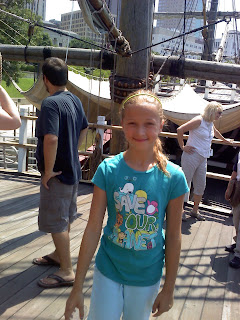
In July 2011, before visiting the Museum of Science and Industry in Columbus OH called COSI, my family and I decided to visit the Santa Maria Museum on the other side of the Scioto River. For about $15 the whole family could take a short tour of the full-scale replica of the Santa Maria that Christopher Columbus sailed on August 3rd, 1492 (along with the Pinta and Nina) from Palos de la Frontera, Spain with 39 men in 1492. This, of course, became the first voyage to have a lasting impact on the New World.
The replica ship was built in the 1990’s as part the commemoration of the 500th anniversary of the Columbus expeditions. It seemed like a good opportunity to get a hands-on idea of what it was like to live on a 15th-century sailing vessel.

Founded in 1812 the city of Columbus, is named after Christopher Columbus and was designed to be the state capital to replace Chillicothe in that role for it's more central state location and it's proximity to the confluence of the Scioto and Olentangy rivers. Prior to 1812, Columbus OH did not even exist as a settlement, it was just forest.

that's Chris back there
Walking to the ship we happened to pass by City Hall on Broad Street which has a gift from the people of Genoa Italy, a colossal statue of Christopher Columbus sculpted by artist Edoardo Alfieri in 1955.

On our tour, we learned that this Santa Maria was built on the US East Coast and it then had to be transported to Columbus in two halves by truck. It was reassembled on the West side of the Scioto River (where COSI is) and then sailed to the East side of the river where it is today. That is the extent of the voyages of this Santa Maria.

This ship, like the original, was only about 75 ft x 26 ft which seems even smaller when you are standing on it. During our 45 minute tour, as our guide described the living conditions of the men with a few livestock aboard along with the rats, filthy drinking water, bathroom considerations, etc, you could get a real sense of how cramped and filthy this ship must have been for those 2 months although history books seem to up the ante on the trip. While it was a long hard trip, they did enjoy relatively good weather most of the time per Columbus’ journal. There was a long stopover in the Canary Islands for storm damage repairs which made the actual voyage only 5 weeks. Still, it's hard to imagine 40 men living here even under the best conditions.

15th-century toilet paper
We were able to see demonstrations of the capstan to raise and lower sails and anchors, the navigation process using a compass and pegs, the rudder, (there was no stereotypical ships wheel). She also discussed how they went to the bathroom (over the side of course), how the primitive cannon worked (they were small and inaccurate and shot smooth round stones mostly), how they caught the rats on board (they trapped them in wooden boxes and drug the boxes behind the ship so they would not come into contact with them).
It was a good tour of the ship and I was pretty happy to NOT hear a single word about the myth that people then thought the world was flat. The flat earth myth so often reported by history books was invented by historian Washington Irving in 1828 who decided to add some flavor to this story to make it more exciting and romantic and have a story of sailors risking sailing over the edge of the Earth. Pure make-believe. This story appears nowhere before his time. Mariners and educated people knew the Earth was a sphere back then.

Oh Columbus!
Knowing that I am an Indian sympathizer, you are probably wondering if I will editorialize on the impact of this voyage. No, not really. Entire books have been written on Columbus that are way over the top with praise as a great explorer and some that portray him as a monster for beginning the first slave trade from the Western Hemisphere and everything in between. I suppose he was both. He did explore where no European had before but he also became a disgraced brutal dictator of these new colonies only 8 years later. Like the tour, this post is mainly about the ship and its men but I couldn't help take a cheap shot in the photo to your right.

I do feel compelled to comment on a couple of items mentioned on the tour that I feel are inaccurate.
She remarked that the "natives" Columbus encountered in what is now San Salvador Island (she didn't refer to them as Arawaks or Indians at all) "were naked and had nothing and were eager to trade". This may be true but not for the reason she implied. They were certainly impressed by the items Columbus had that they had never seen before but the Arawak were self-sufficient for thousands of years and in good health even by Columbus' observations. A Spanish writer wrote in 1518 that "these islands were full of people lacking nothing they needed" but after European contact "they were laid waste". That's a bit different than the suggestion these were stupid poor savage natives which is what was implied. If she was going to gloss over contact with the Arawak and not even mention them by name, she should just leave this simplistic Disney story out of the script completely or at least call them by their name. The book 1491 is a good read if you want to know more about pre-Columbian Indian culture.
no ladies allowed in 1492
Our tour guide also mentioned the two different sets of books with Columbus' routes and calculations. One set was correct and one that was not. She mentioned the idea that this was done to keep his men less fearful on their voyage since one set of records had a much shorter route and they might freak out if they knew the real distances they had really traveled. However, most experts agree that this may have been done to keep others from knowing the exact route, to keep it a secret from even his men so they wouldn’t spill the beans to others eager to get rich quick. It was very hard expensive work and the pay off was high, so they wanted to protect this route. 
On Christmas Day 1492 after the initial landing in the Caribbean in October, the Santa Maria ran aground on present-day Haiti. An attempt was made to repair it but the damage was too severe and the ships wood was used to build a settlement there that they named La Navidad which is modern day Môle-Saint-Nicolas, Haiti. The 39 men remained here to wait for Columbus’ return on another ship but when he returned in 1493 he had found they had all been killed at the hands of the Taíno people after a dispute with the Spanish colony. Supposedly the anchor is the only item from this ship that survived to modern times and is in the Haitian National Museum.

Overall it really was a great tour despite some slight historical inaccuracies. I would recommend it to anyone who is in the area who would like to see a great reproduction of 15th-century sailing vessel. That's not something very common anywhere in Ohio!  One recommendation...just maybe go when it's not 90+ degrees.

UPDATE 2017: I that the ship is now in storage due to various factors but mainly because of extensively needed repairs. There are no current plans to re-open.